Introduction
Environmental management used to be something companies addressed when a regulator showed up. That's changed. Tightening regulations, customer expectations, and the real financial exposure from environmental incidents have pushed it firmly into the category of operational priorities that leadership can't ignore.
ISO 14001 is often treated as a compliance checkbox — something to achieve and then shelve. The organizations getting the most out of it use it as an active management tool: cutting waste costs, strengthening supply chain relationships, and building the kind of documented compliance history that matters when regulators come calling.
This article breaks down the specific, measurable benefits organizations experience when they implement ISO 14001 — what it actually changes on the ground.
TL;DR
- ISO 14001 provides a structured framework to identify, control, and continuously improve environmental performance
- Its most measurable benefits: regulatory compliance, cost reduction through resource efficiency, and expanded business opportunities
- Certified organizations avoid regulatory fines, qualify for supply chain contracts, and strengthen credibility with clients and auditors
- Treat it as an ongoing management tool — not a one-time certification milestone
- Without a structured EMS, cost, compliance, and competitive disadvantages compound over time
What Is ISO 14001?
ISO 14001 is the international standard specifying requirements for an effective Environmental Management System (EMS). Published by ISO, it gives organizations a repeatable framework to identify their environmental impacts, set objectives to reduce them, monitor progress, and improve over time.
Three things to understand before going further:
- Scope: ISO 14001 applies to any organization regardless of size, industry, or geography
- Current version: ISO 14001:2026 was published on 15 April 2026, replacing the 2015 edition; organizations certified to the 2015 edition have until April 2029 to transition
- Integration: ISO 14001 shares the same Annex SL High Level Structure as ISO 9001 (Quality) and ISO 45001 (Health & Safety), making it practical to run as an integrated management system rather than a separate parallel program
What ISO 14001 actually delivers is structured process discipline around the environmental aspects of operations. That discipline reduces risk, improves operational efficiency, and produces measurable results that show up on the balance sheet — not just in a sustainability report.
Key Benefits of ISO 14001 Implementation
The benefits below connect directly to metrics organizations already track: cost, regulatory exposure, efficiency, and market access. They also compound — an EMS that's been running for three years delivers more value than one in its first year, because the data, processes, and organizational habits are more developed.
Benefit 1: Regulatory Compliance and Reduced Legal Risk
Without a structured system, environmental compliance is reactive. Someone notices a regulatory change, or they don't. An auditor finds a gap, or an incident does. Either way, the organization is behind.
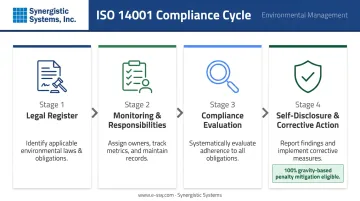
ISO 14001 changes this by requiring organizations to build and maintain a register of applicable environmental laws, assign monitoring responsibilities, schedule compliance evaluations, and document corrective actions. The result is a verifiable compliance trail — not just internal confidence, but documented evidence that holds up under external scrutiny.
The EPA's FY 2025 enforcement results show $652.46 million in federal administrative and civil judicial penalties and $6.43 billion in injunctive relief commitments to return facilities to compliance — across 2,127 civil enforcement case conclusions, the highest number in nine years. That's not theoretical exposure.
The EPA's Audit Policy adds another layer: organizations that self-disclose violations and meet all audit policy conditions can receive 100% mitigation of gravity-based penalties. An ISO 14001 EMS directly supports the systematic discovery and self-policing processes that make self-disclosure possible.
KPIs this benefit affects:
- Regulatory incident rate
- Number of compliance violations
- Fines and penalties avoided
- Audit non-conformance rate
This benefit is highest-impact for manufacturing, construction, chemical processing, and multi-site operations where environmental regulations are complex, overlapping, and frequently updated.
Benefit 2: Cost Control Through Resource Efficiency
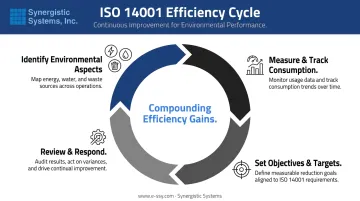
ISO 14001 requires organizations to identify and assess their environmental aspects — energy consumption, water use, raw material inputs, waste generation. For many organizations, this is the first time these numbers are tracked systematically rather than estimated.
That visibility is itself the benefit. When resource consumption is measured and reviewed, leaders can see where waste is occurring and prioritize changes with the highest cost-reduction payoff.
The continuous improvement cycle built into ISO 14001 then drives organizations to set measurable objectives, track progress, and respond when targets slip. Over time, this creates a compounding efficiency effect.
The EPA estimates 600 million tons of construction and demolition debris were generated in the US in 2018 — more than twice the municipal solid waste total. For manufacturing sectors, the energy consumption data tracked by the EIA's Manufacturing Energy Consumption Survey shows energy expenditure as a major variable cost line for most producers.
Peer-reviewed research supports the connection: Franchetti's 2011 Journal of Cleaner Production study found a relationship between ISO 14001 certification and solid waste generation rates in US manufacturing organizations.
KPIs this benefit affects:
- Energy cost per unit of output
- Waste disposal costs
- Raw material consumption rate
- Total cost of environmental incidents
Cost savings are most significant in high energy or material-intensity operations — manufacturing, food processing, construction, distribution — where even small efficiency gains translate directly to margin improvement.
Benefit 3: Competitive Advantage and New Business Opportunities
ISO 14001 certification is increasingly a supply chain qualification criterion, not just a differentiator. Major OEMs and global buyers are formalizing the requirement.
Ford's July 2023 Supplier Code states directly that suppliers must "maintain an environmental management system certified to ISO 14001 through an accredited third-party registrar" — and that Ford may request confirmation of compliance before business is awarded. Stellantis similarly states that its supply chain strategy includes selecting suppliers based on environmental criteria such as ISO 14001 certification.
ISO 14001 is trusted by more than 670,000 certified organizations worldwide, according to the ISO Survey 2024. Novanta's 2024 Sustainability Report notes that more than 40% of its key suppliers held ISO 14001 certification — a share that shows how the requirement is spreading through supply chains.
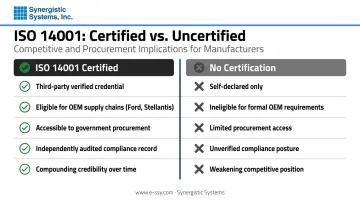
Unlike a self-declared environmental policy, ISO 14001 certification is verified by an accredited third-party registrar. That distinction matters to procurement teams and government buyers who can't rely on supplier self-assessment alone.
KPIs this benefit affects:
- New contracts won
- Customer retention rate
- Number of qualified RFPs or tenders accessible
- Market share in sustainability-focused sectors
This advantage is most pronounced for organizations in regulated industries or those supplying to large OEMs, government agencies, or international markets where environmental credibility is a formal qualification criterion.
What Happens When ISO 14001 Is Missing or Ignored
The consequences of operating without a structured EMS don't announce themselves all at once — they accumulate quietly until an audit, incident, or lost contract makes them impossible to ignore.
- Compliance gaps go undetected until an incident or external audit triggers a violation — producing fines, legal exposure, and potential operational shutdown
- Environmental costs grow invisibly — energy waste, excess material consumption, and remediation expenses erode margins slowly and are nearly impossible to reverse without measurement systems in place
- Supply chain access narrows — Ford, Stellantis, and other OEMs increasingly require certified suppliers as a condition of doing business, and organizations without certification lose eligibility
- Competitive position weakens over time relative to certified peers who are compounding efficiency and credibility advantages year over year
Those individual gaps add up to real enforcement exposure. The EPA's FY 2025 data puts a number on the upper end: $602.24 million in criminal fines and restitution, and required cleanup of an estimated 62.37 million cubic yards of contaminated soil and water. Most organizations won't approach that scale — but the documented processes, monitoring programs, and corrective action systems that prevent a $50,000 fine are the same ones that would prevent a $5 million one.
How to Get the Most Value from ISO 14001
Certification is the milestone. The management discipline is what delivers the value — and that discipline only works if the system stays active after the certificate arrives.
Treat the EMS as a living system:
- Review environmental objectives on a regular cycle, not just before surveillance audits
- Act on internal audit findings within defined timeframes
- Connect EMS performance metrics to business planning and budget cycles
Integrating ISO 14001 with existing management systems is where the structural efficiency gains become tangible. ISO 14001 shares the Annex SL High Level Structure with ISO 9001 and ISO 45001, so shared documentation, combined internal audits, and a unified management review reduce overhead and reinforce continuous improvement across all operational disciplines at once.
For organizations already holding ISO 9001 certification, that shared foundation makes a direct cost difference. Adding ISO 14001 as an integrated module — rather than building a standalone EMS — can cut implementation cost by 40–60%, because the process framework, document control system, internal audit structure, and management review processes are already in place.
Synergistic Systems implements ISO 14001 as an add-on module within a single Integrated Management System built on the ISO 9001 foundation. The engagement uses the same 10-step fixed-price methodology and cloud-based intranet already running the client's QMS, with integrated ISO 9001 + ISO 14001 pricing that reflects the efficiency of building one system rather than two. For organizations beginning implementation or upgrading an existing EMS, that starting point shortens the timeline and makes the results easier to sustain.
Conclusion
The certificate matters for market access. The management system is what reduces costs, prevents incidents, and builds the compliance record that holds up under scrutiny.
Organizations that treat ISO 14001 as an ongoing practice — with active objectives, regular audits, and leadership engagement — see benefits that compound as the system matures. Those that achieve certification and then disengage find that the operational and competitive advantages disappear along with the active management discipline.
What separates organizations that gain lasting value from those that don't isn't the certificate on the wall — it's whether the management discipline stays active after the auditors leave.
Frequently Asked Questions
What are the benefits of implementing ISO 14001?
ISO 14001 delivers benefits across four categories: regulatory compliance and reduced legal risk, cost savings through resource efficiency, competitive advantage through independently verified certification, and improved credibility with customers, investors, and regulators. Each benefit reinforces the others as the EMS matures and becomes embedded in daily operations.
How does ISO 14001 help with regulatory compliance?
The standard requires organizations to identify all applicable environmental legal requirements, build monitoring and evaluation processes around them, and maintain documented evidence of compliance. This proactive structure reduces the risk of undetected violations and provides the documented due diligence regulators look for during audits or penalty proceedings.
Does ISO 14001 certification help win new business or contracts?
Yes. Major buyers including Ford and Stellantis formally require or prefer ISO 14001-certified suppliers, and government procurement programs increasingly favor certified organizations. The independently verified credential carries weight that a self-declared environmental policy cannot match in competitive procurement situations.
Can ISO 14001 be integrated with ISO 9001 or other management system standards?
ISO 14001 shares the same Annex SL High Level Structure as ISO 9001 and ISO 45001, making integration straightforward. Combined audits, shared documentation, and a unified management review reduce duplication, and organizations with existing ISO 9001 certification can cut ISO 14001 implementation cost substantially by building on what's already in place.
How long does it typically take to implement ISO 14001?
Timelines vary by organization size, complexity, and existing system maturity, but most implementations run several months to about a year. Organizations integrating ISO 14001 with an existing ISO 9001 system typically move faster, since the foundational structure, documentation, and audit processes are already in place.
Is ISO 14001 suitable for small organizations?
ISO 14001 is designed to apply to organizations of any size. Smaller organizations frequently see proportionally high returns from a structured EMS, particularly when implemented as an integrated module alongside ISO 9001 rather than as a separate standalone system.