That misunderstanding is costly. Organizations that implement ISO 9001 purely for the certificate miss most of its value. The ones that embed it into daily operations — how work gets done, how problems get caught, how teams communicate — see real operational gains.
This article walks through six concrete benefits of ISO 9001 implementation, explaining how each one affects performance, customer relationships, and competitive position.
TL;DR
- ISO 9001 builds customer satisfaction directly into your processes, reducing variability and complaint rates
- Certification signals verified quality to buyers, often meeting a hard requirement in tenders and supply chain agreements
- The standard's process approach surfaces inefficiencies at handoff points, where most quality failures actually occur
- Data-driven review cycles replace reactive firefighting — and continual improvement becomes built into operations, not bolted on
- Employee engagement rises when workers understand how their roles connect to quality outcomes
What Is ISO 9001?
ISO 9001:2015 is the international standard for Quality Management Systems (QMS). It gives organizations a documented, auditable framework for ensuring their processes consistently produce quality outcomes — for customers, for operations, and for long-term performance.
Three things separate ISO 9001 from common misconceptions:
- Applies across all industries. Manufacturers, service firms, healthcare providers, engineering companies, labs, and distributors all use it. The standard governs process quality, not product type.
- Requires ongoing commitment. Certified organizations undergo annual surveillance audits and recertification cycles, keeping the system active and accountable year over year.
- Demands real performance, not paperwork. Organizations must understand customer requirements, measure process outcomes, and act on findings — documentation is the tool, not the goal.
Six Key Benefits of ISO 9001 Implementation
These benefits aren't theoretical. Each one connects to how work gets done, how customers respond, and how the business performs over time.
Benefit 1: Improved Customer Satisfaction
Customer satisfaction isn't a byproduct of ISO 9001 — it's a design requirement. The standard explicitly requires organizations to identify customer needs, plan processes around them, and monitor customer perceptions on an ongoing basis.
In practice, this creates two mechanisms that reduce dissatisfaction:
- Process standardization reduces variability, so customers receive consistent outcomes regardless of which operator, shift, or location handled the work
- Complaint loops are built into the QMS — issues are captured, investigated for root cause, and resolved in ways that prevent recurrence
A 2021 peer-reviewed study of 50 automotive component manufacturers found that ISO 9001:2015 had a significant positive relationship with operational performance, including customer satisfaction and product quality. The standard requires organizations to treat customer feedback as QMS input — so that result is built into how the system works.
The business case is straightforward. Retained customers cost less to maintain than acquired ones. When quality is consistent enough to reduce complaints and drive repeat business, the economic return on the QMS investment compounds quickly.
Benefit 2: Enhanced Market Credibility and Competitive Edge
ISO 9001 certification is globally recognized — and in many markets, it's a procurement filter. The UK Crown Commercial Service explicitly requires suppliers to demonstrate ISO 9001 compliance. Similar requirements appear in aerospace, defense, medical device, construction, and manufacturing supply chains worldwide.
The scale of adoption reflects this: ISO Survey 2024 data from IAF CertSearch shows approximately 1.47 million valid ISO 9001:2015 certificates across 2.32 million certified sites globally. When that many buyers and suppliers are working within the same framework, being outside it creates a visible gap.
Where this advantage is most visible:
- Government and public sector tenders that require certified suppliers
- Enterprise procurement processes in manufacturing supply chains
- New market entry where you have no established track record
- Competitive bids where a certified competitor is the alternative
When an accredited registrar certifies your QMS, new customers don't need to conduct their own quality audits. That reduces their due diligence burden and shortens the path from first contact to contract.
Benefit 3: Better Process Integration and Operational Efficiency
Most quality failures don't happen inside a single department — they happen at handoff points between departments. ISO 9001's process approach requires organizations to examine how their functions interact, not just how each team operates in isolation. That's where the inefficiencies are.
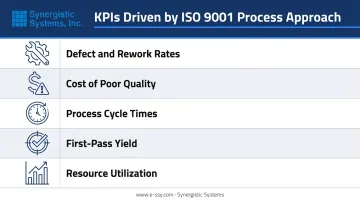
KPIs typically improved through this benefit:
- Defect and rework rates
- Cost of poor quality (COPQ) — including waste, warranty claims, and customer complaints
- Process cycle times
- First-pass yield
- Resource utilization across sites and shifts
ISO 9001 requires organizations to monitor, measure, and analyze performance data before making process decisions. ISO's Quality Management Principles identify evidence-based decision making as a core principle — decisions grounded in data analysis produce more reliable results than those based on instinct or assumption.
This shifts management from reactive firefighting to structured review. Instead of responding to the loudest problem, teams work from performance trends, audit nonconformances, and customer satisfaction data.
Where this matters most:
- Strategic management reviews, where resource decisions need performance justification
- Root cause investigations — accurate data shortens the cycle from problem identification to verified fix
- Supplier evaluations, replacing subjective assessments with objective performance records
- Process improvement decisions, where baseline data confirms whether a change actually worked
The KPIs most commonly tracked under this benefit include defect rates, on-time delivery, customer satisfaction scores, and audit nonconformance trends — though ISO's position is that organizations should determine the indicators that reflect their specific objectives, not apply a universal list.
Benefit 5: A Built-In Continual Improvement Culture
Continual improvement is one of ISO 9001's seven core quality management principles. The standard doesn't just encourage it — it requires organizations to regularly review processes, act on audit findings, and pursue incremental gains year over year.
A one-time process overhaul has a shelf life. A continual improvement culture, embedded in the QMS, keeps adapting to new challenges without losing quality consistency — and that's what makes this benefit compound over time.
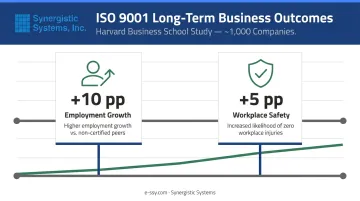
Research supports the long-term effect: a Harvard Business School study of nearly 1,000 California companies found that ISO 9001 adopters had lower organizational death rates than non-adopters, with employment roughly 10 percentage points higher after certification and a 5 percentage point increase in the likelihood of reporting zero workplace injuries.
That said, the research also makes clear that these outcomes depend on maintaining the system. Organizations that achieve certification and then allow the QMS to become dormant tend to lose the benefit over time. Surveillance audits, active management reviews, and internal audit programs aren't just compliance requirements — they're the mechanism that keeps improvement compounding.
Benefit 6: Higher Employee Engagement
ISO 9001 includes Engagement of People as one of its seven quality management principles. The connection to quality output is well-established: when employees understand how their roles connect to quality outcomes and are included in identifying problems and testing fixes, they become more accountable for results.
Gallup's 2024 Q12 meta-analysis — covering over 183,000 business units and 3.3 million employees — found that top-quartile engaged teams produced 32% fewer quality defects, 18% higher sales productivity, and 14% higher production productivity than bottom-quartile teams.
ISO 9001 creates the structural conditions for this kind of engagement: process ownership, clear role definitions, involvement in corrective actions, and regular communication about quality performance.
During implementation, Synergistic Systems works directly with client teams at every level — from hourly workers to top management — during documentation development and working sessions. That collaborative approach ensures the QMS reflects actual practices rather than theoretical procedures, and gives employees a stake in the system from the start.
What Happens Without a Quality Management System in Place
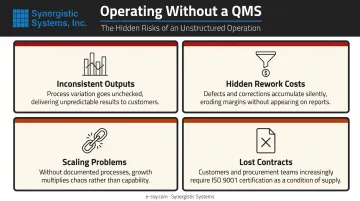
Organizations operating without a structured QMS tend to manage quality reactively. Each problem becomes a firefighting exercise, and without documented root cause analysis, the same issues recur.
The most common consequences:
- Inconsistent outputs that vary by operator, shift, or location — leading to unpredictable quality and rising customer complaints
- Hidden rework costs that eat into margins without ever being traced back to specific process failures
- Scaling problems as growth exposes undocumented processes that degrade across sites or new hires
- Lost contracts where ISO 9001 certification is a tender requirement and non-certified competitors are disqualified
ASQ defines the cost of poor quality (COPQ) as internal and external failure costs — waste, rework, warranty claims, and customer complaints. Without a QMS creating visibility into these costs, they compound quietly — and the organizations that measure COPQ for the first time after implementing a QMS are often surprised by how much was hiding in plain sight. That's precisely what ISO 9001 is designed to address.
Getting the Most Out of ISO 9001 Implementation
ISO 9001's benefits are proportional to how it's implemented. Organizations that treat the standard as a documentation exercise typically see limited returns. Those that embed it into daily operations — how decisions get made, how audits are used, how teams review performance — see the compounding gains described above.
Three conditions that maximize value:
- Processes are applied consistently across all teams and sites — not just documented for auditors
- Performance data is reviewed and acted upon during management reviews, not filed away
- Internal audit findings are treated as improvement inputs, not just compliance checkpoints
Working with an experienced ISO 9001 consultant can cut months off the implementation timeline and prevent the most common structural mistakes — particularly overly complex documentation that employees don't use and can't maintain.
Synergistic Systems follows a proven 10-step fixed-price methodology, taking clients from no system to certified with defined deliverables and a clear timetable. The engagement includes:
- Collaborative documentation development so procedures reflect how the operation actually works
- Working sessions that embed the QMS into daily workflows across teams and sites
- A cloud-based quality management intranet that centralizes documents, records, corrective actions, and management reviews — no hardware or software purchase required
For organizations in DFW, Houston/Gulf Coast, Northwest Arkansas, or anywhere in the US via cloud-based delivery, that structured approach means certification is a starting point — not the finish line.
Conclusion
The six benefits covered here — customer satisfaction, market credibility, operational efficiency, evidence-based decisions, continual improvement, and employee engagement — don't operate independently. A well-run QMS creates feedback loops between them.
Better processes reduce defects, which improves customer satisfaction and strengthens retention. Engaged employees catch problems earlier, cutting rework costs and freeing resources for the next round of improvement.
This is what makes ISO 9001 a long-term management investment rather than a one-time certification event. Organizations that treat it as an ongoing practice — reviewing performance data, acting on audit findings, maintaining their processes — find that the gains compound over time.
Frequently Asked Questions
What are the main benefits of implementing ISO 9001?
ISO 9001 delivers multiple operational benefits, with improved customer satisfaction, better process efficiency, and stronger market credibility among the most commonly cited. It achieves this by building quality into daily operations rather than treating it as a final inspection step.
How long does it take to see the benefits of ISO 9001 implementation?
Some benefits, including clearer processes, reduced rework, and improved internal communication, begin to appear during the implementation phase itself. Market-facing benefits like winning new contracts and improving customer satisfaction scores typically build over the first 12–24 months after certification.
Can small businesses benefit from ISO 9001 certification?
ISO 9001 is designed to be scalable and applies equally to small businesses and large enterprises. Smaller organizations often see faster, more visible gains because the standard introduces process structure and documentation discipline that may not have existed before.
Do the benefits of ISO 9001 apply to service businesses or only manufacturers?
ISO 9001 is industry-neutral and applies equally to service-oriented organizations , including consulting firms, healthcare providers, IT companies, and logistics operations, because it focuses on process quality and customer outcomes, not product type.
What is the difference between ISO 9001 compliance and ISO 9001 certification?
Compliance means operating in accordance with ISO 9001 requirements without third-party verification. Certification involves an independent accredited registrar auditing the QMS and issuing a certificate, which provides the external credibility needed to satisfy customer and tender requirements.
How does ISO 9001 help organizations win new contracts?
Many procurement processes , especially in public sector, defense, and manufacturing supply chains, require or prefer suppliers with ISO 9001 certification. Holding an accredited certificate eliminates the need to submit quality documentation with each bid and signals verified compliance to prospective clients.