What it doesn't come with is a standard price tag.
ISO 9001 certification costs vary significantly depending on company size, how mature your existing quality processes are, your industry, and which certification body you choose. Many organizations budget only for the audit fee — and get blindsided by preparation costs that can dwarf it.
This guide breaks down every cost component: by organization size, by implementation phase, and by approach. Whether you're starting from scratch or polishing up an existing system, you'll leave with a realistic budget framework.
TL;DR
- Total ISO 9001 certification cost ranges from roughly $5,000–$15,000 for small organizations up to $80,000+ for large, complex, or multi-site companies over a full 3-year certification cycle
- Preparation is usually the largest cost driver — gap analysis, documentation, and training routinely exceed what the audit itself costs
- Organizations with an existing quality system spend considerably less than those starting from scratch
- Three implementation approaches exist — DIY, template-based, and full consultant — each with meaningfully different cost and time tradeoffs
- The full 3-year cycle — initial audit, two surveillance audits, and recertification — should be budgeted upfront
How Much Does ISO 9001 Certification Cost?
ISO itself does not issue certificates or charge for certification. Independent, accredited certification bodies (registrars) perform audits and issue certificates — and their fees vary by region, scope, auditor day rates, and travel. There is no single "official" price.
Two budgeting mistakes show up constantly:
- Focusing only on the audit fee while underestimating preparation costs (gap analysis, documentation, training)
- Ignoring the 3-year cycle — initial certification is just the starting point; surveillance audits are required annually to keep the certificate valid
The table below shows realistic total investment ranges by organization size, followed by what drives costs at each tier.
| Organization Size | Employees | 3-Year Total Investment | Key Cost Drivers |
|---|---|---|---|
| Small | Fewer than 25 | $5,000–$15,000 | Preparation, training, single-site audit fees |
| Mid-Size | 26–250 | $15,000–$40,000 | Broader documentation scope, more audit days, consultant support |
| Large / Multi-Site | 250+ or multiple sites | $40,000–$80,000+ | Per-location audit fees, complex scope management |
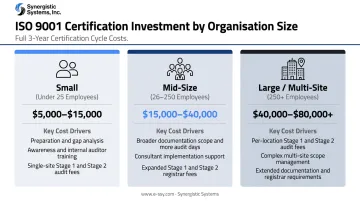
Note: All ranges cover preparation through year-three recertification. Annual surveillance audit fees apply after year one at every tier.
Small Organizations (Fewer Than 25 Employees)
For a single-site business with fewer than 10 employees, initial certification alone may fall closer to $4,000–$6,000 depending on scope and registrar. The full 3-year cycle — including preparation, training, and all certification body fees — typically lands in the $5,000–$15,000 range.
This tier suits single-site service or manufacturing businesses starting fresh or with limited existing QMS documentation.
Mid-Size Organizations (26–250 Employees)
Broader documentation scope, more audit days, and consultant involvement push the 3-year total to $15,000–$40,000. Companies at this tier typically have multiple departments, moderate process complexity, and some prior quality management activity — all of which affect both preparation time and registrar fees.
Large or Complex Organizations (250+ Employees or Multiple Sites)
Industry cost benchmarks place large or multi-site organizations in the $40,000–$80,000+ range. Certification bodies charge per location reviewed, so multi-site companies face proportionally higher audit fees — making scope definition one of the most important cost-control decisions at this tier.
Key Factors That Affect ISO 9001 Certification Cost
Five variables drive most of the cost variation in ISO 9001 certification. Knowing where you stand on each one before you start prevents budget surprises.
Organization Size and Number of Locations
Certification bodies calculate audit days using a standard methodology — IAF Mandatory Document MD 5:2023 — based on the effective number of personnel within scope (including part-time and shift workers).
Here's how that translates to audit days:
| Effective Personnel | Initial Audit Days (Stage 1 + Stage 2) |
|---|---|
| 1–5 | 1.5 days |
| 6–10 | 2 days |
| 16–25 | 3 days |
| 46–65 | 5 days |
| 86–125 | 7 days |
| 176–275 | 9 days |
| 276–425 | 10 days |
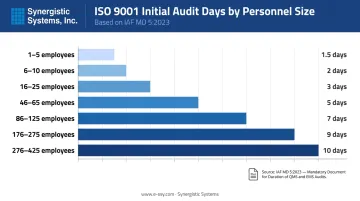
Each additional site adds audit days — and often travel costs billed separately at cost.
Maturity of Your Existing Quality Management System
An organization with no QMS builds documentation, processes, and records essentially from scratch. One with a mature existing system may need only gap remediation. The gap analysis outcome is the clearest predictor of preparation cost — and the first thing any serious implementation partner should assess before quoting.
Industry Type and Process Complexity
Highly regulated industries — medical devices, aerospace, food manufacturing — carry additional compliance layers that increase documentation depth and audit scrutiny. A machine shop and a pharmaceutical contract manufacturer don't face the same documentation burden, even with the same headcount.
Choice of Certification Body
Accredited registrars vary in fee structures, auditor day rates, travel policies, and administrative charges. Getting quotes from 3–4 ANAB-accredited registrars is standard practice. Fees, auditor industry experience, and contract terms differ meaningfully between bodies.
Synergistic Systems has worked alongside registrars including ABS Quality Evaluations, DNV, Bureau Veritas, LRQA, BSI, NQA, Perry Johnson Registrars, SGS, and Intertek — experience that gives you a practical reference point when evaluating which registrar fits your industry and scope.
Implementation Approach
Whether you build the QMS in-house, use documentation templates, or hire a full-service consultant is the single largest controllable cost variable. This is covered in depth below.
Full ISO 9001 Certification Cost Breakdown
The total investment runs across three phases: preparation, certification, and ongoing maintenance.
Gap Analysis
A gap analysis assesses how far current processes and documentation fall short of ISO 9001 requirements. Professional gap analysis typically costs $1,000–$3,000 for small businesses and up to $10,000 for larger organizations. Organizations with stronger existing systems spend considerably less here.
Skipping it costs more in the long run: without a gap analysis, organizations routinely over-invest in areas already compliant and miss the gaps that would actually fail a Stage 2 audit.
Documentation Development and QMS Build-Out
Creating or updating quality manuals, procedures, work instructions, and records is the most time-intensive component. Three approaches:
| Approach | Dollar Cost | Internal Time Burden |
|---|---|---|
| In-house | Labor only (no outlay) | Highest |
| Templates | $700–$1,000 for a structured package | Moderate |
| Consultant | $500–$1,250 per consultant day | Lowest |
Employee Training
All relevant personnel need to understand ISO 9001 requirements and their role in the QMS. Cost scales with headcount and delivery method:
- Online awareness training: as low as $169 per person (ASQ)
- Internal auditor training (face-to-face): $1,500–$2,500 per person
- On-site group training for larger teams: quote-based
Synergistic Systems includes ISO 9001 awareness training and internal auditor training as part of its standard fixed-price engagement — no separate training budget required.
Certification Audit Fees (Stage 1 and Stage 2)
Stage 1 is a documentation readiness review (typically 1–2 days). Stage 2 is the full on-site system audit, with days scaled to headcount per the IAF MD 5 table above. Typical ranges:
| Organization Size | Initial Audit Fee Range |
|---|---|
| Small business | $3,000–$7,000 |
| Mid-size | $7,000–$10,000 |
| Large / complex | $30,000+ |
Travel and accommodation are typically billed separately at cost. Always request a fully itemized quote.
Ongoing Surveillance and Recertification Costs
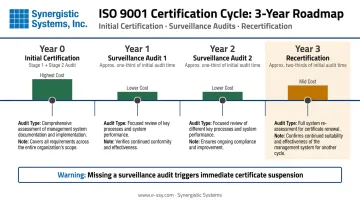
ISO 9001 certification is valid for 3 years, but annual surveillance audits are required. Missing one results in certificate suspension, which renders your certificate invalid until the suspension is lifted.
Per IAF MD 5, annual surveillance audit time is approximately one-third of the initial audit time; recertification runs about two-thirds. Budget accordingly:
- Annual surveillance audits: $1,000–$10,000+ depending on organization size
- Recertification (year 3): slightly less than the initial audit, but not negligible
Plan for the full 3-year cycle before you start: initial audit, two surveillance audits, and recertification. Organizations that budget only for initial certification routinely underestimate total cost of ownership by 40–60%.
DIY, Templates, or Consultant: Choosing the Right Approach
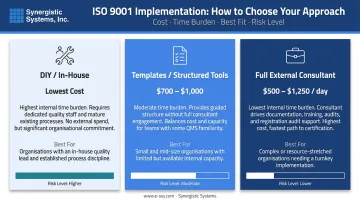
No single approach suits every organization. The right choice depends on internal bandwidth, existing expertise, and how much budget risk you're willing to accept.
| Approach | Dollar Cost | Time Burden | Best For |
|---|---|---|---|
| DIY (fully in-house) | Lowest (~$170 for the standard + audit fees) | Highest | Organizations with a dedicated quality person and mature processes |
| Templates/structured tools | Low–moderate ($700–$1,000 for templates + audit fees) | Moderate | Most small and mid-size organizations with some internal capacity |
| Full external consultant | Highest ($500–$1,250/day + audit fees) | Lowest | Organizations with stretched internal resources or high process complexity |
The DIY path carries real risk: the ISO 9001 standard is not self-explanatory, and organizations that miss requirements during Stage 2 face costly corrective action cycles and delayed certification.
Template-based implementations reduce that risk while keeping costs manageable — but only when the templates are built from real-world QMS projects, not generic checklists.
That distinction matters in practice. Synergistic Systems' modular documentation and training system has been refined across hundreds of real projects, so clients aren't starting from a blank page or retrofitting generic templates to fit their operations.
The fixed-price engagement model gives small and mid-size manufacturers a defined path to certification — including:
- A fixed timetable with clear deliverables
- A cloud-based QMS intranet (no client hardware or software required)
- ISO 9001 awareness and internal auditor training
- Onsite Stage 1/Stage 2 registration audit support
For organizations that need more than a template but don't want open-ended consulting fees, it's a concrete middle ground.
How to Reduce Your ISO 9001 Certification Costs
Three decisions, made before you fully commit, consistently separate organizations that control their certification costs from those that don't:
Do the gap analysis first. It identifies where your processes already comply and focuses effort only where gaps exist — preventing wasted spend before it happens.
Manage your certification scope actively. Starting with core processes or a single site reduces audit days and documentation burden. You can expand scope in later certification cycles once the system is running smoothly.
Compare multiple accredited registrars before committing. Fees, auditor experience, travel policies, and contract terms vary meaningfully. Request a fully itemized quote covering Stage 1, Stage 2, travel, administration, and the full 3-year surveillance schedule — hidden travel costs alone can shift your total by thousands.
Conclusion
ISO 9001 certification costs range from a few thousand dollars for a well-prepared small business to tens of thousands for a complex multi-site organization. The biggest budget variable is your preparation approach — specifically, how well your current processes align with the standard before the audit clock starts.
Viewing certification as a long-term investment rather than a one-time event changes the math. Organizations that plan the full 3-year cycle, build solid QMS documentation upfront, and work with a consultant who understands both the standard and their industry typically spend less time in remediation and avoid costly findings at surveillance audits. Synergistic Systems' fixed-price implementation model — which includes a cloud-based QMS intranet, internal auditor training, and Stage 1/Stage 2 audit support — is structured specifically to manage that full cycle from day one.
Frequently Asked Questions
How much does it cost to implement ISO 9001?
Total implementation cost — covering gap analysis, documentation, training, consultant support, and audit fees — typically ranges from $5,000–$15,000 for small organizations to $40,000–$80,000+ for large or multi-site companies over a 3-year certification cycle. The audit fee alone is only one component of that total.
Is ISO 9001 changing in 2026?
ISO/FDIS 9001 has been submitted for approval and is expected to replace ISO 9001:2015 in September 2026. If your organization is planning initial certification or recertification in the near term, monitor ISO's official communications for transition timeline details.
How long does it typically take to get ISO 9001 certified?
Most organizations take 3–12 months from gap analysis to Stage 2 certification, with preparation time as the biggest variable. NQA requires at least 3 months of documented QMS operation — including a completed internal audit cycle and management review — before certification can proceed.
Can I implement ISO 9001 without hiring a consultant?
Yes. Many organizations implement ISO 9001 in-house, particularly when using structured documentation templates or tools. The standard requires documented evidence, completed internal audits, and a functioning management review process. Internal resources need the time and commitment to deliver all three.
What are the ongoing annual costs of maintaining ISO 9001 certification?
Annual surveillance audit fees typically run $1,000–$10,000+ depending on organization size, plus internal time for maintaining the QMS, conducting internal audits, and running management reviews. Budget for these from the start, not just the initial certification year.