An Integrated Management System (IMS) resolves this by merging ISO 9001, ISO 14001, and ISO 45001 into one coordinated framework. This article explains what each standard covers, how they compare, what integration actually delivers in practice, and how to build one that works.
TL;DR
- An IMS combines ISO 9001 (quality), ISO 14001 (environmental), and ISO 45001 (safety) under one framework — one policy, one audit, one management review
- All three standards share the same 10-clause Harmonized Structure — integration is by design, not an afterthought
- Over 1 million ISO 9001 certificates exist across 189 countries — making it the logical foundation for any IMS
- Integrated implementation can cut ISO 14001 build costs by 40–60% compared to a standalone system
- The most common mistake is treating IMS as a paperwork project rather than an operational system
What Is an Integrated Management System?
An IMS is a single framework that manages quality, environmental, and occupational health and safety requirements together — rather than running three parallel systems with separate documents, audits, and reviews.
The Harmonized Structure Makes It Possible
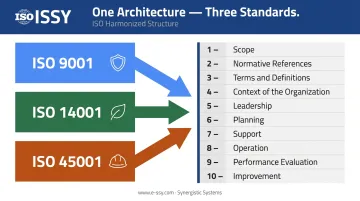
ISO standardized the architecture of all modern management system standards through what is now called the Harmonized Structure (HS) — also referenced as Annex SL in ISO's directives. Every standard covered here follows the same 10-clause framework:
| Clause | Title |
|---|---|
| 1 | Scope |
| 2 | Normative references |
| 3 | Terms and definitions |
| 4 | Context of the organization |
| 5 | Leadership |
| 6 | Planning |
| 7 | Support |
| 8 | Operation |
| 9 | Performance evaluation |
| 10 | Improvement |
Because ISO 9001, ISO 14001, and ISO 45001 all follow this same clause-by-clause structure, organizations can write one procedure, conduct one internal audit, and hold one management review — and satisfy all three standards simultaneously.
What Integration Actually Means
A true IMS shares governance infrastructure across all three standards. In practice, that means:
- A single policy covering quality, environmental, and safety commitments
- One document control system housing all procedures, records, and work instructions
- One internal audit program that covers all three standards in a single cycle
- One management review where leadership evaluates performance across all three
Each standard still has unique requirements. ISO 14001 demands environmental aspects and impacts registers. ISO 45001 requires hazard logs and worker consultation processes. Those elements stay standard-specific — the shared infrastructure is what makes managing them together practical.
Who Benefits Most
Any organization that serves customers, has environmental obligations, and employs workers can benefit. The IMS model is most common where quality, environmental, and safety functions overlap daily — which describes most industrial and field-based operations.
Industries that adopt IMS most frequently include:
- Manufacturers, fabricators, and contract manufacturers
- Construction and engineering firms
- Oil and gas service companies
- Logistics and transportation operators
- Multi-site organizations managing consistent compliance across locations
ISO 9001, ISO 14001, and ISO 45001: What Each Standard Covers
ISO 9001 — Quality Management System
ISO 9001:2015 is the world's most widely adopted management system standard. It helps organizations consistently deliver products and services that meet customer requirements and applicable regulations, with ongoing emphasis on process improvement and risk-based thinking.
Any organization — regardless of size or sector — can pursue ISO 9001. Manufacturing, healthcare, logistics, professional services, and government agencies all use it. Organizations typically pursue certification to demonstrate quality reliability to customers, win contracts that require it, or improve operational consistency.
That structural consistency is what makes ISO 9001 the natural foundation for an IMS — every other major management standard follows the same framework.
ISO 14001 — Environmental Management System
ISO 14001 provides a framework for managing environmental responsibilities in a structured, auditable way. It covers:
- Identifying environmental aspects and impacts
- Controlling waste and emissions
- Maintaining legal compliance
- Pursuing continual improvement in environmental performance
Manufacturers, construction contractors, logistics companies, and chemical processors most commonly pursue it — typically in response to regulatory pressure or sustainability commitments.
Note on versioning: ISO's own standard page indicates that ISO 14001:2015 is no longer the current edition, with ISO 14001:2026 now published. Organizations currently certified to the 2015 version should monitor transition timelines with their registrar.
ISO 45001 — Occupational Health and Safety Management System
ISO 45001:2018 is designed to prevent workplace injuries, illnesses, and fatalities. The ILO reports that nearly 3 million workers die every year from work-related accidents and diseases — a figure more than 5% higher than 2015 levels — which frames exactly why a systematic approach matters.
ISO 45001 focuses on proactive hazard identification, risk assessment, and controls to protect workers and contractors. One element that sets it apart: Clause 5.4 explicitly requires worker consultation and participation, a requirement not found in either ISO 9001 or ISO 14001.
Industries with elevated safety risk — construction, manufacturing, oil and gas, heavy industrial — most commonly pursue ISO 45001, alongside any organization that wants a certified, systematic approach to duty of care.
Key Similarities and Differences
What Makes Integration Practical
All three standards share the same management architecture. Specifically, they all require:
- Top management commitment and accountability
- Risk-based thinking applied to planning and operations
- The Plan-Do-Check-Act (PDCA) cycle for continual improvement
- Documented information (Clause 7.5)
- Internal audits (Clause 9.2)
- Management reviews (Clause 9.3)
This structural alignment is why a single audit program can satisfy all three — that outcome is built into how the standards are designed.
Where They Differ
That shared architecture doesn't mean the standards cover the same ground. Each one points in a distinct direction:
- ISO 9001 looks outward — toward customers, products, and service quality
- ISO 14001 looks at the surrounding environment — regulatory bodies, communities, emissions, waste
- ISO 45001 looks inward — at workers, contractors, and the hazards they face every day
Risk terminology also differs: ISO 9001 identifies "risks and opportunities," ISO 14001 evaluates "environmental aspects and their significance," and ISO 45001 conducts "hazard identification and occupational risk assessment." The underlying approach is consistent across all three — the terminology is not.
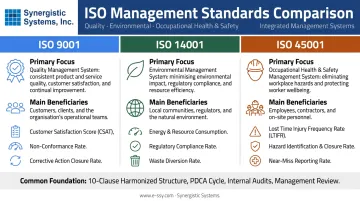
Quick Comparison Table
| Standard | Primary Focus | Main Beneficiaries | Key Performance Indicators |
|---|---|---|---|
| ISO 9001:2015 | Quality management | Customers, operations | Customer satisfaction, nonconformities, process performance |
| ISO 14001 | Environmental management | Regulators, communities | Environmental aspects, emissions, legal compliance |
| ISO 45001:2018 | Occupational health & safety | Workers, regulators | Incident rates, hazards identified, OH&S performance |
Benefits of Building an Integrated Management System
Operational and Cost Efficiency
Three separate systems mean three audit cycles, three document sets, and three management reviews. Consolidating them removes that burden directly.
According to IAF MD 11, integrated management system audits allow time reductions based on integration level — capped at 20% from the calculated starting point for combined certifications. Certification bodies including DNV and SGS independently note that IMS audits reduce duplication and lower overall certification costs.
In implementation terms, adding ISO 14001 onto an existing ISO 9001 foundation typically cuts build costs by 40–60% compared to a standalone EMS project — because document control, internal audit, and management review infrastructure already exists.
Risk and Compliance Visibility
When quality, environmental, and safety teams manage risk in silos, gaps appear at the boundaries. An integrated system surfaces cross-functional hazards that no single-standard audit would catch. A unified compliance register ensures no regulatory requirement falls through the cracks across quality, environmental, and safety domains.
Organizational Consistency
An IMS signals credibility to customers, regulators, and supply chain partners. The consistency it enforces reaches every level of the organization:
- Standardizes procedures across multiple sites, preventing location-specific variations from developing
- Gives employees cleaner, non-conflicting instructions instead of separate quality, environmental, and safety protocols that may contradict each other
How to Implement an IMS: A Practical Roadmap
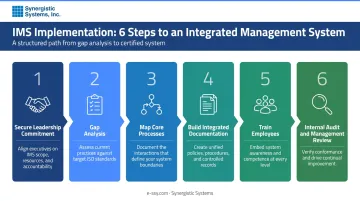
The Core Implementation Sequence
- Secure top management commitment — Define a unified IMS policy covering quality, environmental, and safety commitments before anything else
- Conduct a gap analysis — Assess current state against all three standards to identify what exists, what's missing, and where processes overlap
- Map core processes — Identify which procedures can be written once to satisfy multiple standards simultaneously
- Build integrated documentation — One policy, combined procedures, shared document control, unified records system
- Train employees — Role-appropriate awareness training and internal auditor training across all three standards
- Run internal audits and management review — Validate the system before inviting a registrar
Phasing and Timelines
Implementation timelines vary based on organization size, process complexity, and the maturity of any existing systems. A phased approach consistently produces more stable results than attempting to implement everything at once:
- Phase 1: Framework, policy, and context documentation
- Phase 2: Documented procedures, risk registers, and compliance registers
- Phase 3: Training, operational controls, and awareness
- Phase 4: Internal audit, management review, and certification readiness
Working With a Consultant
Organizations don't have to implement an IMS on their own. Firms like Synergistic Systems deliver IMS projects on a fixed-price basis, with ISO 9001 as the foundation and ISO 14001 and ISO 45001 integrated as add-on modules.
The engagement includes a single cloud-based intranet that manages all system components:
- Controlled documents and records
- Internal audits and corrective actions
- Management reviews, risk registers, and hazard logs
No hardware or software purchase is required. Synergistic Systems also provides onsite Stage 1 and Stage 2 registration audit support when the client's chosen registrar arrives.
Common Mistakes Organizations Make When Building an IMS
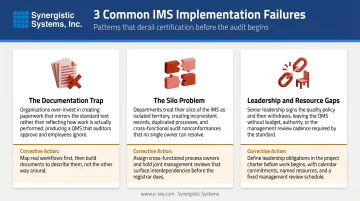
Three patterns consistently derail IMS projects before they reach certification:
The documentation trap. Organizations that treat IMS as a paperwork project produce manuals nobody follows. Procedures should describe how work actually happens — not how someone imagines it should. Effective implementation means developing documentation collaboratively with the people doing the work, adapted to specific operations rather than copied from generic templates.
The silo problem. If quality, environmental, and safety functions keep operating independently, integration exists only on paper. A genuine IMS requires cross-functional thinking and shared ownership — not three departments that each "own" one standard while ignoring the other two.
Leadership and resource gaps. IMS projects stall when top management delegates implementation and steps back. Visible leadership commitment matters both for allocating adequate budget and time, and for signaling that the unified system reflects real organizational values rather than just a compliance checkbox.
Frequently Asked Questions
What is the difference between ISO 9001, ISO 14001, and ISO 45001?
ISO 9001 governs quality management and customer satisfaction, ISO 14001 governs environmental management and impact reduction, and ISO 45001 governs occupational health and safety. All three are built on the same 10-clause Harmonized Structure but serve different stakeholders and focus on distinct performance domains.
Can ISO 9001, ISO 14001, and ISO 45001 be implemented at the same time?
Yes. The shared Harmonized Structure makes simultaneous or phased integration practical, and most organizations find that pursuing them together reduces overall implementation time and cost compared to three sequential standalone rollouts.
How long does it take to implement an Integrated Management System?
Most organizations complete implementation in 4–12 months, depending on size, process complexity, and whether existing systems are already in place. A phased approach — framework first, then documentation, training, and internal audit — tends to produce more reliable results than a compressed single-stage rollout.
How do I get QMS certified?
Build and document the QMS, conduct internal audits and a management review, then engage an accredited third-party certification body for a formal Stage 1 and Stage 2 audit. Working with an experienced ISO consultant from gap analysis through the registration audit typically shortens the path to certification and reduces the risk of nonconformances during the registrar's visit.
What are the 7 elements of ISO 45001?
ISO 45001 is not a 7-element framework — it follows the same 10-clause Harmonized Structure as ISO 9001 and ISO 14001. Core clauses cover context, leadership, planning, support, operation, performance evaluation, and improvement, with Clause 5.4 adding a unique requirement for worker consultation and participation.
How much does ISO 45001 certification cost?
Typical cost components include gap analysis, documentation development, training, consulting fees, and the certification body's audit fees — with total investment ranging from several thousand to tens of thousands of dollars depending on organization size, industry, and scope. Integrating ISO 45001 with an existing ISO 9001 system meaningfully reduces per-standard costs by eliminating duplicate documentation and audit work.