Who conducts the audits? Do they have the right qualifications? Are they independent from the processes they're auditing? For small and mid-market organizations, these questions often don't have clean answers.
Outsourcing the ISO internal audit function is a practical, increasingly common solution. This guide covers what it actually means, why organizations choose it, and how to find the right partner.
TL;DR
- ISO Clause 9.2 requires internal audits, but organizations often lack qualified, independent auditors in-house
- Outsourced auditors bring objectivity and standards expertise without the overhead of training or hiring dedicated staff
- ISO permits internal audits to be performed by an external provider — the organization stays accountable for the audit program
- Three models exist: full outsourcing, co-sourcing, and subject matter expert engagement
- When choosing a partner, prioritize CQA or lead auditor credentials, multi-standard experience, and familiarity with your registrar
The Role of Internal Audits in ISO Management Systems
What Clause 9.2 Actually Requires
ISO 9001:2015 Clause 9.2 requires organizations to conduct internal audits at planned intervals to determine whether the quality management system conforms to requirements and is effectively implemented and maintained. The audit program must define frequency, methods, responsibilities, and reporting — and frequency must account for process importance, organizational changes, and previous audit results.
This same structure appears in ISO 14001, ISO 45001, ISO 22000, and other management system standards. It's not a suggestion — it's a mandatory element that third-party registrars verify at every surveillance and recertification audit.
Two Purposes, Not One
Internal audits serve a dual function that many organizations underestimate:
- Conformance check — Does the system meet ISO requirements and your own documented procedures?
- Improvement tool — Where are the gaps, inefficiencies, and risks that need attention before your registrar finds them?
An audit that only checks boxes misses the improvement function entirely — which is where most nonconformances are caught before they surface during a registrar visit.
The Independence Problem
ISO 9001:2015 requires that auditors be selected and audits conducted in a way that ensures objectivity and impartiality. ISO 19011:2018 reinforces this directly: auditors must be independent from the function being audited wherever practicable, treating that independence as the foundation for impartial conclusions.
In small organizations, this creates a structural problem. If your quality manager helped design the processes, your operations supervisor runs them, and your EHS coordinator handles the rest — there may be no one left who can audit those areas without a conflict. That's not a policy failure; it's a structural gap. And it's one of the most common reasons organizations turn to an outside auditor.
What Outsourcing the ISO Internal Audit Function Actually Means
Outsourced ISO internal auditing means engaging an external provider — such as a certified ISO consulting firm — to plan and conduct your organization's internal audits on your behalf, either fully or alongside internal staff.
The ISO/IAF Auditing Practices Group guidance confirms this is explicitly permitted: internal audits may be performed by the organization or by an external provider. In practice, that flexibility plays out across three distinct models.
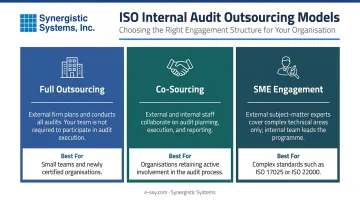
Three Models
| Model | What It Means | Best For |
|---|---|---|
| Full outsourcing | External firm plans and conducts all internal audits | No qualified in-house auditors; small teams; newly certified orgs |
| Co-sourcing | External auditors work alongside internal staff | Organizations wanting to retain involvement while filling gaps |
| Subject matter expert engagement | External specialists cover high-risk or technical areas (ISO 17025, ISO 22000) | Internal staff handles routine audits; external handles complex ones |
What the Provider Typically Does
A qualified outsourced auditor should handle:
- Developing or reviewing the annual internal audit program
- Preparing audit plans and process-specific checklists
- Auditing processes against the relevant ISO standard
- Documenting findings and nonconformances in clear, actionable terms
- Supporting root cause analysis and corrective action follow-up
Who Retains Ownership
Outsourcing the execution of internal audits does not mean handing over control of the audit function. Your management representative or quality manager retains responsibility for approving the audit program, reviewing results, and ensuring corrective actions get implemented.
The external provider operates within that structure — they don't replace your oversight, they support it. ISO's intent is that the organization manages the audit program, not that every audit must be performed by its own employees.
Key Benefits of Outsourcing Your ISO Internal Audits
Auditor Independence and Objectivity
An outsourced auditor has no stake in the outcome. They didn't design the process, don't report to the department head, and have no reason to soften a finding. That's exactly what ISO requires — and exactly what's hardest to achieve internally when your team is lean.
Third-party registrars notice the difference. Findings from an independent auditor carry more weight because both parties know they weren't filtered through internal politics.
Access to Certified Expertise Across Multiple Standards
Outsourced auditors bring current knowledge of ISO requirements, audit methodology, and common nonconformance patterns. For organizations managing multiple standards — ISO 9001 + ISO 14001 + ISO 45001, for example — this makes a real difference.
Training internal staff to competency across multiple standards takes time and money. ASQ's ISO 9001 internal auditor course runs three days; lead auditor programs through DNV and LRQA run a full week. Multiply that across three standards, add recertification requirements every three years, and the overhead adds up fast.
An outsourced provider with multi-standard experience eliminates that burden while giving you auditors who understand how integrated management systems actually work.
Cost Efficiency
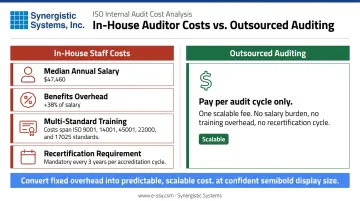
Those training and credential costs are only part of the picture. Maintaining qualified internal audit staff also means salary, benefits, and ongoing investment between audit cycles. BLS data puts the median annual wage for quality control inspectors at $47,460, and SHRM reports that benefits add roughly 38% on top of base compensation.
Outsourcing converts this into a predictable, scalable cost. You pay for audits when you need them — not for a full-time role sitting idle between audit cycles.
Consistency Across Multiple Sites
Multi-site organizations face real challenges maintaining audit quality across locations. IAF MD 1:2023 governs certification of management systems operated by multi-site organizations, and the requirements for controlled sampling and audit discipline are substantial.
An outsourced provider applying a standardized methodology across all sites reduces variability in findings and helps every location perform at the same level — which matters when one weak site can put an entire multi-site certificate at risk.
Findings That Actually Drive Improvement
An external auditor isn't familiar with "how things have always been done" — and isn't hesitant to document a finding that might create friction internally. That independence produces more substantive observations and more actionable recommendations. That's the real purpose of an internal audit: not just to maintain a certificate, but to find what the operation can actually fix.
Outsourcing vs. Co-Sourcing: Choosing the Right Model
When Full Outsourcing Makes Sense
- Newly certified organizations that haven't yet developed internal auditor competency
- Small organizations where most staff are involved in the processes being audited
- Organizations that want a complete, managed audit solution without internal resource allocation
When Co-Sourcing Is the Better Fit
- Organizations with an existing quality team that wants to stay involved and build internal capability
- Larger organizations that need external expertise only for technically complex areas (laboratory operations, food safety hazard analysis, IT systems)
- Organizations that want cost advantages of internal staff handling straightforward audits while outsourcing high-risk process areas
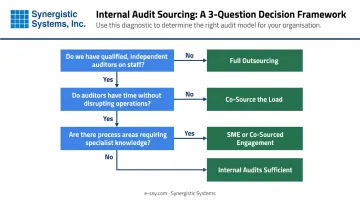
If you're still unsure which model fits, a short diagnostic makes the decision straightforward.
A Simple Decision Framework
Ask three questions:
- Do we have qualified, independent auditors on staff? If no, full outsourcing is likely the answer.
- Do our auditors have time to conduct audits without disrupting operations? If no, at minimum co-source the load.
- Are there process areas requiring specialist knowledge we don't have? If yes, subject matter expert engagement or co-sourcing covers those gaps.
Most organizations find these three questions point decisively to one model. Those that answer "no" to the first and "yes" to the third often land on a co-sourced approach — external expertise where it matters most, internal ownership everywhere else.
How to Select the Right ISO Internal Audit Outsourcing Partner
Verified Credentials and ISO-Specific Expertise
The provider's auditors should hold recognized credentials — CQA (Certified Quality Auditor), CQI/IRCA lead auditor certification, or Exemplar Global auditor certification for the relevant standard. These aren't mandatory under ISO, but they're credible evidence of auditor competence you can verify.
Ask specifically about experience with the standards your organization is certified to, and whether the provider stays current with standard revisions and registrar expectations. Synergistic Systems, for example, holds CQA certification and has worked with major registrars including DNV, Bureau Veritas, Lloyd's Register, BSI, and others, giving their audit findings the framing and structure those registrars expect during surveillance.
Industry Experience and Multi-Site Capability
ISO requirements apply broadly, but how they're implemented varies considerably across industries. A manufacturing audit looks different from a laboratory audit under ISO/IEC 17025. Food safety audits under ISO 22000 involve HACCP and prerequisite program review that require specific knowledge.
A partner with experience in your sector will identify relevant, practical findings rather than generic observations that could apply to any organization. Before engaging a provider, verify they can address your specific situation:
- Demonstrated experience in your industry (manufacturing, food safety, laboratory, etc.)
- Familiarity with the specific standard(s) your organization is certified to
- Capacity and systems for consistent audits across multiple locations, if applicable
Documentation and Corrective Action Support
The audit doesn't end when the auditor leaves the building. Look for a partner who:
- Provides clear, well-documented nonconformance reports
- Supports root cause analysis (not just observation documentation)
- Can verify corrective action effectiveness in follow-up reviews
- Delivers findings in a format your registrar will recognize
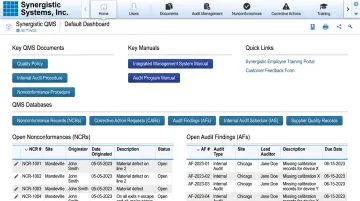
Synergistic Systems manages internal audit findings, nonconformance records, and corrective action tracking through a cloud-based QMS intranet. Audit records are accessible across locations and integrated with the broader management system, rather than sitting in a standalone spreadsheet.
Frequently Asked Questions
Can an internal audit function be outsourced?
Yes. ISO standards require organizations to manage and own their audit program, but they do not require audits to be performed by employees. The ISO/IAF Auditing Practices Group explicitly confirms that internal audits may be performed by an external provider, making outsourcing a fully accepted and compliant approach.
What is the difference between outsourcing and co-sourcing ISO internal audits?
Full outsourcing means the external provider conducts all internal audits. Co-sourcing combines internal staff and external auditors — useful when an organization wants to retain involvement, build capability over time, or needs external expertise only for specific standards or complex process areas.
How often are internal audits required under ISO standards?
ISO requires internal audits at "planned intervals" — there is no fixed frequency. Most organizations conduct full QMS coverage at least annually, but high-risk processes or recently changed areas may require more frequent auditing. The audit program should be risk-based and reviewed each year.
Can the same consultant who helped implement our ISO system also conduct our internal audits?
ISO requires auditors to be independent of the activity being audited, so a consultant who helped design or implement a specific process cannot audit that same process. A firm can provide both implementation and audit services — provided different personnel handle each role, or audits are limited to processes the consultant had no involvement in.
What credentials should I look for in an outsourced ISO internal auditor?
Look for CQA certification from ASQ, CQI/IRCA lead auditor certification, or Exemplar Global auditor certification for the relevant standard. Hands-on experience auditing in your industry — and direct familiarity with how major registrars run surveillance audits — matters just as much as credentials on paper.
How does outsourcing ISO internal audits benefit organizations with multiple sites?
A qualified outsourced provider applies a consistent audit methodology across all locations, ensuring every site is held to the same standard — critical for multi-site certificates governed under IAF MD 1:2023, where inconsistent audit quality at one location can put the entire certification at risk.