This guide is written for quality managers, operations leaders, and business owners either pursuing initial ISO 9001 certification or maintaining it. Whether you're building an audit program from scratch or fixing one that's been flagged by an external registrar, you'll find a clear explanation of what internal audits require, how to run one properly, and what separates an effective program from a compliance exercise.
TL;DR
- A mandatory first-party review of your QMS against ISO 9001 requirements and your own documented procedures
- Clause 9.2 requires audits at planned intervals based on process risk — not a fixed annual schedule
- Auditors must be independent of the areas they audit; no one audits their own work
- Nonconformities only count when corrective action is verified and sustained — not just logged
- Internal audit results feed directly into management review — a required strategic input for leadership
What Is an ISO 9001 Internal Quality Audit?
An ISO 9001 internal audit — formally called a first-party audit — is a structured, evidence-based evaluation conducted by the organization itself. Its purpose is to determine whether the QMS conforms to ISO 9001:2015 requirements and the organization's own documented processes — and whether that system is effectively implemented and maintained.
The audit isn't a binary pass/fail check. It's designed to surface actionable insights into process performance, gaps, risks, and improvement opportunities.
Internal vs. External Audits
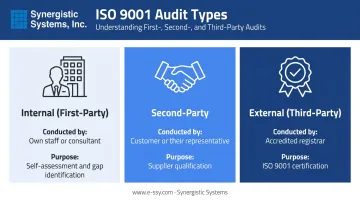
Understanding where internal audits sit within the broader audit taxonomy helps clarify their role:
| Audit Type | Who Conducts It | Purpose |
|---|---|---|
| Internal (First-Party) | Organization's own trained staff, or a consultant acting on the organization's behalf | Self-assessment; identify gaps and drive improvement |
| Second-Party | Customer or their representative | Supplier qualification or oversight |
| External (Third-Party) | Accredited registrar (DNV, BSI, Bureau Veritas, etc.) | Grant or maintain ISO 9001 certification |
Under ISO 19011:2018 — the management system auditing guidance standard — internal audits provide the organization with its own evidence of QMS conformance before an external registrar ever shows up. Completing a proper internal audit cycle is a prerequisite for the certification audit, not an afterthought.
Why ISO 9001 Internal Audits Matter Beyond Certification
The Clause 9.2 Requirement
ISO 9001 Clause 9.2, as confirmed by NQA, requires organizations to:
- Plan, establish, implement, and maintain an audit programme covering frequency, methods, responsibilities, and reporting
- Define audit criteria and scope for each audit
- Select auditors who ensure objectivity and impartiality
- Report results to relevant management
- Take corrective action without undue delay
- Retain documented information as evidence (Clause 9.2.2(f))
Failing any of these — especially auditor impartiality or documented evidence — generates nonconformances during external audits.
The Strategic Value
When audits are done well, they deliver real operational benefits:
- Early identification of hidden risks before they become customer complaints
- Stronger process controls through verified procedure compliance
- Alignment between daily operations and documented quality objectives
- A documented improvement history that demonstrates QMS maturity to registrars
What Happens Without Them
Organizations that skip or underinvest in internal audits face predictable consequences:
- Processes drift from documented procedures with no one catching the gap
- Nonconformities accumulate until the external auditor finds them
- Corrective action becomes reactive and rushed rather than planned
A disciplined internal audit program shifts that equation. By the time the registrar arrives, there are no surprises — only evidence of a system that actually runs as documented.
How an ISO 9001 Internal Audit Works: Step-by-Step
The audit cycle runs through five stages: planning → preparation → conducting the audit → reporting findings → corrective action follow-up. ISO 9001 doesn't prescribe a specific technique, but the process must be systematic, documented, and impartial.
One factor that consistently shortens each stage: a well-organized QMS with clear procedures, process maps, and defined responsibilities. When documentation is structured and accessible — whether in a physical binder or a cloud-based QMS intranet — auditors spend less time hunting for evidence and more time evaluating process performance.
Step 1: Planning and Scheduling
The audit plan must define:
- Scope — which processes, departments, or locations are included
- Criteria — ISO 9001 requirements and the organization's own procedures
- Frequency — risk-based; higher-risk or recently changed processes get more frequent attention
- Auditor assignments — ensuring no one audits their own area
A risk-based programme isn't a rotating calendar. Per the ISO/IAF Auditing Practices Group guidance, processes with higher levels of risk or previous nonconformities should have priority in the programme. Organizational changes, new products, and past audit results all drive scheduling decisions.
Step 2: Preparing for the Audit
Before the on-site review, auditors should gather:
- Relevant documented procedures and work instructions
- Previous audit findings and corrective action records
- Customer complaint data and process metrics
- Applicable ISO 9001 clauses for the processes under review
Auditors who skip preparation often miss the pattern: a nonconformity that keeps recurring because no one traced it back to a process gap. Using an internal audit checklist aligned to the processes being reviewed improves finding quality.
Step 3: Conducting the Audit
Auditors collect objective evidence through three methods, as described in ISO 19011:2018:
- Interviews — asking process owners and operators whether they know and follow documented procedures
- Observation — confirming that what is documented matches what is actually done
- Record review — verifying that outputs meet requirements (calibration records, inspection records, training records, delivery documents, etc.)
Auditors may issue three types of findings:
- Nonconformity — a requirement is clearly not being met; requires formal root-cause analysis and corrective action
- Opportunity for Improvement (OFI) — the process meets requirements but could be enhanced; no mandatory action required
- Observation — a neutral note about an emerging trend; worth monitoring but no action required
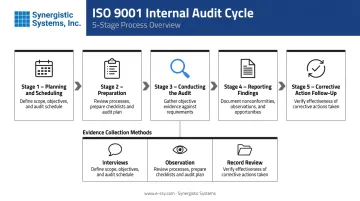
Step 4: Reporting and Corrective Action Follow-Up
The audit report must contain:
- Audit scope and criteria
- Summary of what was audited
- All findings: conformances, nonconformities, OFIs, and observations
- The corrective action plan for each nonconformity
Results must be communicated to relevant management and retained as documented evidence per Clause 9.2.2. Each nonconformity then requires root-cause investigation, a corrective action with a defined owner and deadline, and verification in a follow-up audit that the fix held.
Audits that generate paper findings with no verified resolution are more than a missed opportunity: they signal a non-functioning QMS to an external registrar and put certification at risk.
What Makes an Internal Audit Program Effective
Auditor Independence and Competence
Auditors must be:
- Trained — familiar with ISO 9001 requirements and auditing techniques
- Impartial — cannot audit their own work or areas where they have a conflict of interest
- Cross-functional — drawn from across departments, not only from the quality team
Clause 9.2.2(c) requires that auditors be selected to ensure objectivity and impartiality. ISO 19011 reinforces this: auditors should be independent of the activity being audited wherever practicable. Auditors who participate infrequently lose proficiency — consistent involvement is what keeps skills sharp and findings reliable.
Risk-Based Scheduling in Practice
The audit programme should be reviewed and updated regularly, not treated as a fixed annual calendar. Triggers for revision include:
- Process changes or new product lines
- Previous nonconformances and their root causes
- New sites or significant staff turnover
- Shifts in organizational risk or customer requirements
As the ISO/IAF APG guidance states, ISO 9001 does not specify frequency, duration, or scope — the organization defines these through its risk-based programme. Most organizations complete a full QMS cycle annually, but high-risk processes get more frequent attention within that cycle.
From Compliance Policing to Process Evaluation
Effective auditors don't just ask "are you following the procedure?" They ask: "Is this process consistently achieving its intended results?"
That shift — from compliance checking to process evaluation — is what surfaces systemic issues rather than individual errors. Consider the difference:
- An auditor who finds one missing signature catches an error. The finding generates a corrective action record and closes.
- An auditor who finds the approval step is routinely skipped because the form is inaccessible catches a process design problem. Leadership can actually fix something.
The second type of finding drives improvement. The first just generates paperwork.
Feeding Audit Results Into Management Review
Internal audit results should not arrive at management review as a simple nonconformity count. Leadership should analyze:
- Recurring themes across audit cycles
- Systemic weaknesses in specific processes or departments
- Corrective action effectiveness trends
- Performance data relative to quality objectives
When structured this way, audit results become direct inputs for resource allocation, policy updates, and improvement priorities — not just a compliance score. Synergistic Systems structures its implementation engagements so the system-wide internal audit (Step 8) feeds directly into the facilitated management review (Step 9). Findings reach leadership in a format they can act on before the registration audit.
Common Mistakes in ISO 9001 Internal Audits
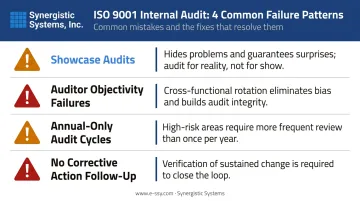
DNV's 2024 ISO audit guidance identifies several recurring failure patterns. Here are the most damaging:
- Showcase audits: Treating internal audits as a dress rehearsal for external registrars hides problems instead of surfacing them — and guarantees costly surprises at certification time.
- Auditor objectivity failures: Employees auditing their own departments is one of the most frequently cited nonconformances by external registrars. Cross-functional rotation or outside audit support is the fix.
- Annual-only audit cycles: A single yearly sweep misses process changes, staff turnover, and customer complaints that occur between cycles. High-risk areas need more frequent review.
- No corrective action follow-up: Finding nonconformities without verifying that root-cause corrections have held is a systemic gap. Audits that generate paperwork with no sustained change signal a non-functioning QMS to any external auditor reviewing your records.
When to Consider External ISO Audit Support
Some situations make external audit support not just useful but necessary:
- Insufficient trained internal auditors to maintain objectivity across all functions
- Single-person quality departments where the quality manager is involved in every process
- Multiple sites that need consistent audit coverage without bias
- First-time implementers approaching their initial certification audit
- Previous internal audits flagged as inadequate by an external registrar
Synergistic Systems, for example, provides structured, impartial audit support as part of its implementation engagements — drawing on Certified Quality Auditors with experience across hundreds of ISO projects and direct working relationships with registrars including DNV, BSI, Bureau Veritas, LRQA, and NQA.
That support doesn't replace the organization's own audit program. The goal is to build internal auditing competence over time, with external support filling the gap — or providing independent coverage where internal objectivity cannot be guaranteed.
Conclusion
An ISO 9001 internal audit is a mandatory, structured, impartial review of your QMS — checking both conformance to the standard and real-world process effectiveness. When run properly, it drives continual improvement. When treated as paperwork, it creates liability.
The organizations that get the most from internal audits treat them as a strategic management tool: risk-based scheduling, independent auditors, root-cause corrective action, and direct integration with management review. Done consistently, these practices turn your internal audit program into the engine that makes your QMS self-correcting — not just compliant on paper, but functional under real operating conditions. If your organization needs help building or strengthening that program, an experienced ISO 9001 consultant can compress the learning curve significantly.
Frequently Asked Questions
What does ISO 9001 Clause 9.2 require for internal audits?
Clause 9.2 requires organizations to plan, establish, implement, and maintain an audit programme covering frequency, methods, responsibilities, scope, criteria, and reporting. The organization must also retain documented evidence of audit programme implementation and results per Clause 9.2.2(f).
How many internal audits are required per year for ISO 9001?
ISO 9001 does not mandate a specific number. The standard requires audits at "planned intervals" based on process importance, organizational changes, and previous audit results. Most organizations complete a full QMS cycle annually, with higher-risk areas audited more frequently within that cycle.
Can an employee audit their own department or work area?
No. Clause 9.2.2(c) requires auditors to be selected to ensure objectivity and impartiality of the audit process. Auditing your own work creates a direct conflict of interest that external registrars will flag as a nonconformance.
What is the difference between an internal audit and a certification audit?
An internal audit is a self-assessment conducted by the organization (or a consultant acting on its behalf) to identify gaps and drive improvement. A certification audit is performed by an accredited third-party registrar to determine whether the QMS meets ISO 9001 requirements and qualifies for certification.
What should be included in an ISO 9001 internal audit report?
The report must include: audit scope and criteria, a summary of activities conducted, all findings (conformances, nonconformities, OFIs, and observations), and the corrective action plan. All of this must be retained as documented evidence per Clause 9.2.2(f).
What happens when nonconformities are found during an internal audit?
Each nonconformity requires a formal corrective action. The organization investigates the root cause, assigns an owner with a defined deadline, implements the fix, and confirms in a follow-up audit that the issue has not recurred.