That confusion matters. The two audits serve entirely different purposes, are conducted by different parties, carry different stakes, and require different preparation. Getting clear on the distinction helps organizations invest appropriately in each — and avoid the costly mistake of treating one as a substitute for the other.
This article covers the definitions of each audit type, a side-by-side comparison, the key differences in purpose, auditor role, scheduling, and outcomes, and how the two work together across the full certification lifecycle.
TL;DR
- Internal audits (first-party) are self-assessments required by ISO 9001 Clause 9.2 to identify gaps and drive improvement.
- External audits are conducted by an accredited Certification Body to verify conformance and issue or maintain your ISO 9001 certificate.
- The core difference: internal audits are improvement tools; external audits are compliance verifications with real certification stakes.
- Schedules differ significantly: internal audits are flexible; external audits follow a fixed Stage 1, Stage 2, surveillance, and recertification cycle.
- A strong internal audit program is your best preparation for a successful external audit.
Internal vs. External ISO 9001 Audits: Quick Comparison
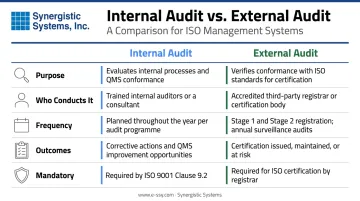
The table below summarizes how internal and external ISO 9001 audits differ across five key dimensions — useful whether you're planning your audit program or preparing for certification.
| Dimension | Internal Audit | External Audit |
|---|---|---|
| Purpose | Identify gaps, improve QMS, prepare for certification | Verify conformance to ISO 9001; grant or maintain certification |
| Who Conducts It | Employees or hired consultants (independent of area audited) | Accredited third-party Certification Body or Registrar |
| Frequency | Organization-determined, risk-based | Fixed cycle: Stage 1 & 2, annual surveillance, 3-year recertification |
| Outcomes | Internal Corrective Action Requests (CARs) | OFIs, Minor NCs, or Major NCs — major NCs can halt or suspend certification |
| Mandatory? | Yes — required by Clause 9.2 | Yes — required to achieve and maintain ISO 9001 certification |
What Is an ISO 9001 Internal Audit?
An internal audit is a first-party self-assessment mandated by ISO 9001 Clause 9.2. The standard requires organizations to plan, establish, implement, and maintain an audit programme — covering frequency, methods, responsibilities, and reporting. Guidance on how to structure and run that programme comes from ISO 19011:2018, the current guidelines standard for auditing management systems.
One requirement that catches organizations off guard: auditors must not audit their own area of work. A quality manager might audit the sales department; a production manager might audit purchasing. That separation prevents bias and ensures findings reflect reality, not self-interest.
What Internal Auditors Are Evaluating
Internal auditors assess three things:
- Conformity — do processes meet the organization's own documented requirements and the ISO 9001 standard?
- Effectiveness — is the QMS actually working, not just documented on paper?
- Improvement opportunities (gaps, inefficiencies, or risks that corrective action can address)
Finding nonconformities during an internal audit is a sign of a healthy QMS, not a failure. Internal Corrective Action Requests (CARs) are improvement tools : there is no certification risk attached to an internal finding. The organization investigates the root cause, implements a fix, and closes the CAR in its own system.
That's a very different dynamic from what happens when an external auditor finds the same issue.
When Are Internal Audits Most Valuable?
Internal audits deliver the most value at three specific moments:
- During initial QMS implementation — to confirm the system is implemented and operational before pursuing certification
- When a process area is underperforming — a structured readiness check before the external auditor arrives
Audit frequency should also be risk-based. ISO 9001 Clause 9.2 specifically requires that organizations consider process importance, changes affecting the organization, and the results of previous audits when setting their schedule. High-risk or frequently changed processes warrant more frequent auditing than stable, low-risk areas.
That scheduling discipline assumes you have trained internal auditors to carry it out. For organizations that don't, outside support bridges the gap. Synergistic Systems provides ISO 9001 internal auditor training to client teams as part of its 10-step implementation methodology. The firm also conducts the system-wide internal audit at Step 8, two steps before the Stage 1/Stage 2 registration audit.
What Is an ISO 9001 External Audit?
An external audit is a third-party assessment conducted by an accredited Certification Body (CB), an independent body governed by ISO/IEC 17021-1:2015. The external auditor's job is to objectively verify conformance, not to advise on how to fix problems.
Independence rules are strict. A certification body cannot certify an organization's management system if it (or a related body) provided management system consultancy within the previous two years. That boundary exists to ensure the certificate carries real credibility.
The registrar landscape includes organizations like ABS Quality Evaluations, DNV, Bureau Veritas, LRQA, BSI, NQA, SGS, Intertek, and Perry Johnson Registrars, all operating under accreditation from bodies like ANAB. Synergistic Systems has supported clients through audits with each of these registrars, so documentation and evidence packages are prepared to each registrar's expectations.
Types of External ISO 9001 Audits
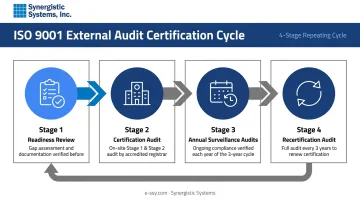
Stage 1 (Readiness Review) The auditor reviews documentation, confirms that internal audits and management reviews have been conducted, and assesses whether the organization is ready for the full certification audit. Often conducted remotely to reduce travel costs.
Stage 2 (Certification Audit) The full on-site assessment. Auditors interview staff, observe processes, and review documented evidence. A Major Nonconformity at this stage can prevent certification until resolved and verified. If corrections aren't verified within six months of the last Stage 2 audit day, another Stage 2 must be conducted before certification can proceed.
Surveillance Audits Conducted at least once each calendar year after initial certification. Less comprehensive than Stage 2, but still capable of triggering certificate suspension if Major NCs go unaddressed.
Recertification Audit Occurs every three years. Roughly equivalent in scope to the original Stage 2. The three-year cycle then repeats from the recertification decision date.
Key Differences Between Internal and External ISO 9001 Audits
Purpose and Objectives
Internal audits are a management tool focused on process improvement, QMS effectiveness, and readiness building. External audits are compliance assessments — independent verification for customers, stakeholders, and markets that the QMS genuinely meets ISO 9001 requirements.
That difference in purpose changes what your audit program looks like in practice: who audits, what evidence gets examined, and what happens when gaps surface.
The Auditor's Role and Relationship
Internal auditors (whether in-house staff or contracted consultants) act as partners in improvement. They bring organizational context to their findings and can discuss root causes collaboratively.
External auditors are formally evaluative. They are focused on objective evidence, will not offer consulting advice during the audit, and are bound by independence requirements that prohibit them from suggesting solutions. When an external auditor finds a gap, it becomes a documented nonconformity. Resolving it is entirely your responsibility.
Scheduling and Flexibility
Internal audit schedules are set by the organization and can be adjusted based on process risk, recent changes, or quality events. Used well, that flexibility lets you concentrate audit attention where the system is under the most stress.
External audits follow a fixed accreditation cycle with almost no flexibility. Missing a surveillance audit window, allowing a certificate to lapse, or leaving a Major NC unresolved has direct business consequences up to and including suspension of certification status. For manufacturers and suppliers whose customer contracts specify active ISO 9001 certification, a lapsed certificate can disqualify them from the supply chain.
Outcomes and Consequences
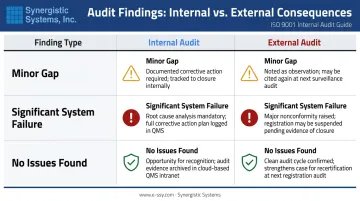
The stakes differ significantly:
| Finding Type | Internal Audit | External Audit |
|---|---|---|
| Minor gap identified | Internal CAR — managed internally, no external consequence | Minor Nonconformity — correction required within defined timeframe |
| Significant system failure | Internal CAR — opportunity to fix before external scrutiny | Major Nonconformity — can prevent certification or trigger suspension |
| No issues found | Verify scope was adequate; "zero findings" can signal a weak audit | Opportunities for Improvement (OFIs) noted; certificate maintained |
A Quality Digest analysis of ANAB nonconformance data identified the most frequently cited ISO 9001 finding categories: QMS process documentation (Clause 4.4.1), competence (7.2), control of externally provided processes (8.4.1), customer satisfaction monitoring (9.1.2), internal audit programme (9.2.1), and management review inputs (9.3.2).
The internal audit clause itself appears on that list. Organizations that run a weak internal audit programme don't just miss improvement opportunities — they create a nonconformity risk in the very system designed to prevent nonconformities.
How Internal and External Audits Work Together
Despite their differences, the two audits are designed to function as a continuous loop. Internal audits feed directly into external audit readiness — and external auditors know it.
At Stage 1, the external auditor specifically reviews whether internal audits and management reviews have been planned and performed, then uses that evidence to assess whether the organization is genuinely ready for Stage 2. The external audit report must include a summary of evidence related to the internal audit and management review processes. In other words, your internal audit program is itself audited.
The "Dress Rehearsal" Principle
Organizations that run rigorous, honest internal audits — ones that find real issues, generate genuine CARs, and track corrective action through to closure — are far more likely to pass external audits cleanly. The paper trail demonstrates that the QMS can police itself.
Internal audit reports showing "zero findings" across all areas are a red flag. When internal audits consistently report nothing while the external auditor finds obvious issues, it signals the program isn't functioning as intended. A well-run internal audit program finds things — and fixes them before the Certification Body arrives.
Signs of a healthy internal audit program:
- Findings documented across multiple process areas
- Corrective action requests (CARs) generated and tracked to closure
- Evidence of follow-up at subsequent audits
- No pattern of "all clear" results in high-risk processes
NQA confirms that to achieve ISO 9001 certification, an organization must show its QMS has been operational for at least three months and has completed a full cycle of internal audits and a management review. This is the minimum evidence base an external auditor needs to make a certification decision — not a box-checking step.
Building the Documentation Trail
For organizations managing complex or multi-site QMS implementations, maintaining a clean documentation trail across both audit types requires discipline. Synergistic Systems includes a cloud-based QMS intranet in every implementation engagement. It hosts internal audit records, corrective action logs, management review minutes, and all controlled documents in one place. That centralized structure means when the Certification Body arrives, the objective evidence is organized and accessible rather than scattered across spreadsheets and shared drives.
Conclusion
Internal and external ISO 9001 audits are not competing activities — they're complementary ones. Internal audits provide the continuous improvement loop and the readiness signal; external audits provide the independent validation and market-facing certification. Each tool does something the other cannot.
For organizations just beginning their ISO journey: build the internal audit program first. Get it running, get it finding things, and get corrective actions closed before you invite an external auditor in.
For organizations approaching certification, recertification, or an annual surveillance audit: treat every internal audit as preparation for the external auditor's scrutiny. Your records should tell the story of a QMS that actively monitors and improves itself — because that's exactly what auditors look for.
When the stakes are highest, experience with both the standard and the registrars matters. Synergistic Systems has guided organizations through hundreds of ISO 9001 implementations over 25+ years, working alongside every major accredited registrar — so clients arrive at their external audit prepared, not surprised.
Frequently Asked Questions
What is the difference between internal and external ISO audits?
Internal audits are self-assessments conducted by the organization (or a hired consultant acting on its behalf) to evaluate QMS conformance and drive improvement. External audits are conducted by an independent, accredited Certification Body to verify conformance to ISO 9001 and issue or maintain the certificate. The key distinction is purpose: one is an improvement tool, the other is a compliance verification.
What are the 5 C's of internal audit?
The 5 C's are Criteria, Condition, Cause, Consequence, and Corrective Action. This framework helps internal auditors structure findings so they do more than log a problem — documenting the requirement violated, what was observed, why it happened, the impact, and what needs to be fixed.
Who can conduct an ISO 9001 internal audit?
Internal audits can be performed by trained employees or external consultants, provided the auditor is independent of the area being audited and competent to evaluate QMS conformance. Organizations without in-house auditors commonly engage ISO consultants like Synergistic Systems, particularly before a first certification audit.
How often do internal ISO 9001 audits need to be conducted?
ISO 9001 Clause 9.2 requires internal audits at planned intervals but does not specify a fixed frequency ; the organization sets the schedule based on process importance, risk level, and prior audit results. Higher-risk or frequently changed processes warrant more attention than stable, low-risk areas.
What happens if a major nonconformity is found during an external ISO 9001 audit?
A Major Nonconformity at a Stage 2 certification audit blocks certification until the NC is resolved and independently verified. If verification doesn't occur within six months, a repeat Stage 2 audit is required. During a surveillance audit, unresolved Major NCs can lead to suspension or withdrawal of the certificate.
Can an organization hire a consultant to help with ISO 9001 internal audits?
Yes. Organizations routinely engage ISO consultants for internal audits, especially when they lack trained in-house auditors or are preparing for first certification. A consultant brings technical expertise and direct familiarity with what registrars look for, which strengthens both findings and the corrective action program.