The good news: audit outcomes are largely determined before the auditor walks through the door.
This guide breaks down 10 actionable strategies across three phases—pre-audit preparation, during-audit execution, and post-audit improvement. Whether you're pursuing initial certification, preparing for your annual surveillance audit, or approaching a recertification cycle, these strategies apply directly to your situation.
TLDR
- Before the audit: define compliance obligations, close gaps, assign roles, and lock down document control
- During the audit: map environmental aspects, run proactive monitoring, and communicate openly with auditors
- After the audit: categorize findings, execute structured CAPA, and feed results back into your EMS
- All 10 strategies follow the PDCA (Plan-Do-Check-Act) cycle — ISO 14001's built-in framework for continuous improvement
What ISO 14001 Compliance Audits Actually Require
Auditors aren't just reviewing paperwork—they're verifying that your Environmental Management System (EMS) actually operates the way your documentation says it does.
An ISO 14001 compliance audit evaluates two things: whether your EMS conforms to the standard's requirements, and whether your organization is meeting its identified compliance obligations. Clause 9.1.2 governs the evaluation of compliance with legal and voluntary requirements. Clause 9.2 governs internal audit of EMS conformity and effectiveness. These are related but distinct.
That distinction matters because, as the ISO/IAF expected outcomes document makes clear, ISO 14001 certification is not a full regulatory compliance audit and cannot guarantee the absence of legal violations. Your EMS should aim at full legal compliance—but the organization, not the certification body, bears responsibility for demonstrating it.
The Three-Year Certification Cycle
According to NQA, ISO 14001 certification follows a structured cycle:
- Stage 1 audit — Document review, scope confirmation, readiness assessment
- Stage 2 audit — Evidence-based audit: site inspection, staff interviews, record review
- Annual surveillance audits — Years one and two of the certification cycle
- Recertification audit — End of the three-year cycle
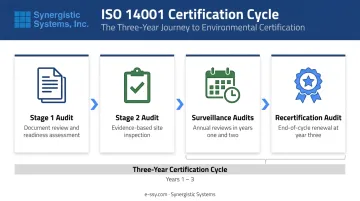
All four audit types verify the same thing: that your organization is doing what its documented EMS says it's doing.
Pre-Audit Preparation: Strategies 1–4
Strategy 1: Define Your Complete Compliance Obligations
Your compliance obligations register is often the first document an auditor examines. Under Clause 6.1.3, compliance obligations include two categories:
Mandatory requirements:
- Federal regulations (Clean Water Act NPDES permits, Clean Air Act Title V operating permits under 40 CFR Part 70)
- RCRA hazardous waste requirements
- State environmental permits and operating conditions
- Applicable emissions standards
Voluntary commitments:
- Industry codes of practice
- Contractual environmental obligations
- Sustainability pledges to customers or stakeholders
Organizations underestimate the scope of voluntary obligations. A customer contract requiring annual carbon reporting is a compliance obligation. So is a trade association environmental code your leadership signed two years ago.
Build or update a formal Compliance Obligations Register that includes:
- Each obligation identified
- The specific duty imposed
- The environmental aspect it links to
- The responsible party
- A next review date
This register isn't a static spreadsheet—it's a living document that must be revisited after operational changes, new legislation, or management review outcomes.
Strategy 2: Conduct a Pre-Audit Gap Analysis and Mock Audit
DNV describes a gap analysis as identifying discrepancies between current business processes and standard requirements—and explicitly recommends it as a readiness step before certification. The practical goal: find your nonconformities before an external auditor does.
Complete your gap analysis and mock evidence review early enough to resolve any Stage 1 areas of concern before Stage 2. NQA describes Stage 1 and Stage 2 as typically separated by roughly three months. That's your working window for closing gaps before the certification auditor arrives.
A mock internal audit adds value beyond the gap analysis alone. It:
- Familiarizes your team with auditor question patterns
- Tests whether staff can locate and present records under mild pressure
- Surfaces documentation gaps in a low-stakes setting
Findings from the gap analysis should feed directly into a pre-audit corrective action plan with clear owners and completion deadlines.
Strategy 3: Assemble and Train a Competent, Cross-Functional Audit Team
ISO 14001 requires internal auditors to be competent and impartial (Clause 9.2.2)—meaning auditors cannot review their own work. ISO 19011:2018, the guideline standard for management system auditing, covers audit principles, audit program management, and evaluating auditor competence.
Competency for ISO 14001 internal auditors means:
- Familiarity with applicable environmental law for your industry and location
- Understanding of EMS structure and the Annex SL framework
- Practical auditing skills: evidence gathering, interview techniques, finding classification
A cross-functional team matters because environmental aspects cross departmental lines. Operations, facilities, procurement, and management all contribute to the aspect picture:
- Operations: process emissions, waste generation, energy consumption
- Facilities: stormwater management, spill containment, utility metering
- Procurement: supplier environmental requirements, hazardous material sourcing
- Management: legal compliance oversight, objective-setting, resource allocation
If your organization lacks dedicated in-house EMS expertise, working with an ISO consulting partner familiar with your registrar's expectations can accelerate readiness. Synergistic Systems has supported ISO 14001 certification audits alongside registrars including Bureau Veritas, DNV, BSI, and NQA, and that registrar-specific experience shapes how preparation is structured from day one.
Strategy 4: Establish and Maintain Rigorous Document Control
Poorly controlled documentation is a direct certification risk. If a record doesn't exist—or can't be found—it didn't happen as far as an auditor is concerned.
DNV's ISO 14001 documentation guide confirms that documented information is required across the full span of the standard: scope (Clause 4.3), environmental policy (Clause 5.2), aspects and impacts (Clause 6.1.2), compliance obligations (Clause 6.1.3), objectives (Clause 6.2), monitoring results (Clause 9.1), internal audit results (Clause 9.2), management review evidence (Clause 9.3), and corrective action records (Clause 10.2).
Documents auditors routinely examine:
| Document | Clause |
|---|---|
| EMS scope statement | 4.3 |
| Environmental policy | 5.2 |
| Aspect-impact register | 6.1.2 |
| Compliance obligations register | 6.1.3 |
| Environmental objectives and targets | 6.2 |
| Monitoring and measurement records | 9.1.1 |
| Internal audit reports | 9.2 |
| Management review minutes | 9.3 |
| Corrective action records | 10.2 |
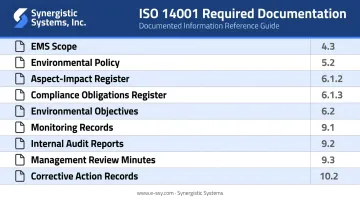
Document control means version history, access controls, retention policies, and clear ownership. An auditor who pulls an obsolete procedure or finds a record with no assigned owner will log a nonconformity—regardless of how well your actual processes perform.
During-Audit Execution: Strategies 5–7
Strategy 5: Identify and Prioritize Significant Environmental Aspects
Under Clause 6.1.2, an environmental aspect is any element of your activities, products, or services that interacts—or could interact—with the environment. The standard requires you to identify which aspects are significant and demonstrate that controls exist for them.
Auditors verify two things: that you've identified all significant aspects, and that your controls are actually operating. Both are required.
Common environmental aspects across industrial operations:
- Air emissions (combustion, process vents, fugitive releases)
- Water discharge and stormwater runoff
- Hazardous and non-hazardous waste generation
- Energy consumption
- Raw material and chemical use
Assess significance using criteria your organization defines. Documented internal criteria should be defensible to auditors. Common evaluation tools include:
- Process flow diagrams
- Environmental impact assessments
- Aspect-impact matrices
- Frequency, scale, severity, and regulatory sensitivity scoring
Review your aspect register before each audit cycle. New products, operational changes, or updated regulatory thresholds all affect the register's accuracy. An outdated register that doesn't reflect current operations is a predictable audit finding.
Strategy 6: Implement Proactive Monitoring and Measurement
Clause 9.1.1 requires more than data collection. Auditors look for evidence that your monitoring data is used for decision-making. KPIs should tie to environmental objectives, and trends should inform action.
Effective monitoring in practice looks like:
- Measurement schedules based on risk level and permit requirements, not set arbitrarily
- Equipment calibrated on schedule with current records on file
- Personnel trained specifically for the measurements they perform
- Trend records that show performance over time, not just point-in-time snapshots
For regulated discharges, monitoring frequency may be set by your permit. EPA's NPDES program establishes reporting frequency based on the nature and effect of the discharge under 40 CFR 122.44(i)(2). Don't set monitoring schedules that conflict with permit conditions.
Strategy 7: Communicate Transparently and Effectively with Auditors
How your team behaves during the audit matters. Auditors follow evidence trails, not agendas. Clear, direct communication reduces the risk of misunderstandings that turn into findings.
Practical guidance for audit day:
- Designate a single point of contact to coordinate auditor movement, document requests, and staff interviews
- Brief employees beforehand on their specific role, the environmental aspects relevant to their work, and where records are kept—not on reciting ISO language
- Provide evidence, not explanations — a record speaks more clearly than a verbal assurance
- Answer questions directly without over-explaining in ways that open new areas of scrutiny
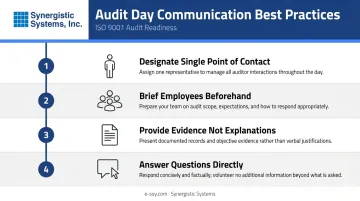
NQA's audit guidance confirms that organizations can discuss raised nonconformities with auditors during the closing meeting. Come prepared with a factual response and an initial corrective action plan — that approach tends to resolve nonconformities faster than disputing the finding.
Post-Audit Strategies for Sustained Compliance: Strategies 8–10
Strategy 8: Document and Categorize All Audit Findings Systematically
Not all findings carry the same weight, and misclassifying them delays corrective action inappropriately.
| Finding Type | Definition | Closure Requirement |
|---|---|---|
| Major nonconformity | Systemic failure to fulfill a standard requirement; creates doubt about EMS achieving intended outputs | Response within 30 days; objective evidence within up to 90 days |
| Minor nonconformity | Isolated lapse that doesn't undermine overall system integrity | Response within 30 days |
| Opportunity for improvement (OFI) | Advisory suggestion; not a failure | No response required |
Source: NQA nonconformity guidance
NQA will not issue, reissue, or revise a certificate until all nonconformance responses are accepted and evidence for major findings is verified. Missed deadlines can result in certification suspension.
After the audit, review the full report with key stakeholders promptly. Assign each finding an owner, a root cause assessment, and a resolution timeline. That documented review becomes evidence for subsequent audits.
Strategy 9: Address Nonconformities with a Structured CAPA Process
Clause 10.2 requires more than fixing the immediate problem. It requires investigating root causes and implementing corrective actions that prevent recurrence.
A complete CAPA plan includes:
- Root cause analysis method — 5 Whys, Fishbone (Ishikawa) diagram, or barrier analysis
- Specific corrective steps tied directly to the identified root cause
- Assigned responsibility for each action
- Completion deadline with a verification step confirming the fix actually held
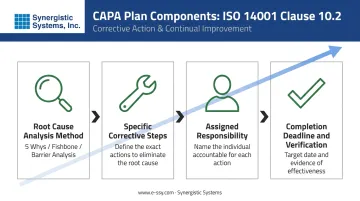
The difference between organizations that cycle through the same nonconformities audit after audit and those that don't usually comes down to how seriously they apply root cause analysis. Fixing the symptom closes the finding on paper. Fixing the cause prevents it from reappearing.
Organizations that integrate CAPA into daily operations (rather than activating it only after an audit) demonstrate the culture of continual improvement ISO 14001 is designed to build.
Strategy 10: Use Audit Findings to Drive Long-Term EMS Improvement
The audit is the "Check" phase of the PDCA cycle. Its strategic value lies in what you do with the findings.
Use audit results to:
- Identify repeat nonconformities — trends reveal systemic EMS weaknesses, not isolated incidents
- Refine environmental objectives based on performance data and finding patterns
- Update training programs where staff knowledge gaps contributed to findings
- Strengthen the compliance obligations register when gaps in legal coverage are exposed
Feed findings as formal input into the next management review cycle (Clause 9.3). Management review is where audit results become improvement decisions — updated objectives, resource allocation, procedural changes. Closing this loop makes the next audit cycle demonstrably stronger.
ISO 14001:2015 explicitly identifies the Plan-Do-Check-Act model as the basis for the EMS approach. Each audit cycle produces documented findings, verified corrections, and updated objectives — the inputs that make the following cycle more effective than the last.
How Synergistic Systems Supports ISO 14001 Compliance Audit Readiness
Preparing for an ISO 14001 compliance audit means aligning documentation, training, monitoring systems, aspect registers, and team knowledge simultaneously. For most organizations—especially those without dedicated in-house EMS expertise—that's a significant coordination challenge.
Synergistic Systems is an ISO consulting firm headquartered in Plano, TX, with over 25 years of experience helping organizations across the Dallas Metroplex, Gulf Coast, and Northwest Arkansas implement and maintain ISO 14001 Environmental Management Systems. The firm has worked alongside major third-party registrars including Bureau Veritas, DNV, BSI, LRQA, NQA, and others throughout the certification process.
ISO 14001 is delivered as an integrated add-on to an existing ISO 9001 foundation — not a separate, parallel system. That structural choice drives meaningful advantages:
- Cuts implementation cost by 40–60% compared to a standalone EMS build
- Eliminates duplicate documentation across quality and environmental systems
- Consolidates to one combined internal audit and one combined management review
- Manages all documents, records, corrective actions, and management reviews through a cloud-based intranet included in the engagement — no hardware or software purchase required
The 10-step fixed-price methodology covers everything from initial gap analysis through internal audit, management review facilitation, and onsite Stage 1/Stage 2 registration audit support.
Contact Synergistic Systems to discuss your ISO 14001 audit readiness and schedule a complimentary discovery consultation.
Frequently Asked Questions
What is an ISO 14001 compliance audit?
An ISO 14001 compliance audit is a systematic evaluation—internal or external—that verifies whether an organization's EMS and operations conform to the standard's requirements and its identified compliance obligations, as defined under Clauses 6.1.3 and 9.1.2. It confirms the organization is implementing and maintaining what its documented EMS describes.
How often are ISO 14001 compliance audits required?
Internal compliance evaluations must occur at planned intervals based on the risk level of each obligation. External audits follow a three-year cycle: Stage 1 and Stage 2 initial certification, annual surveillance audits in years one and two, and a recertification audit in year three.
What is the ISO 14001 compliance audit checklist?
A compliance audit checklist typically covers the compliance obligations register, environmental aspect identification, monitoring and measurement records, documented information controls, internal audit reports, management review minutes, and corrective action records—confirming the EMS is implemented as documented.
What are the types of ISO 14001 compliance audits?
The four main types are:
- Internal audits — conducted by the organization's own team
- Stage 1 and Stage 2 certification audits — performed by an accredited certification body
- Surveillance audits — annual reviews in years one and two of the cycle
- Recertification audits — conducted at the end of the three-year cycle
Who should conduct an ISO 14001 compliance audit?
Internal auditors must be competent and impartial—they cannot audit their own work. External certification audits must be conducted by accredited certification bodies. Organizations may also engage qualified ISO consultants to conduct pre-audit assessments or support internal audit programs.
What happens if my organization fails an ISO 14001 compliance audit?
Major nonconformities require documented corrective action before certification can be granted or maintained. Responses are due within 30 days, with objective evidence required within 90 days. Minor nonconformities must be resolved within an agreed timeframe; unclosed findings by the certificate anniversary date can result in suspension or withdrawal.