Introduction
When an organization begins the ISO 14001 certification process, the environmental policy is typically the first document auditors examine during a Stage 1 review. It signals immediately whether leadership understands the standard's intent—or whether someone downloaded a generic template and swapped in the company name.
According to the ISO Survey of Certifications, more than 670,000 organizations worldwide hold ISO 14001 certification. That's a substantial benchmark, and every one of those organizations had to produce an environmental policy that satisfied Clause 5.2. Many struggled with the same pitfalls: policies that were too generic, too detailed, or signed by the wrong person.
This article explains what Clause 5.2 actually requires and provides a free structural template with sample language. It also covers how to tailor that template to your organization's specific environmental context, so your policy holds up when auditors arrive.
TL;DR
- ISO 14001 Clause 5.2 requires five specific commitments in your environmental policy — skip any one and you have a nonconformance
- The policy sets intent, not targets — objectives belong in a separate Clause 6.2 document
- Top management must sign it; an EMS coordinator alone cannot own this document
- A complete policy is one page — two at most
- The policy must be available to anyone who requests it, including customers and regulators
What Is an ISO 14001 Environmental Policy?
The environmental policy is a high-level declaration from top management that establishes the organization's overall direction and commitment to managing its environmental impact. It communicates intent — not methods, targets, or step-by-step procedures.
ISO 14001 places the environmental policy in Clause 5 (Leadership) deliberately. The standard requires this document to originate from the highest level of management, not from an environmental coordinator or quality team working independently. Top management must establish, implement, and maintain it — and sign it.
Policy vs. Objectives: A Common Confusion
Many organizations blur the line between their policy and their objectives. Here's the distinction:
- The environmental policy states broad commitments: "we commit to preventing pollution"
- Environmental objectives translate those commitments into measurable targets: "reduce water consumption by 15% by Q4"
The policy feeds into the objectives document — but the two are separate documents governed by different clauses. Objectives are documented under Clause 6.2. Embedding targets inside the policy will generate an audit finding.
The 5 Required Elements of an ISO 14001 Environmental Policy
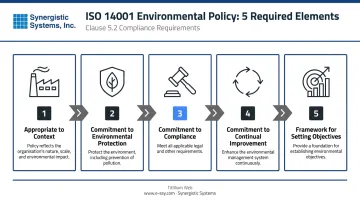
Clause 5.2 specifies five elements every environmental policy must contain.
Element 1 — Appropriate to the Organization's Context
The policy must reflect the nature, scale, and specific environmental impacts of the organization's activities, products, and services. A generic policy fails this test immediately.
Two concrete examples of what this looks like in practice:
- A logistics company should address fuel consumption, vehicle emissions, and transport-related environmental impacts
- A chemical manufacturer should address hazardous waste management, spill prevention, and process emissions
If an auditor reads your policy and can't tell what industry you're in, it isn't appropriate to your context.
Element 2 — Commitment to Protecting the Environment, Including Prevention of Pollution
The standard requires an explicit commitment to environmental protection. Pollution prevention is named specifically, but the 2015 revision broadened this . The Clause 5.2 note lists additional commitments organizations may need to include depending on their context:
- Sustainable resource use
- Climate change mitigation and adaptation
- Protection of biodiversity and ecosystems
A manufacturing facility with high water usage should address resource conservation. An organization operating near sensitive ecosystems may need to address biodiversity explicitly. The policy should reflect your environmental reality.
Element 3 — Commitment to Fulfilling Compliance Obligations
The policy must commit to identifying and meeting all applicable legal and other requirements related to the organization's environmental aspects. The 2015 standard uses the formal term "compliance obligations"—this replaced the older phrase "legal and other requirements."
Sample language you can adapt:
"[Company Name] is committed to identifying and fulfilling all applicable compliance obligations related to our environmental aspects, including relevant federal, state, and local regulations."
The policy makes this commitment. The specific regulations are tracked separately in a Register of Compliance Obligations—not listed inside the policy itself.
Element 4 — Commitment to Continual Improvement of the EMS
The policy must commit to ongoing improvement of the Environmental Management System and the organization's environmental performance. This does not require improvement on every metric every year — it requires a systemic commitment to improvement over time, supported by setting and reviewing measurable objectives. That connection to measurable objectives leads directly into what Element 5 demands.
Element 5 — Framework for Setting Environmental Objectives
The policy must show a commitment to establishing, communicating, and reviewing environmental objectives. The objectives themselves do not appear in the policy—but the policy should make clear they will be set and aligned with these commitments.
Sample language:
"We will establish, maintain, and review environmental objectives to drive continual improvement consistent with this policy."
Free ISO 14001 Environmental Policy Template
How to Use This Template
The following template addresses all five Clause 5.2 requirements. Replace bracketed placeholders with your organization's specific information. Keep the final document to one page.
ENVIRONMENTAL POLICY [Company Name] | [City, State] | Document No.: [XXX] | Rev: [01] | Effective Date: [MM/DD/YYYY]
[Company Name] is a [brief description of organization type and primary activities—e.g., "contract manufacturer of precision machined components"] operating from [Location(s)]. We recognize that our operations have the potential to affect the environment through [identify 2–3 primary environmental aspects, e.g., "energy consumption, waste generation, and air emissions"], and we are committed to managing these impacts responsibly.
Commitment to Environmental Protection We are committed to the prevention of pollution and the protection of the environment in connection with our activities, products, and services. We will work proactively to minimize adverse environmental impacts and promote sustainable practices, including [sustainable resource use / climate change mitigation / protection of biodiversity—select those relevant to your context].
Commitment to Compliance [Company Name] is committed to identifying and fulfilling all applicable compliance obligations, including federal, state, and local environmental regulations and any other requirements to which we subscribe.
Commitment to Continual Improvement We are committed to the continual improvement of our Environmental Management System and to the ongoing enhancement of our environmental performance.
Framework for Environmental Objectives We will establish, communicate, and regularly review environmental objectives to ensure they are aligned with this policy and support our commitment to improving environmental performance.
This policy is appropriate to the nature, scale, and environmental impacts of our activities, products, and services. It is communicated to all persons working under our control and is available to interested parties upon request.
Authorized by: [Name, Title] Date: [MM/DD/YYYY] Review Frequency: This policy will be reviewed at planned intervals and whenever significant changes occur in our organizational context, scope, or compliance obligations. Availability: This policy is maintained on the company intranet and is available externally upon request at [website/contact].
A Note on Policy Length
A complete environmental policy is one page—rarely two. When a policy runs longer, it has typically drifted into operational territory: procedures, targets, or work instructions that belong in separate documents.
Synergistic Systems has guided organizations through ISO 14001 implementation for over 25 years, across manufacturing, oil and gas, food and beverage, chemical processing, and other industries. If your team wants a documentation system built for your specific context rather than adapted from a generic template, that experience is available from the start.
How to Tailor the Template to Your Organization
A template is a starting point — four steps will turn it into a policy that actually reflects your organization.
Step 1 — Complete Your Environmental Aspects Assessment First
Before finalizing the policy, complete or at least begin your environmental aspects and impacts assessment (Clause 6.1.2). The policy must reflect the environmental realities of your operations—what you actually impact.
Common environmental aspects by industry type:
| Industry | Typical Significant Aspects |
|---|---|
| Metal fabrication / machining | Metal waste, cutting fluid disposal, energy use |
| Food and beverage | Water consumption, wastewater, packaging waste |
| Oil and gas services | Spill risk, air emissions, hazardous waste |
| Logistics | Fuel consumption, vehicle emissions, packaging |
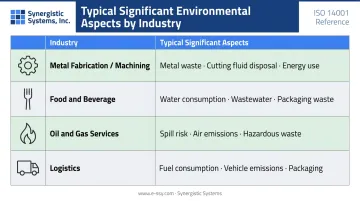
If your policy doesn't reference what you actually do, it will fail the "appropriate to the organization" test during audit.
Step 2 — Align Language with Your Legal Context
U.S.-based organizations should reference applicable federal frameworks generically without listing every regulation inside the policy:
- Clean Air Act for air emissions from stationary and mobile sources
- Clean Water Act for discharges to U.S. waters
- RCRA for hazardous waste management
The policy commits to compliance. A separate Register of Compliance Obligations is where specific regulations are tracked and updated.
Step 3 — Get Top Management Genuinely Involved
Auditors will interview employees at multiple levels to verify awareness of the policy. If front-line workers can't explain what it means for their role, the finding traces back to leadership communication—not just the document.
A practical approach: create a 3–5 sentence summary of the policy for posting in work areas, including in onboarding materials, or displaying on bulletin boards near production floors. Awareness training should specifically help employees connect their daily tasks to the policy's commitments — that link is what auditors are listening for.
Step 4 — Update the Policy When Your Context Changes
The policy is a living document. Revisit it when:
- Operations expand to new locations
- New product lines or manufacturing processes are added
- Significant new regulatory requirements take effect
- The organization acquires new equipment with different environmental impacts
"Maintained" in the standard means actively kept current—not signed once and filed.
Documentation and Communication Requirements
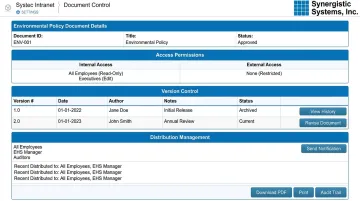
ISO 14001 requires the environmental policy to be maintained as documented information—a written, controlled document with a version number, approval signature, and effective date. Verbal guidance does not satisfy this requirement.
Two Communication Audiences
Internal: All employees and contractors whose work can affect environmental performance must be aware of the policy and understand how their role connects to it. Clause 7.3 makes this explicit—awareness is a requirement, not a nice-to-have.
External: The policy must be made available to any interested party who requests it. Unlike most business documents, the environmental policy is specifically intended to be public-facing.
Two practical steps cover both obligations:
- Publish the policy on your company website so it's accessible without a formal request
- Include it in supplier and contractor onboarding materials, where procurement partners increasingly expect documented proof of environmental commitment
Synergistic Systems' cloud-based QMS intranet manages document control for the environmental policy, including access permissions that separate internal distribution from external availability — all within the same controlled system the organization already uses for its broader management system.
Common Mistakes to Avoid
Mistake 1 — Using a Generic Template Without Customization
Downloading a policy from the internet and submitting it with only the company name changed will draw an audit finding. Auditors are experienced at recognizing boilerplate, and they will probe whether the policy reflects the organization's actual environmental aspects. The policy must be appropriate to your organization specifically—not to a hypothetical organization in your industry.
Mistake 2 — Embedding Objectives and Targets Inside the Policy
Organizations frequently make their policy too detailed by including specific reduction targets—"reduce water consumption by 15%," "achieve zero landfill waste by 2026." Those belong in a separate objectives and targets document under Clause 6.2. The policy only commits to the framework of setting objectives, not to the objectives themselves.
Mistake 3 — Treating the Policy as a One-Time Document
Many organizations write a policy, achieve certification, and never revisit it. When the organization's scope, activities, or regulatory environment changes, an outdated policy becomes a nonconformance.
ISO 14001 Clause 9.3 requires management review at planned intervals — and the policy is part of that review. Build a recurring schedule for it rather than waiting for an auditor to flag the gap.
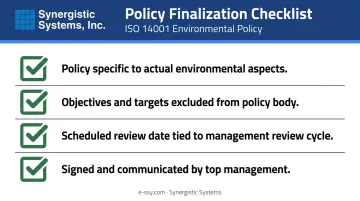
A quick checklist before finalizing your policy:
- Confirms the policy is specific to your organization's actual environmental aspects
- Keeps objectives and targets out of the policy body (those go in Clause 6.2 documents)
- Includes a scheduled review date tied to your management review cycle
- Has been signed and communicated by top management
Frequently Asked Questions
What is the difference between an environmental policy and environmental objectives?
The policy sets high-level commitments and direction. Environmental objectives are the specific, measurable goals that flow from those commitments — concrete targets with defined timelines. Objectives are documented separately under Clause 6.2 and must be traceable back to the policy's commitments.
Who is responsible for creating the ISO 14001 environmental policy?
Top management is responsible for establishing, implementing, and maintaining the policy, and must sign it. An EMS coordinator or consultant may draft the document, but Clause 5.2 requires genuine leadership ownership — a policy without meaningful top-management review is a common audit finding.
How long should an ISO 14001 environmental policy be?
One page is the target—almost never more than two. Policies that run longer have typically drifted into operational territory, incorporating procedures, objectives, or work instructions that belong in separate documents.
Does the environmental policy need to be publicly available?
Yes. ISO 14001 requires the policy to be available to interested parties—customers, regulators, suppliers, community members—who request it. Publishing it on the company website or including it in procurement documentation covers this requirement.
How often should an environmental policy be reviewed and updated?
At minimum during the management review process (Clause 9.3), which must occur at planned intervals. Review it sooner if the organization's context, scope, environmental aspects, or compliance obligations change significantly.
Can one policy document cover both ISO 14001 and ISO 45001 requirements?
Yes. Integrated EHS policies covering both ISO 14001 and ISO 45001 are common and fully acceptable — both standards share the same Annex SL structure. The combined document must address every required commitment from each standard's Clause 5.2; neither set of requirements can be skipped.