Introduction
Factories face mounting pressure from regulators, customers, and supply chains to demonstrate credible environmental management — not just good intentions. Yet many manufacturers treat ISO 14001 as a paperwork exercise, miss the gap assessment entirely, or run out of steam before reaching certification.
This guide is written for factory managers, EHS leads, and quality professionals who need a clear, sequential path from no system to certified. Whether you're responding to a customer requirement, preparing for an EPA compliance review, or building an Environmental Management System (EMS) from scratch, the steps below follow the Plan-Do-Check-Act structure the standard requires.
A note on the current standard: The active edition is ISO 14001:2015. ISO periodically revises its standards, so confirm the latest published version at ISO.org before beginning your implementation — particularly if a new edition has been published since this guide was written.
TL;DR
- ISO 14001 provides a structured EMS framework built on the PDCA cycle, designed for continuous improvement rather than one-time compliance
- Implementation runs: leadership commitment → gap assessment → scope and policy → documentation → training → monitoring → internal audits → certification
- Most factories reach certification in 6–18 months, depending on size and operational complexity
- The two-stage certification audit tests whether documented procedures are actually being followed on the floor
- Integrating ISO 14001 onto an existing ISO 9001 foundation can cut implementation cost by 40–60%
What Is ISO 14001 and How Does It Apply to Factories?
ISO 14001 is the internationally recognized standard for Environmental Management Systems. It gives organizations a framework to identify, control, and improve their environmental impacts — without mandating specific performance thresholds. More than 670,000 organizations worldwide hold ISO 14001 certification, making it the dominant EMS framework globally.
The PDCA Engine Underneath the Standard
The standard is built on the Plan-Do-Check-Act cycle, as the EPA describes it: commit to policy, plan objectives, implement actions, evaluate performance, review results, repeat. That structure is what makes ISO 14001 a continuous improvement system rather than a one-time compliance exercise. Certification marks the beginning of the cycle — not the end of it.
How It Differs from Regulatory Frameworks
ISO 14001 is voluntary — no law requires it. But that distinction is narrowing fast. The standard sits alongside, not instead of, EPA regulations, Clean Water Act permits, and state environmental requirements. Your factory still needs to comply with all applicable law. ISO 14001 provides the management structure to identify those obligations, track compliance, and respond when conditions change.
ISO standards are reviewed on a roughly five-year cycle. Factories implementing ISO 14001 today should monitor ISO's update schedule and build their EMS with enough flexibility to absorb future revisions — particularly around climate-related impacts and resource efficiency.
Why ISO 14001 Matters for Manufacturing Operations
Regulatory and Liability Exposure
Environmental enforcement carries real financial consequences. EPA FY2025 enforcement results show over $1.2 billion in civil penalties and criminal fines across 2,127 civil enforcement cases, plus $6.4 billion in commitments from facilities to return to compliance. Individual enforcement actions against manufacturers have reached nine-figure penalties for Clean Air Act and emissions violations.
ISO 14001 doesn't guarantee regulatory compliance, but it forces the systematic identification of applicable legal obligations and creates documented evidence that the factory is actively managing them.
Operational Cost Reduction
An EMS compels factories to look hard at energy, water, raw materials, and waste — often for the first time systematically. The returns can be substantial. An EPA-backed EMS demonstration project found that Hach Company, a chemical manufacturing business, reduced waste-disposal costs by 70% in a single year after implementing an ISO 14001-oriented EMS.
Key operational areas where factories typically find savings:
- Reduce waste streams through better segregation and disposal procedures
- Lower energy consumption per unit of production through active monitoring and output targets
- Cut water usage in cooling, rinsing, and processing by tracking consumption against baselines
- Minimize chemical handling losses through tighter inventory tracking and dosing controls
Supply Chain Access
Major OEMs now treat ISO 14001 as a supplier qualification requirement. Ford requires all Tier 1 manufacturing and assembly suppliers to maintain ISO 14001 certification through an accredited third-party registrar. Boeing's supplier code of conduct expects suppliers to establish an appropriate EMS — ISO 14001 or equivalent.
For manufacturers in the Dallas Metroplex, Gulf Coast, and Northwest Arkansas corridors — the regions Synergistic Systems serves — these requirements flow down through automotive, aerospace, energy, and defense supply chains. A missing certification can disqualify a facility from bidding on contracts before price or capability ever enters the conversation.
ISO 14001 Implementation Steps for Factories
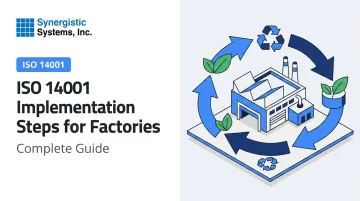
Implementation typically takes 6–24 months depending on factory size, process complexity, and the maturity of existing environmental controls. The steps below follow the PDCA structure required by the standard.
Step 1: Secure Leadership Commitment and Conduct a Gap Assessment
Nothing else works without this. Without documented management commitment, no budget gets allocated, no accountability structure exists, and the EMS never becomes operational.
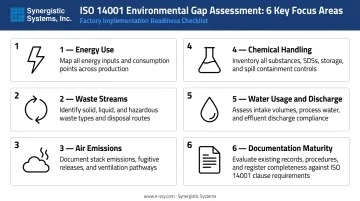
The gap assessment compares current factory operations against ISO 14001 requirements. A thorough assessment covers:
- Energy use — consumption data, metering, and reporting gaps
- Waste streams — types, volumes, disposal methods, and manifest documentation
- Air emissions — point sources, permit status, and monitoring records
- Chemical handling — storage, labeling, SDS availability, and spill response
- Water usage and discharge — permits, monitoring, and treatment processes
- Documentation maturity — what procedures exist and whether they're followed
The output is a prioritized list of gaps that drives the rest of the project plan. Factories that skip this step often discover compliance gaps late in implementation — at substantial rework cost.
Step 2: Define EMS Scope and Identify Legal Requirements
Scope definition determines which facilities, production lines, processes, and activities fall under the EMS. For multi-site or multi-line factories, this requires deliberate planning. Setting scope too narrow leaves real environmental impacts outside the system; setting it too broad creates unmanageable obligations.
Once scope is defined, the factory must build and maintain a compliance obligations register — ISO 14001's term for what practitioners often call a legal register. For a US factory, this maps:
- Applicable federal EPA regulations (Clean Air Act, Clean Water Act, RCRA)
- State and local environmental permits and requirements
- Voluntary commitments the factory has made
- Evaluation frequency and retained records for each obligation
This register isn't a one-time document. It requires regular review as regulations change and factory operations evolve.
Step 3: Develop Environmental Policy and Set Measurable Objectives
The environmental policy is a leadership-signed commitment document that must be communicated to all personnel. Under ISO 14001, it must explicitly include commitments to:
- Compliance with legal and other obligations
- Prevention of pollution
- Continual improvement of the EMS
Objectives must connect directly to the significant environmental aspects identified in the gap assessment. ISO 14001 Clause 6.2 requires objectives to align with the environmental policy, account for significant aspects and compliance obligations, and be monitorable.
Vague objective: "Improve environmental performance"
Compliant objective: "Reduce hazardous waste from Line 3 by 10% by December 31 — assigned to EHS Manager, tracked monthly via waste manifests"
The difference matters. Certification auditors will probe whether objectives are measurable, assigned, and connected to real environmental impacts.
Step 4: Document the EMS and Implement Operational Controls
ISO 14001 Clause 7.5 requires specific documented information. For a factory, that includes:
- EMS scope document
- Environmental policy
- Environmental aspects register (significant aspects and their impacts)
- Compliance obligations register
- Environmental objectives and programs
- Operational procedures for processes with significant environmental aspects
- Emergency response plans
- Monitoring and measurement records
Operational controls are the day-to-day procedures that translate policy into floor-level action: chemical handling protocols, waste segregation and disposal processes, energy management procedures, and preventive maintenance schedules. These must reflect how the factory actually operates — not an idealized version of it.
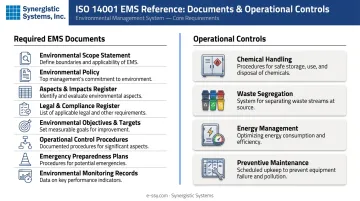
A modular documentation approach — adapting proven EMS document structures to the specific factory rather than building from scratch — cuts weeks off this phase without sacrificing compliance integrity.
Step 5: Train All Personnel and Build Environmental Awareness
ISO 14001 requires competence and awareness at every level. Floor operators who handle chemicals, sort waste, or run energy-intensive equipment have direct influence over the factory's significant environmental aspects. They can't manage what they don't understand.
An effective factory training program covers:
- The factory's significant environmental aspects relevant to each job function
- Roles and responsibilities within the EMS
- Emergency procedures and spill response
- Consequences of deviation from operational controls
Formal competence training must be documented and verified — records showing who was trained, on what, and when. This is distinct from general awareness communication (toolbox talks, visual postings on the factory floor), which maintains ongoing awareness but doesn't substitute for documented role-specific training.
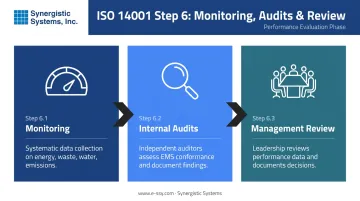
Step 6: Monitor Performance, Run Internal Audits, and Conduct Management Review
With training in place, the EMS shifts from setup to active operation — and that requires systematic performance tracking.
Monitoring means collecting regular data on key environmental metrics — energy consumption per unit, waste tonnage by stream, water usage, emissions — and linking that data back to objectives. Informal observation doesn't satisfy Clause 9.1.2.
The data collection must be systematic, assigned to responsible parties, and retained as records.
Internal audits are a formal ISO 14001 requirement. They assess whether the EMS is being followed and whether it is achieving its objectives. Effective internal audits require:
- Trained auditors who are independent of the area being audited
- Documented audit findings, including nonconformances
- Corrective actions addressed and closed before the certification audit
Management review is a formal meeting where senior leadership reviews EMS performance data, internal audit results, changes in legal requirements, and external factors — then makes documented decisions about resources, objectives, and system direction.
This isn't an informal check-in. It produces documented outputs that demonstrate leadership engagement to the certification auditor.
What to Expect During the ISO 14001 Certification Audit
Stage 1: Documentation Review
The certification body reviews all EMS documentation to verify the system meets ISO 14001 requirements on paper. Nonconformances found here must be corrected before Stage 2 can proceed.
Common Stage 1 findings include:
- Incomplete environmental aspects identification
- Missing compliance obligations documentation
- Gaps in the operational control framework
Registrar selection matters more than most factories realize. Having worked with registrars including ABS Quality Evaluations, DNV, Bureau Veritas, LRQA, BSI, and NQA, Synergistic Systems helps clients choose based on industry sector experience, not cost alone.
Stage 2: On-Site Operational Audit
Auditors visit the factory floor, interview workers at all levels, and review records collected during EMS operation. This stage verifies that documented procedures are actually being followed and that the EMS is producing real, measurable results.
Auditors specifically probe the gap between documentation and practice. A procedure describing proper waste segregation means nothing if the factory floor shows bins mixed with the wrong materials.
Post-Certification Requirements
Certification is a three-year cycle, not a permanent status:
- Annual surveillance audits — typically within 12 months of initial certification
- Recertification audit at the end of the three-year cycle
- Ongoing continual improvement — auditors look for evidence that the EMS is evolving, not static
Common ISO 14001 Implementation Mistakes Factories Make
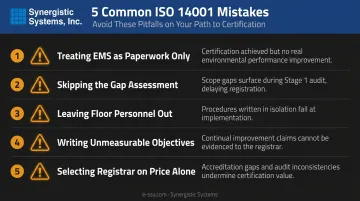
Five patterns consistently trip up factories during ISO 14001 implementation — and each one shows up in certification audits as a nonconformance.
- Treating the EMS as a documentation exercise. Auditors are trained to probe the gap between procedures and actual floor behavior. If the documents say one thing and the shop floor shows another, that's a finding.
- Skipping the gap assessment. Factories that bypass a thorough baseline review hit compliance gaps late in implementation — when rework is expensive and timelines are already compressed.
- Leaving floor-level personnel out. Operators handling chemicals, managing waste, or running energy-intensive equipment are the people generating your environmental aspects. ISO 14001 requires their awareness and participation, not just the EHS team's.
- Writing objectives that can't be measured. "Improve environmental performance" won't survive a certification audit. A compliant objective names the metric, sets a target, assigns an owner, and defines a monitoring method — and it must tie directly to a significant environmental aspect.
- Selecting a registrar on price alone. Auditor familiarity with your industry sector shapes audit scope and ongoing surveillance relevance. A registrar with no background in chemical processing or heavy manufacturing may miss the risks that actually matter to your operation.
Frequently Asked Questions
What are the steps to ISO 14001 implementation?
Implementation follows this sequence: leadership commitment and gap assessment, EMS scope definition and compliance obligations register, environmental policy and measurable objectives, documentation and operational controls, personnel training, monitoring and internal audits, management review, and the two-stage certification audit. Most factories take 9–18 months from start to initial certification.
What is ISO 14001 in manufacturing?
ISO 14001 is an international standard that helps manufacturing facilities build a structured EMS to control emissions, waste, energy use, and environmental risk. It demonstrates to customers, regulators, and supply chain partners that the factory manages environmental impacts through a structured, documented system — not on an ad hoc basis.
What are common ISO 14001 mistakes?
The most damaging factory-specific mistakes include:
- Treating the EMS as a paperwork exercise without changing floor behavior
- Skipping a thorough gap assessment before implementation begins
- Failing to involve shop floor employees who directly handle environmental aspects
- Setting vague objectives that can't be measured or tied to real impacts
Is ISO 14001 being updated in 2026?
ISO 14001:2026 was published on April 15, 2026, replacing ISO 14001:2015. The update adds clearer structure and stronger alignment with climate change, biodiversity, and resource efficiency. Organizations certified to the 2015 standard have until April 15, 2029 to transition — verify current requirements with your certification body or at ISO.org.
How long does ISO 14001 implementation take for a factory?
Most mid-sized manufacturing facilities complete implementation and achieve initial certification within 9–18 months. The full range is 6–24 months depending on factory size, process complexity, number of environmental aspects, and how mature existing environmental controls already are.
How does ISO 14001 integrate with ISO 9001 in a factory setting?
ISO 14001 and ISO 9001 share a common high-level structure, so factories can align documentation, internal audits, management reviews, and corrective actions across both — running one combined audit cycle instead of two parallel systems. This integrated approach typically cuts ISO 14001 implementation cost by 40–60% compared to building a standalone EMS.