Introduction
If you're an EMS coordinator, quality manager, or environmental officer, you've probably seen internal audits treated as a compliance checkbox — something to finish before the registrar arrives, not something that actually strengthens your system. It's also how Stage 2 audits expose gaps you thought were closed.
An ISO 14001 internal audit is a structured, organization-led review that verifies whether your Environmental Management System (EMS) conforms to ISO 14001:2015 requirements and is being effectively implemented and maintained.
This article covers:
- What the ISO 14001 internal audit process actually involves
- How to build a compliant audit program
- What your checklist should address
- Three structural mistakes that consistently undermine otherwise solid EMS implementations
TL;DR
- Clause 9.2 requires internal audits at planned intervals to verify EMS conformance and effective implementation
- The audit program must document frequency, methods, responsibilities, and planning requirements — and must follow a risk-based approach
- Auditors must be objective and impartial — they cannot audit their own work areas
- The checklist should cover all certifiable "shall" requirements across Clauses 4 through 10
- Findings must be documented, reported to management, and fed into corrective action and management review
What Is an ISO 14001 Internal Audit?
Per Clause 9.2.1 of ISO 14001:2015, internal audits must provide information on two things:
- Whether the EMS conforms to the organization's own requirements and to ISO 14001:2015
- Whether the EMS is effectively implemented and maintained
That dual-criteria structure has a practical implication: you're not just confirming that procedures exist — you're verifying whether they're working in practice.
Both criteria apply equally, which shapes what auditors examine and how findings get documented. The structure also draws a clear line between internal and external audit roles.
Internal vs. External Audits
These are distinct exercises:
- Internal audits are first-party reviews, self-initiated and ongoing, conducted within your organization
- External certification audits are third-party reviews conducted by an accredited registrar during Stage 1, Stage 2, surveillance, and recertification cycles
The relationship between them is direct: well-executed internal audits are what make certification audits go smoothly. External auditors review your internal audit records as part of their Stage 1 assessment — gaps there signal larger system problems.
The Role of Management Review
The internal audit's job is to provide information, not to determine overall EMS effectiveness. That determination happens during management review (Clause 9.3), where audit results are a required input and where leadership formally draws conclusions about suitability, adequacy, and effectiveness. In practice, this means audit reports document findings and evidence — they don't declare the EMS effective or ineffective. That verdict belongs to the management review.
How the ISO 14001 Internal Audit Process Works
The process runs end-to-end in five stages. Every stage produces documented evidence required by Clause 9.2.2.
Step 1: Plan the Audit Schedule
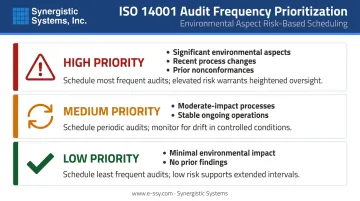
The audit program must document which processes will be audited, when, by whom, and how often. Frequency must be risk-based — areas with significant environmental aspects, recent process changes, or previous nonconformances get audited more often than low-impact, stable processes.
Per Clause 9.2.2, the program must account for:
- Environmental importance of the processes involved
- Changes affecting the organization
- Results of previous audits
A rolling 12-month schedule is the practical minimum for most organizations.
Step 2: Prepare for the Audit
Before stepping into any process area:
- Assign impartial auditors (not responsible for the area being audited)
- Review previous audit reports and any open corrective actions
- Pull relevant documented information: environmental policy, aspects register, compliance obligations register, monitoring records
- Prepare a checklist tailored to the scope of this specific audit
Auditors who arrive without reviewing prior findings miss recurring patterns — and recurring patterns are where systemic nonconformities hide.
Step 3: Conduct the Audit
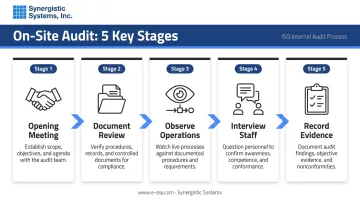
On-site activities follow a consistent sequence:
- Open with a brief meeting to confirm scope, criteria, and logistics with the auditee
- Review controlled documents to verify they are current and accessible
- Observe actual operations — not just what the procedures say should happen
- Interview staff at all levels, not just supervisors
- Record objective evidence against each checklist item as you go
A process-approach audit traces inputs and outputs of each process area. Typical time per area: 1–3 hours depending on complexity.
Step 4: Document Findings
Every finding needs objective evidence. Record:
- Conformances — where requirements are met with evidence
- Nonconformities — where requirements aren't met, classified by severity (major or minor per your registrar's conformity assessment conventions)
- Observations — potential issues that don't yet constitute a nonconformity
- Opportunities for improvement — optional, but useful for demonstrating continual improvement at the management review
Clause 9.2.2 requires retaining documented information as evidence of both audit program implementation and audit results. Audit schedules alone don't satisfy this requirement.
Step 5: Report Results and Initiate Follow-Up
Once findings are documented, the lead auditor prepares the audit report and presents results to relevant management. Those results trigger specific obligations:
- Nonconformities trigger a formal corrective action process under Clause 10.2 — root cause analysis, action plan, and verification of effectiveness
- Audit results become a required input to the next management review (Clause 9.3)
- The audit program itself should be updated if findings reveal new risk areas
Building Your ISO 14001 Internal Audit Program
The audit program is a living document, not a one-time setup. Clause 9.2.2 specifies what it must contain:
| Program Element | What It Must Address |
|---|---|
| Frequency | How often each process area is audited |
| Methods | How audits are conducted (document review, interview, observation) |
| Responsibilities | Who conducts which audits |
| Planning requirements | How individual audits are prepared |
| Reporting requirements | How results are communicated and retained |
Risk-Based Prioritization
Use your Environmental Aspects Register as the foundation for scheduling. Processes involving significant environmental aspects — waste handling, emissions, chemical storage, effluent discharge — deserve higher audit frequency. The same applies to recently changed processes, new facilities, and any area with prior nonconformances.
Clause 9.2.2 explicitly requires the program to account for environmental importance, organizational changes, and previous audit results.
Managing Auditor Independence
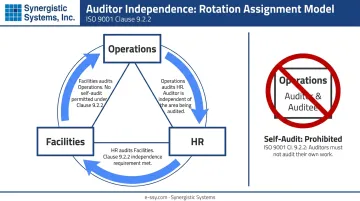
Clause 9.2.2 requires auditors to ensure objectivity and impartiality — meaning they cannot audit their own work areas. For small teams, this creates a practical challenge. Common solutions:
- Rotate audit assignments across departments: operations audits HR, HR audits facilities, facilities audits operations
- Prevent the same auditor from covering the same area in consecutive cycles
- Bring in an external consultant for areas where internal independence is hard to maintain
Synergistic Systems supports ISO 14001 clients with audit program design, internal auditor training, and a cloud-based intranet that centralizes audit schedules, checklists, findings, corrective actions, and reports in one place.
Documentation Retention
Both the audit program and individual audit results must be retained as documented information. That means keeping:
- The master audit schedule
- Individual audit plans
- Completed checklists
- Audit reports
- Linked corrective action records
Align retention periods with your certification cycle — most organizations keep records through at least one full recertification cycle.
ISO 14001 Internal Audit Checklist: Key Areas to Cover
The checklist below translates ISO 14001:2015's certifiable "shall" requirements into specific, evidence-seeking questions, grouped by clause so auditors can work systematically through the standard.
Clauses 4–5: Context and Leadership
- Are internal and external issues identified, documented, and current?
- Are interested parties and their relevant requirements documented?
- Is the EMS scope defined and appropriate?
- Is the environmental policy documented, communicated, and understood at all levels?
- Does top management demonstrate active leadership of the EMS?
Clause 6: Planning
- Are significant environmental aspects and impacts identified, assessed, and updated?
- Is the compliance obligations register current and accessible to relevant personnel?
- Are environmental objectives established, measurable, and linked to action plans with assigned owners and timelines?
Clauses 7–8: Support and Operations
- Are personnel with environmental responsibilities competent, with training records retained?
- Is documented information controlled, versioned, and accessible?
- Are operational controls in place for significant environmental aspects?
- Has emergency preparedness and response been tested, and are records retained?
Clauses 9–10: Performance and Improvement
- Is monitoring and measurement being conducted as planned, with records retained?
- Are compliance evaluations being performed at defined intervals?
- When nonconformities occur, is Clause 10.2 corrective action being followed: root cause analysis completed, action plans assigned, and effectiveness verified?
- Are improvement actions tracked and closed out?
Common Mistakes in ISO 14001 Internal Auditing
Treating It as a Paperwork Exercise
The most common structural failure: auditing documented procedures without observing actual operations. Clause 9.2.1 requires information on whether the EMS is effectively implemented and maintained — not just whether procedures exist on paper. An audit that only reviews documents misses this entirely. Process observation and staff interviews are not optional.
Auditor Independence Failures
Allowing personnel to audit their own processes invalidates the objectivity requirement in Clause 9.2.2. External certification auditors look specifically at auditor assignment records. If your audit program doesn't clearly demonstrate impartial assignments — with auditors documented as independent of the areas they reviewed — expect this raised as a nonconformity during Stage 1 or Stage 2.
Program Stagnation
Auditing the same processes at the same frequency, year after year, without adjusting for new risks or prior outcomes is a gap external auditors consistently flag. Clause 9.2.2 requires the program to account for:
- Environmental importance of the processes involved
- Organizational changes that affect environmental risk
- Results from previous internal audits
A program unchanged over multiple audit cycles signals to a registrar that it isn't being actively maintained — which is a nonconformity, not just a recommendation.
Frequently Asked Questions
What is an ISO 14001 internal audit?
An ISO 14001 internal audit is a planned, systematic review conducted by the organization to verify whether its EMS conforms to ISO 14001:2015 requirements and is being effectively implemented and maintained. It is distinct from the external certification audit conducted by an accredited third-party registrar.
What should an ISO 14001 internal audit checklist include?
The checklist should address the certifiable "shall" requirements across all relevant clauses of ISO 14001:2015 — from context, leadership, and planning through support, operations, performance evaluation, and improvement. Each item should be phrased as an evidence-seeking question, not a yes/no checkbox.
What should an ISO 14001 internal audit report include?
The report must document audit scope and criteria, auditor names, areas reviewed, findings (conformances, nonconformities, and observations), and corrective actions required. Distribute it to relevant management and retain it as documented information per Clause 9.2.2.
How often should ISO 14001 internal audits be conducted?
ISO 14001:2015 requires audits at "planned intervals" without specifying a fixed frequency. Most organizations cover their full EMS at least annually, with higher-risk processes or areas with prior nonconformances audited more frequently as part of a risk-based program.
Who can conduct an ISO 14001 internal audit?
Internal auditors must be competent in ISO 14001 requirements and audit techniques, and impartial — meaning they cannot audit work areas where they hold direct responsibility. Organizations with small teams often bring in external consultants to satisfy the independence requirement.
How does the internal audit connect to ISO 14001 certification?
A documented, risk-based audit program with completed reports and corrective action records is reviewed by the certifying body during Stage 1 and Stage 2 audits. An incomplete or weak internal audit record is one of the most common reasons organizations encounter major nonconformities during their certification audit. It signals to the registrar that the EMS isn't being maintained between external visits.