Here's the short version: a surveillance audit is a mandatory periodic external review — conducted by your accredited certification body — to confirm your Environmental Management System (EMS) is still active, effective, and conforming to requirements. It is not a repeat of your initial certification audit. It is narrower, shorter, and focused on sampled areas rather than the full system.
Understanding what the auditor actually does, and what they specifically look for, is what separates organizations that find these visits routine from those that scramble every time one approaches.
TL;DR
- Surveillance audits are mandatory annual checks in Years 1 and 2 of the three-year certification cycle — skipping one puts your certificate at risk
- Auditors sample key processes rather than reviewing the entire EMS
- Auditors focus on your aspects and impacts register, legal compliance evaluation, objectives progress, internal audits, management review, and open corrective actions
- Duration is shorter than your initial certification audit, scaled to organization size, environmental footprint, and number of sites
- Keeping records current and internal audits on schedule makes surveillance visits routine rather than stressful
What Is an ISO 14001 Surveillance Audit?
A surveillance audit is a formal external audit conducted by your accredited certification body — the same registrar (BSI, DNV, NQA, Bureau Veritas, LRQA, or whoever issued your certificate) that performed your original Stage 1 and Stage 2 certification audits.
ISO/IEC 17021-1:2015, Section 9 sets the governing rule: surveillance audits must occur at least once per calendar year, except in recertification years. The first surveillance must take place within 12 months of your certification decision date. Miss that window, and you risk certificate suspension.
How It Fits into the Three-Year Cycle
The certification cycle follows a consistent structure:
- Initial certification — Stage 1 (document review) followed by Stage 2 (on-site audit)
- Year 1 — First surveillance audit
- Year 2 — Second surveillance audit
- Year 3 — Recertification audit before certificate expiry
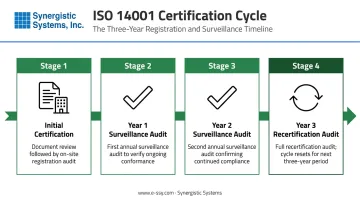
Each of those years involves a different level of scrutiny. Surveillance audits are on-site visits, but they are not full system audits. The recertification audit in Year 3 is a comprehensive review comparable in depth to the original Stage 2, covering the entire management system. Surveillance audits are narrower: they confirm the EMS has not lapsed, that conformity is being maintained, and that continual improvement is ongoing.
Put simply, recertification re-examines the whole house; surveillance checks whether the doors are still locked and the lights are on.
What Happens During an ISO 14001 Surveillance Audit
The visit follows a consistent structure across certification bodies — here's how a typical audit day unfolds.
Opening Meeting
The auditor opens with a formal meeting — usually 30–60 minutes — covering:
- Confirmation of audit scope and objectives for this visit
- Which processes or clauses will be examined
- Any outstanding findings from the previous audit
- Schedule for the day and which staff should be available
Make sure the right people are present. The EMS manager needs to be there, and operational supervisors for any areas being audited should be on standby.
Audit Execution
Evidence gathering uses three methods:
- Document and record review — environmental aspects register, legal compliance records, objectives data, training logs, internal audit reports, and corrective action records
- Process observation — the auditor walks the floor to confirm that documented procedures are actually being followed in practice, not just written down
- Staff interviews — conversations with employees at various levels to verify they understand their environmental responsibilities and the procedures they follow
Throughout this process, auditors use sampling. They do not examine every record or observe every process — they select a representative cross-section. This is why gaps tend to surface: a sampled record that happens to be incomplete stands out immediately.
Closing Meeting
At the end of the visit, the auditor presents findings categorized as:
| Finding Type | What It Means |
|---|---|
| Opportunity for Improvement | A suggestion — no formal response required, but useful input |
| Minor Non-conformity | A lapse that requires a corrective action plan; must be resolved before the next visit |
| Major Non-conformity | A significant failure that requires prompt corrective action and may trigger a follow-up audit |
The auditor also confirms the expected date and scope of the next visit, and a formal written audit report follows within an agreed timeframe.
What the Auditor Reviews: ISO 14001-Specific Focus Areas
Surveillance audits sample rather than cover everything, but certain areas appear at virtually every visit. ISO/IEC 17021-1 defines what surveillance activities must include — and for ISO 14001, several elements are standard targets regardless of which registrar conducts the audit.
Environmental Aspects and Impacts Register
The auditor will check that your aspects and impacts register is current and reflects any changes to operations, products, services, or organizational context since the last audit. A register that hasn't been touched in 18 months — despite operational changes — is a common trigger for findings.
Legal Compliance Evaluation
Organizations must maintain an updated register of applicable environmental legal obligations and provide evidence that compliance has been evaluated. A register listing obligations without evaluation records won't hold up — auditors want to see that the assessment occurred, documented and dated.
Environmental Objectives and Performance Data
Progress against environmental objectives is a standard focus area. Auditors look for:
- Measurable data showing movement toward stated goals
- KPIs and performance tracking records
- Evidence that objectives are being actively managed, not just listed in a document
If an objective has no supporting data, expect the auditor to ask who owns it and what's being done — have a clear answer ready.
Internal Audit and Management Review Records
Per ISO/IEC 17021-1, both internal audits and management reviews are mandatory surveillance review items. Auditors check:
- Internal audits were conducted on schedule
- Findings from internal audits were acted upon
- Management reviews took place and produced documented outputs
Lapsed internal audit programs — where the schedule slipped and audits didn't happen — are among the most frequent non-conformity triggers at surveillance visits.
Corrective Actions from Previous Audits
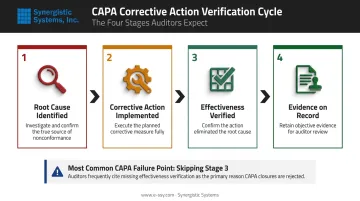
Every corrective action from the previous external audit (and internal audits) is subject to review. The auditor confirms:
- Root causes were identified, not just symptoms corrected
- Corrective actions were actually implemented
- Effectiveness of those actions was verified
Verified effectiveness is the part most organizations skip. Closing a corrective action without evidence that the fix actually worked is one of the clearest signals that your CAPA process needs attention.
How to Prepare for Your ISO 14001 Surveillance Audit
Preparation doesn't need to be complicated. The organizations that struggle at surveillance visits are usually ones whose EMS has drifted since certification — records weren't maintained, internal audits were skipped, corrective actions were half-closed. If your system is genuinely active, preparation is mostly about organizing what already exists.
Step 1: Conduct an Internal Audit First
Run an internal audit before the surveillance visit — covering the same areas an external auditor would check. Identify gaps, lapsed records, or incomplete corrective actions and resolve them before the visit, not during it. This single step removes most surprises.
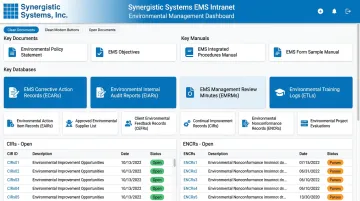
Synergistic Systems provides clients with a cloud-based intranet that keeps corrective actions, internal audit records, management review minutes, and training logs in one place — so this pre-audit review takes hours, not days of hunting through shared drives or paper files.
Step 2: Review the Previous Audit Report
Pull the last external audit report and work through it systematically:
- Confirm every non-conformity has a documented corrective action
- Verify that effectiveness of each corrective action was recorded
- Ensure all evidence is on file and ready to present — not something you'll need to reconstruct on audit day
Step 3: Organize Key Documents and Records
These should be accessible without searching:
- Environmental aspects and impacts register (current)
- Legal compliance register with evaluation evidence
- Environmental objectives progress data and KPIs
- Internal audit reports and schedule
- Management review minutes
- Training and competency records
- Corrective action and non-conformity records
Auditors form immediate impressions based on how readily organizations can produce evidence. If retrieving a document takes 20 minutes, that raises questions about how actively the system is being maintained.
Step 4: Brief Relevant Staff
Employees in operational roles will be interviewed. They don't need to memorize the standard — they need to:
- Explain their own environmental responsibilities in plain language
- Describe the procedures they follow
- Know where the relevant records for their area are kept
When staff use documentation in their actual daily work — not just procedures drafted for audit day — those interviews go smoothly because the answers are already second nature.
What to Expect After the Visit: Outcomes and Misconceptions
Acting on the Audit Report
When the written report arrives, treat it as a working document, not a filing task:
- Assign ownership for each finding immediately
- Set realistic timelines for corrective actions
- Document the plan in your corrective action system
- Track closure and effectiveness verification
Minor non-conformities must be resolved before the next audit visit or they risk escalating to major. Major non-conformities require a documented corrective action plan; left unresolved, they can result in certificate suspension and ultimately withdrawal.
Three Misconceptions Worth Addressing
These three misunderstandings trip up organizations that are otherwise well-prepared:
"Last-minute document preparation is enough." Auditors spend time on-site observing operations and interviewing staff. An EMS that hasn't been actively maintained will surface quickly — a paper system that doesn't reflect actual practice is something auditors spot immediately.
"The auditor covers the same areas every year." Each surveillance visit targets different processes within the certification cycle to ensure all operations are audited over the three-year period. You won't always be reviewed on the same clauses twice.
"Passing a surveillance audit means the EMS is performing well." Surveillance audits sample — they don't verify everything. Passing a visit confirms the sampled areas were conforming on that day. Your internal audit program remains the primary ongoing assurance mechanism between external visits.
Frequently Asked Questions
What is an ISO 14001 surveillance audit?
A mandatory periodic external audit conducted by your accredited certification body in Years 1 and 2 of the three-year certification cycle. It verifies the EMS remains active, effective, and conforming to ISO 14001 requirements — narrower in scope and shorter in duration than the original certification audit.
How often are surveillance audits conducted for ISO 14001?
Most organizations undergo one surveillance audit per year in Years 1 and 2, as required by ISO/IEC 17021-1. Frequency and duration can vary based on organization size, environmental complexity, and number of sites — the specifics are agreed with your certification body.
How do you prepare for an ISO 14001 surveillance audit?
Start with an internal audit and close any open findings from your previous external audit. Then confirm these items are current and accessible before the auditor arrives:
- Aspects register and legal compliance evaluation
- Environmental objectives progress data
- Training logs and internal audit reports
- Briefings for operational staff on their environmental responsibilities
What documents should I have ready for an ISO 14001 surveillance audit?
Have these records current and ready to present:
- Environmental aspects and impacts register
- Legal compliance register with evaluation evidence
- Environmental objectives progress records
- Internal audit reports and management review minutes
- Training and competency records
- Corrective action records
What happens if a non-conformity is found during an ISO 14001 surveillance audit?
Minor non-conformities require a documented corrective action plan and must be resolved before the next visit. Major non-conformities require prompt corrective action and may trigger a follow-up audit. Unresolved major findings can lead to certificate suspension and, ultimately, withdrawal.
How is a surveillance audit different from an ISO 14001 recertification audit?
Surveillance audits are shorter, scope-limited checks on specific EMS areas conducted in Years 1 and 2. The recertification audit in Year 3 is a comprehensive review of the entire management system — comparable in depth to the original Stage 2 certification audit.