Introduction
A test report or calibration certificate is only as good as the credibility behind it. Without independent proof of technical competence, laboratories find their results rejected by regulators, refused by procurement teams, and questioned in litigation — ISO/IEC 17025 accreditation is the recognized solution.
ISO/IEC 17025:2017 is the globally recognized standard defining what testing and calibration laboratories must demonstrate to prove they produce accurate, reliable results. Accreditation to this standard is now a formal requirement under programs run by the FDA, EPA, OSHA, and IATF — and a baseline expectation across aerospace, medical device, food safety, automotive, and environmental sectors.
This guide covers everything laboratory managers and quality leaders need to know: what the standard requires, how it differs from ISO 9001, who needs it, and the step-by-step path to achieving accreditation.
TLDR
- ISO/IEC 17025 accredits labs for technical competence — it goes well beyond ISO 9001's quality management scope
- The 2017 version organizes requirements into 8 clauses; Process Requirements (Section 7) is the operational core
- Personnel competency documentation is one of the most frequently cited nonconformity areas
- The ILAC MRA means accreditation from a U.S. body is accepted across 118 signatory economies
- Most labs take 6 months to 2 years from gap analysis to accreditation
What Is ISO/IEC 17025?
ISO/IEC 17025 is the international standard establishing general requirements for the competence, impartiality, and consistent operation of testing and calibration laboratories. Published jointly by the International Organization for Standardization (ISO) and the International Electrotechnical Commission (IEC), it is the definitive benchmark regulators, customers, and trading partners use to evaluate whether a laboratory's results can be trusted.
A Brief History
The standard has a clear lineage:
- 1990 — ISO/IEC Guide 25 published as the predecessor document
- 1999 — ISO/IEC 17025 formally published as a standalone standard
- 2005 — First major revision (Edition 2)
- 2017 — Current edition (Edition 3), confirmed in a 2023 review
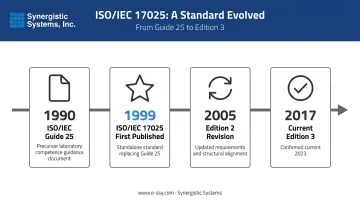
The 2017 update introduced risk-based thinking, reduced prescriptive requirements, and reorganized the content into an 8-clause structure focused on technical outputs rather than procedural inputs.
Accreditation vs. Certification — An Important Distinction
Under ISO 17025, laboratories are accredited, not certified — and those two words are not interchangeable.
- Certification (ISO 9001) — a third-party registrar confirms an organization's quality management system meets a standard
- Accreditation (ISO 17025) — a third-party accreditation body evaluates and formally attests to a laboratory's technical competence within a defined Scope of Accreditation
ANAB states that a laboratory holding only an ISO 9001 certificate is likely not accredited to ISO/IEC 17025. A certificate covers the management system; accreditation covers whether the lab's actual test and calibration results can be trusted.
The Key Requirements of ISO/IEC 17025:2017
The standard is organized into 8 numbered elements. Clauses 1 through 3 cover scope, references, and definitions. The substantive requirements live in Clauses 4 through 8.
General and Structural Requirements (Sections 4–5)
Section 4 addresses impartiality and confidentiality — labs must demonstrate that management actively protects personnel from commercial, financial, or other pressures that could compromise results. Section 5 defines the required organizational structure, including accountability for laboratory activities and communication channels.
These aren't paperwork exercises. Assessors look for evidence that impartiality is genuinely maintained, not just declared in a policy document. That same scrutiny carries into Section 6, where the focus shifts to the resources that make reliable results possible.
Resource Requirements (Section 6)
Section 6 covers the inputs labs need to produce trustworthy results:
- Personnel — Clause 6.2.2 requires documented competence requirements for every function that influences results; Clause 6.2.5 requires formal procedures for selection, training, supervision, authorization, and ongoing monitoring
- Facilities and environment — conditions must be monitored and controlled to the extent they affect results
- Equipment — maintained, calibrated, and fit for intended use
- Measurement traceability — all measurements must be traceable to the International System of Units (SI)
Personnel competency documentation is consistently among the top nonconformity categories cited during assessments. Written job descriptions, competence matrices, and formal authorization records for every role influencing laboratory results are not optional. They are what assessors look for first.
Process Requirements (Section 7)
Section 7 governs how laboratories actually produce results — from method selection through final reporting:
- Review of requests, tenders, and contracts
- Selection, validation, and verification of test and calibration methods
- Sampling and handling of test items
- Technical records and traceability of data
- Evaluation and reporting of measurement uncertainty
- Reporting of results, including conformity statements
- Handling of nonconforming work
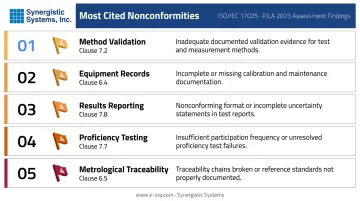
PJLA's 2023 assessment findings identify the most frequently cited problem areas in Section 7:
- Method validation (Clause 7.2)
- Equipment records (Clause 6.4)
- Results reporting (Clause 7.8)
- Proficiency testing (Clause 7.7)
- Metrological traceability (Clause 6.5)
Management System Requirements (Section 8)
Section 8 is where ISO 17025 overlaps most directly with ISO 9001 principles. Labs must maintain:
- Documented quality policies and procedures
- Document and records control
- Internal audit program
- Management review process
- Continual improvement commitment
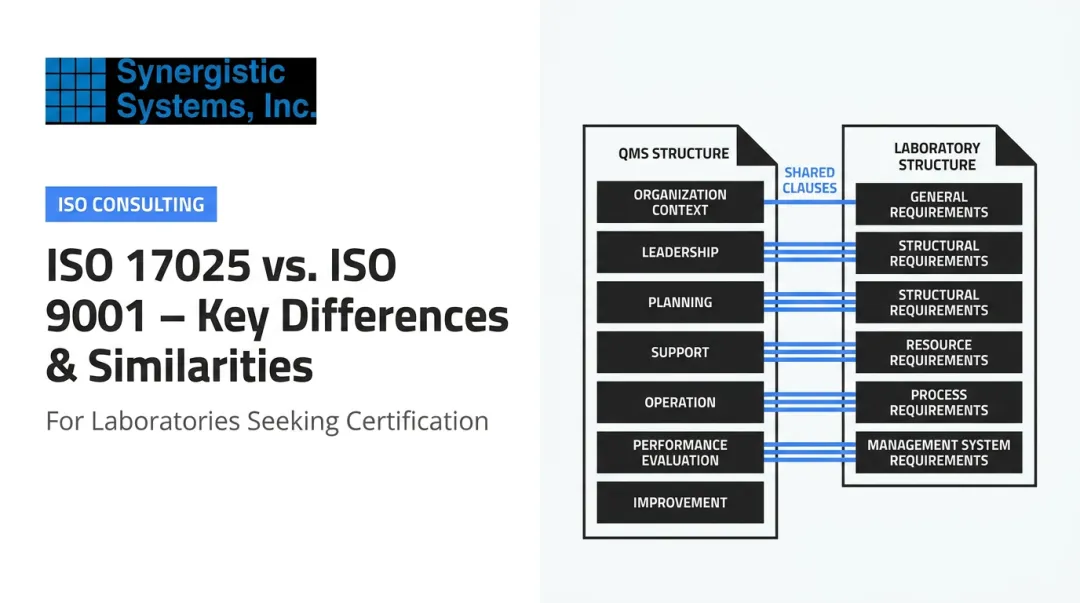
Organizations that already hold ISO 9001 certification will recognize most of Section 8. What they cannot carry over are the technical requirements in Sections 6 and 7, which are specific to laboratory operations and must be built from the ground up.
ISO 17025 vs. ISO 9001: Understanding the Difference
Many quality managers assume ISO 9001 certification gives their laboratory a significant head start toward 17025 accreditation. That's partially true. The gap, however, is wider than most expect.
| Requirement | ISO 9001 | ISO/IEC 17025 |
|---|---|---|
| Scope | Any organization | Testing and calibration labs only |
| Designation | Certified | Accredited |
| QMS framework | ✅ | ✅ (Section 8) |
| Personnel technical authorization | ❌ | ✅ (Clause 6.2.5) |
| Method validation | ❌ | ✅ (Clause 7.2) |
| Measurement traceability to SI | ❌ | ✅ (Clause 6.5) |
| Measurement uncertainty reporting | ❌ | ✅ (Clause 7.8) |
| Proficiency testing | ❌ | ✅ (Clause 7.7) |
ISO 9001 certifies that an organization has a functional quality management system. ISO 17025 certifies that a laboratory's measurement data is technically valid and defensible. The two standards address fundamentally different questions.
A lab with an existing ISO 9001 system has the management system foundation in place — document control, internal audits, management reviews, corrective actions are all familiar territory. That foundation gap is where a structured implementation approach adds the most value. Synergistic Systems structures 17025 engagements for ISO 9001-certified clients as an integrated add-on module, bringing the technical competence requirements directly into the existing QMS:
- Measurement uncertainty — establishing and reporting uncertainty budgets per Clause 7.8
- Calibration traceability — demonstrating SI-traceable reference standards per Clause 6.5
- Proficiency testing — meeting interlaboratory comparison requirements per Clause 7.7
- Method validation — documenting fitness-for-purpose evidence per Clause 7.2
This approach typically reduces implementation costs compared to a standalone 17025 build and allows a single combined internal audit and management review cycle to serve both standards.
Who Needs ISO 17025 Accreditation?
Sectors Where It's Formally Required
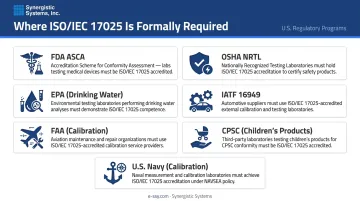
Several U.S. regulatory programs formally reference ISO/IEC 17025 as a condition of acceptance:
- FDA ASCA — accredits testing laboratories using ISO/IEC 17025:2017 for medical device testing
- OSHA NRTL — bases Nationally Recognized Testing Laboratory assessments on ISO/IEC 17025
- EPA drinking water — requires ISO/IEC 17025:2017 compliance for laboratory testing
- IATF 16949 (automotive) — references ISO/IEC 17025 for external laboratory assessments
- FAA — accepts calibrations from ILAC MRA signatory laboratories
- CPSC — requires children's product testing by ISO/IEC 17025-accredited laboratories
- U.S. Navy — accepts calibration accreditations from ILAC-recognized bodies
The International Trade Dimension
Even when accreditation isn't legally mandated, it's increasingly demanded by global supply chains. The ILAC Mutual Recognition Arrangement (MRA) — currently representing 118 signatories across 119 economies — means that test reports and calibration certificates from accredited laboratories are accepted across borders without duplicate testing. For any lab serving international customers, accreditation eliminates the need for costly, time-consuming duplicate testing — removing a real barrier at every cross-border transaction.
How to Achieve ISO 17025 Accreditation: A Step-by-Step Overview
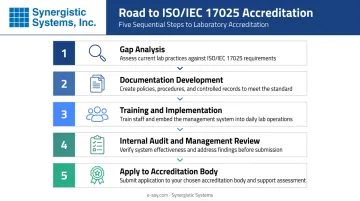
Step 1 — Gap Analysis
Compare the laboratory's current quality system and technical practices against every requirement of ISO/IEC 17025:2017. Document what's missing or deficient across:
- Personnel competence records and authorization documentation
- Equipment calibration and maintenance logs
- Method validation and verification records
- Measurement uncertainty procedures
- Document control and records management
This baseline assessment drives everything that follows.
Step 2 — Documentation Development
Build or update the documentation system to address every gap identified. Core deliverables typically include:
- Laboratory Quality Manual
- Standard Operating Procedures (SOPs) for all technical activities
- Competence records, job descriptions, and authorization logs
- Equipment calibration and maintenance records
- Method validation and measurement uncertainty documentation
- Proficiency testing procedures
Documentation should be practical and embedded in daily operations — not a shelf exercise created to impress an assessor.
Step 3 — Training and Implementation
All personnel whose work influences laboratory results must be trained, authorized for their specific tasks, and actively using the new system. The implementation needs to be fully operational (not just documented) for a meaningful period — typically several months — before applying for accreditation.
Assessors look for evidence of real, sustained use. A system stood up the week before the assessment will not hold up under scrutiny.
Step 4 — Internal Audit and Management Review
Before applying to an accreditation body, labs must complete at least one full internal audit and one management review. These are required records during the body's own assessment — and more practically, they surface any remaining nonconformities while there's still time to correct them. Synergistic Systems conducts the system-wide internal audit and facilitates the management review directly, rather than delegating those activities to unprepared client staff.
Step 5 — Applying to an Accreditation Body
The major U.S. accreditation bodies for ISO/IEC 17025 are:
- A2LA — American Association for Laboratory Accreditation
- ANAB — ANSI National Accreditation Board
- NVLAP — National Voluntary Laboratory Accreditation Program (operated by NIST)
- PJLA — Perry Johnson Laboratory Accreditation
All are ILAC MRA signatories, meaning accreditations they issue are recognized internationally. The process involves a documentation review, an on-site assessment, identification and resolution of any nonconformities, and issuance of accreditation with a defined Scope.
Each of these bodies has its own application requirements and fee structures, so choosing the right one for your lab's scope matters. Synergistic Systems has direct experience with A2LA, ANAB, IAS, PJLA, and L-A-B, and can help laboratories select the right body and manage every step from initial application to accreditation.
Engagements follow a fixed-price methodology with defined deliverables and a clear timetable. The entire quality system is managed through a secure cloud-based intranet — no hardware or software purchase required.
Frequently Asked Questions
What is ISO 17025 in simple terms?
ISO/IEC 17025 is the international standard that defines what a testing or calibration laboratory must do to prove it is technically competent and produces accurate, reliable results. Laboratories that meet its requirements are formally accredited by a recognized third-party body — a step beyond basic certification.
What is the difference between ISO 9001 and ISO 17025?
ISO 9001 addresses an organization's overall quality management system and applies to any industry. ISO 17025 specifically addresses the technical competence of laboratories — including validated methods, measurement traceability to SI units, and personnel authorization. That makes it a more specialized, technically demanding standard for labs producing test and calibration data.
What are the 5 requirements of ISO 17025?
The 2017 version organizes requirements into five practical areas: General and Structural (impartiality, organization), Resource (personnel, equipment, environment), Process (methods, traceability, reporting), Management System, and Impartiality — each verified during the accreditation assessment.
How long does it take to get ISO 17025 accredited?
Most laboratories take between 6 months and 2 years from gap analysis to receiving accreditation, depending on size, complexity, and readiness. Organizations with existing ISO 9001 systems or experienced consulting support typically move through the process faster.
Who accredits laboratories under ISO 17025 in the United States?
The main U.S. accreditation bodies are A2LA, ANAB, NVLAP, and PJLA. All are ILAC MRA signatories, meaning their accreditations are recognized internationally across 118 member economies.
How often must ISO 17025 accreditation be renewed?
Renewal cycles vary by body. PJLA issues 2-year certificates with annual surveillance at the 12-month mark. NVLAP grants initial accreditation for one year, renewable annually, with on-site assessments every two years thereafter.