Getting this wrong has real consequences. Pursuing ISO 9001 when your customers or regulators require ISO 17025 accreditation means failed audits and wasted implementation effort. Assuming your ISO 9001 certification covers your lab's technical requirements leaves gaps that accreditation assessors will find quickly.
This article breaks down both standards clearly: what each requires, where they overlap, where they diverge, and how to decide which path is right for your organization.
TL;DR
- ISO 17025 is the international standard for testing and calibration laboratories — its primary purpose is demonstrating technical competence and producing valid results
- ISO 9001 is a universal Quality Management System standard applicable to any organization in any industry
- Both require document control, corrective actions, internal audits, management reviews, and continual improvement
- ISO 17025 adds technical requirements — method validation, measurement uncertainty, and result validity — that ISO 9001 doesn't address
- ISO 9001 covers organizational requirements — leadership commitments, quality objectives, and strategic context — that fall outside ISO 17025's scope
- Many labs pursue both certifications; ISO 17025 Clause 8.1 Option B is designed for organizations already running an ISO 9001 system
ISO 17025 vs. ISO 9001: At a Glance
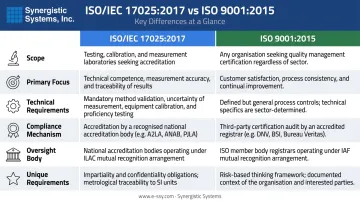
| Dimension | ISO/IEC 17025:2017 | ISO 9001:2015 |
|---|---|---|
| Scope / Who It Applies To | Testing and calibration laboratories only | Any organization, any industry, any size |
| Primary Focus | Technical competence and valid test/calibration results | Customer satisfaction and quality management processes |
| Technical Requirements Depth | Prescriptive — method validation, measurement uncertainty, result reporting formats | General — requires calibrated equipment; doesn't define how |
| Compliance Mechanism | Accreditation by an accreditation body (A2LA, ANAB, NVLAP) | Certification by a third-party registrar |
| Oversight Body Type | Accreditation body performing technical assessment | Certification body (registrar) performing conformance audit |
| Unique Requirements | Impartiality, measurement traceability, uncertainty budgets, sampling procedures | Organizational context, quality policy, quality objectives, organizational knowledge |
These standards are not mutually exclusive. ISO 17025 Clause 8.1 provides two implementation paths, Option A and Option B, specifically to acknowledge the relationship between the two standards. It is the only major ISO management system standard to do so.
What Is ISO 17025?
ISO/IEC 17025:2017 — "General requirements for the competence of testing and calibration laboratories" — is the current third edition of the laboratory standard, published in November 2017 and confirmed in 2023. It applies to laboratories of all sizes across all industries.
The core purpose is specific: ensure laboratories produce technically valid, impartial, and consistent results. Not just that they have good processes — that their actual outputs can be trusted.
The Five Structural Elements
ISO 17025 is built on five requirement areas:
- Clause 4 — General Requirements: Impartiality (freedom from commercial or financial pressures) and confidentiality of client data
- Clause 5 — Structural Requirements: Legal identity, scope of activities, organizational structure
- Clause 6 — Resource Requirements: Personnel competence, equipment, facilities, and metrological traceability
- Clause 7 — Process Requirements: Where the standard becomes uniquely technical (see below)
- Clause 8 — Management System Requirements: Document control, corrective actions, internal audits, management reviews
Clause 7: The Technical Core
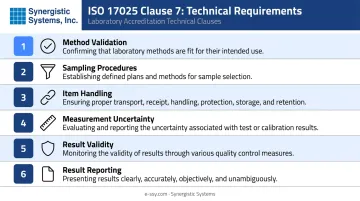
Clause 7 is where ISO 17025 has no equivalent in ISO 9001. Key requirements include:
- Method selection and validation (Clause 7.2): Labs must verify or validate that methods produce results fit for their intended purpose
- Sampling procedures (Clause 7.3): Documented sampling plans with statistical basis where applicable
- Handling of test/calibration items (Clause 7.4): Chain of custody, condition assessment, storage controls
- Measurement uncertainty evaluation (Clause 7.6): Every calibration result must include an uncertainty statement (a quantified range around the reported value)
- Ensuring validity of results (Clause 7.7): Ongoing quality assurance through proficiency testing and reference material checks
- Reporting of results (Clause 7.8): Specific required content for test reports and calibration certificates
Metrological traceability — addressed in Clause 6 under resources — requires that calibration results be linked to national or international measurement standards through a documented, unbroken chain. BIPM VIM 2.41 defines this formally: each link must include a documented uncertainty contribution.
Option A vs. Option B (Clause 8.1)
ISO 17025 offers two paths for satisfying its management system requirements:
- Option A: The lab implements a defined minimum set of management requirements directly within ISO 17025 (document control, records management, risk management, corrective actions, internal audits, management reviews, and improvement)
- Option B: A lab with a functioning ISO 9001 system can use it to satisfy those same management requirements
Option B does not mean ISO 9001 compliance covers all ISO 17025 requirements. Clauses 4 through 7 — impartiality, structural requirements, resources, and all technical process requirements — must still be fully met regardless of which option a lab selects.
Where ISO 17025 Accreditation Is Required
Understanding which path applies to your lab matters most when accreditation itself is mandatory. ISO 17025 is required or strongly expected in several sectors:
- Environmental testing: EPA's National Lead Laboratory Accreditation Program is based on ISO/IEC 17025; the DoD Environmental Laboratory Accreditation Program (32 CFR Part 188) mandates it for definitive environmental data
- Food safety: FDA's LAAF rule incorporates ISO/IEC 17025:2017 and requires accredited labs for specified food testing categories
- Forensic laboratories: ANAB accredits forensic labs to ISO/IEC 17025; the DOJ National Commission on Forensic Science has recommended universal accreditation for forensic service providers
- Calibration services: A2LA is the largest accreditor of calibration labs in the U.S., with NVLAP and ANAB also active
- FDA regulatory laboratories: FDA's own Laboratory Manual of Quality Policies was prepared to meet ISO/IEC 17025:2017 requirements
In some regulated contexts, operating without accreditation disqualifies your results entirely — not just your credibility.
What Is ISO 9001?
ISO 9001:2015 — "Quality management systems — Requirements" — is the fifth edition of the most widely adopted QMS standard globally. According to IAF CertSearch, ISO 9001 has over one million valid certificates worldwide across more than 190 countries. It applies to any organization, regardless of size, industry, or the products and services provided.
The core focus: customer satisfaction through consistent, documented quality management processes.
Seven Quality Management Principles
ISO 9001:2015 is built on seven quality management principles:
- Customer focus
- Leadership
- Engagement of people
- Process approach
- Improvement
- Evidence-based decision making
- Relationship management
These principles translate operationally into a documented, auditable system that drives predictable outcomes. Any customer, regulator, or supply chain partner can assess an organization's performance against a recognized international benchmark.
What the 2015 Revision Added
Several clauses in ISO 9001:2015 go beyond anything ISO 17025 requires:
- Clause 4 — Context of the Organization: Identifying internal and external issues, and understanding the needs of interested parties
- Clause 5 — Leadership: Explicit top management commitments, a quality policy, and defined organizational roles
- Clause 6 — Planning: Quality objectives, risk-based thinking applied across the whole organization
- Clause 7 — Support: Organizational knowledge — capturing and retaining what the organization knows — treated as a managed resource
ISO 9001 does require that measuring equipment be calibrated and controlled — but it says nothing about how that calibration must be performed, what constitutes a technically valid result, or how uncertainty must be reported. That gap is precisely where ISO 17025 operates.
That broader scope is also what makes ISO 9001 so widely required outside laboratory environments.
Where ISO 9001 Applies
ISO 9001 is the standard most customers and procurement teams recognize and require from suppliers:
- Manufacturing: Automotive supply chain (often a prerequisite for IATF 16949), aerospace suppliers, contract manufacturers
- Healthcare products: Medical device suppliers, pharmaceutical contract manufacturers
- Government contracting: Many federal procurement requirements reference ISO 9001
- Service industries: Engineering firms, IT services, professional services organizations
Key Similarities and Differences
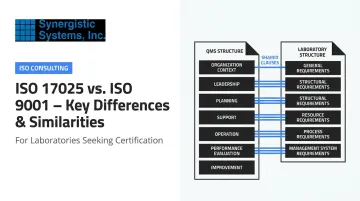
Shared Management System Requirements
Both standards share a common management system foundation. The Joint ISO-ILAC-IAF Communiqué confirms that ISO 17025's management system requirements are written in language relevant to laboratory operations and operate generally in accordance with ISO 9001 principles.
Shared requirements include:
| Requirement | ISO 17025 (Clause 8) | ISO 9001 |
|---|---|---|
| Document control | Clause 8.2 | Clause 7.5 |
| Records control | Clause 8.2 | Clause 7.5 |
| Risk management | Clause 8.5 | Clause 6.1 |
| Corrective actions | Clause 8.7 | Clause 10.2 |
| Internal audits | Clause 8.8 | Clause 9.2 |
| Management reviews | Clause 8.9 | Clause 9.3 |
| Continual improvement | Clause 8.6 | Clause 10.3 |
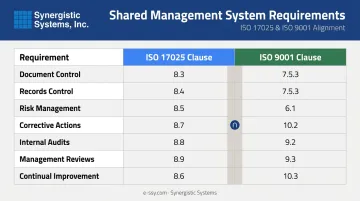
This overlap is exactly why Option B in ISO 17025 exists — and why organizations with ISO 9001 already in place have a head start on the management system side of ISO 17025.
Difference 1 — Scope and Applicability
ISO 9001 is universal — it applies to any organization regardless of type, size, or product. ISO 17025 is scoped exclusively to testing and calibration laboratories.
The practical consequence: a manufacturing company with an in-house test lab may need ISO 9001 for the broader organization and ISO 17025 specifically for the lab function. One standard doesn't replace the other — they address different scopes.
Difference 2 — Technical Depth
ISO 17025 prescribes how laboratory work must be performed. Method validation, uncertainty budgets, result reporting formats, and metrological traceability are all specified requirements. ISO 9001 only requires that measurement processes be controlled and calibrated — it doesn't define what "controlled" means technically.
Metrological traceability makes that difference concrete: every calibration result must be linkable back to a national or international measurement standard (such as NIST in the U.S.) through a documented, unbroken chain of calibrations, each carrying its own stated uncertainty contribution.
Difference 3 — Impartiality and Confidentiality
ISO 17025 requires labs to be demonstrably free from pressures that could compromise technical integrity. ISO 9001 has no equivalent requirement.
The types of pressure ISO 17025 specifically guards against include:
- Commercial pressure — customer demands that could skew reported results
- Financial pressure — revenue incentives tied to specific test outcomes
- Institutional pressure — internal organizational influence over lab decisions
For labs producing results used in regulatory decisions, legal proceedings, or safety determinations, this isn't a procedural detail — it's a foundational credibility requirement.
Difference 4 — What Each Standard Leaves Out
| ISO 17025 does NOT require | ISO 9001 does NOT require |
|---|---|
| Organizational context identification | Measurement uncertainty reporting |
| Formal quality policy from leadership | Method validation |
| Defined quality objectives | Sampling controls |
| Organizational knowledge management | Impartiality structures |
Neither standard is a subset of the other. Organizations operating both a broader business and a laboratory function typically need both — each covering requirements the other doesn't touch.
Which Standard Is Right for Your Organization?
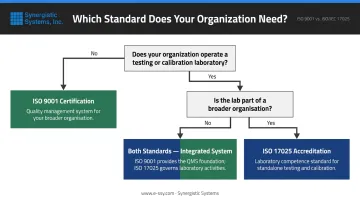
Use this decision guide:
- You operate a testing or calibration laboratory serving external clients or regulated industries → ISO 17025 accreditation is your primary requirement. If you already have ISO 9001, use Option B to satisfy Clause 8.
- You are a non-laboratory organization in any industry → ISO 9001 is your standard.
- You operate a laboratory within a broader manufacturing or service organization → implement both through an integrated system. ISO 9001 covers the organizational spine; ISO 17025 covers lab-specific technical competence.
Do You Actually Need Both?
For labs inside larger organizations, the answer is usually yes — and here's why:
- ISO 9001 fills the strategic gaps ISO 17025 ignores: leadership accountability, quality objectives, organizational context, and knowledge management
- ISO 17025 fills the technical competence gaps ISO 9001 ignores: measurement uncertainty, method validation, traceability chains, and impartiality structures
- Organizations holding both are better positioned for customer audits, regulatory inspections, and continual improvement programs
That said, simply stacking certifications without thoughtful integration creates real audit risk. Internal audits and management reviews for each standard need careful planning — not just combined and hoped to satisfy both simultaneously.
Building documentation that satisfies both standards — and an integrated audit program that holds up to registrar and accreditation body scrutiny — is where experienced ISO consultants make the biggest difference. Synergistic Systems has implemented ISO 9001 and ISO/IEC 17025 together for in-house labs at manufacturers, calibration service providers, environmental testing facilities, and pharmaceutical labs, using a modular documentation approach and fixed-price methodology.
If you're working through the ISO 9001 vs. ISO 17025 question for your organization, contact Synergistic Systems for a complimentary, no-obligation discovery consultation.
Frequently Asked Questions
What is the difference between ISO 17025 and ISO 9001?
ISO 17025 is a laboratory-specific standard focused on technical competence and producing valid test and calibration results. ISO 9001 is a universal QMS standard applicable to any organization, focused on customer satisfaction and quality process management. The two standards address different scopes and neither replaces the other.
Do you need ISO 9001 if you already have ISO 17025?
ISO 9001 is not required — ISO 17025 Clause 8.1 Option A provides a standalone management system path. That said, ISO 9001 fills gaps ISO 17025 doesn't address: leadership accountability, organizational context, quality objectives, and knowledge management. Most labs pursuing both find the combination reduces audit overlap while strengthening their overall system.
What are the main requirements of ISO 17025?
ISO 17025 is organized into five requirement areas:
- General requirements — impartiality and confidentiality
- Structural requirements — organization and defined scope
- Resource requirements — personnel, equipment, facilities, and traceability
- Process requirements — method validation, measurement uncertainty, and result reporting
- Management system requirements — internal audits, corrective actions, and document control
Can a laboratory be certified to both ISO 17025 and ISO 9001?
Yes — many laboratories hold both. ISO 17025 Clause 8.1 Option B explicitly allows a compliant ISO 9001 system to satisfy the management system elements of ISO 17025. All technical clauses (Clauses 4–7) must still be independently met regardless of which option the lab selects.
What is the difference between ISO 17025 accreditation and ISO 9001 certification?
ISO 17025 leads to accreditation granted by an accreditation body (A2LA, ANAB, NVLAP) after a technical assessment of specific lab competencies. ISO 9001 leads to certification granted by a registrar after a conformance audit. Accreditation sets a higher bar because it assesses demonstrated technical competence, not just system conformance.
Which industries require ISO 17025 accreditation?
ISO 17025 is commonly required in pharmaceutical and biotech QC labs (for FDA-regulated programs), environmental testing labs, food safety laboratories under FDA's LAAF rule, forensic labs, and calibration and metrology service providers. Any lab whose results feed regulatory submissions, legal proceedings, or safety determinations will face an ISO 17025 requirement.