The short answer: these standards aren't competing. ISO 9001 governs Quality Management Systems (QMS), while ISO 14001 governs Environmental Management Systems (EMS). They serve different purposes, address different stakeholders, and solve different problems — but they share enough structural DNA that pursuing both is often more efficient than organizations expect.
This guide breaks down what each standard requires, where they diverge, where they overlap, and how to decide which certification path makes sense for your organization.
TL;DR
- ISO 9001 is the international QMS standard, with over 1.2 million certificates issued worldwide, focused on delivering products and services that meet customer requirements.
- ISO 14001 is the international EMS standard held by more than 670,000 organizations globally, focused on reducing environmental impact and maintaining regulatory compliance.
- Both share the ISO Harmonized Structure, making integration far more practical than building two separate systems.
- Key difference: customer satisfaction vs. environmental responsibility.
- Combined certification is possible, saves cost, and is formally supported under IAF MD 11:2023.
ISO 9001 vs. ISO 14001 at a Glance
| Attribute | ISO 9001 | ISO 14001 |
|---|---|---|
| Primary Focus | Quality Management System (QMS) | Environmental Management System (EMS) |
| Core Question | Can we consistently deliver products/services that meet customer requirements? | Can we manage our environmental impacts, risks, and compliance obligations? |
| Key Stakeholders | Customers, regulators, suppliers | Regulators, communities, investors, procurement bodies |
| First Published | 1987 | 1996 |
| Current Edition | ISO 9001:2015 (revision expected September 2026) | ISO 14001:2026 |
| Typical Industries | Manufacturing, IT services, healthcare, construction, aerospace, automotive | Energy, manufacturing, construction, logistics, food processing, agriculture |
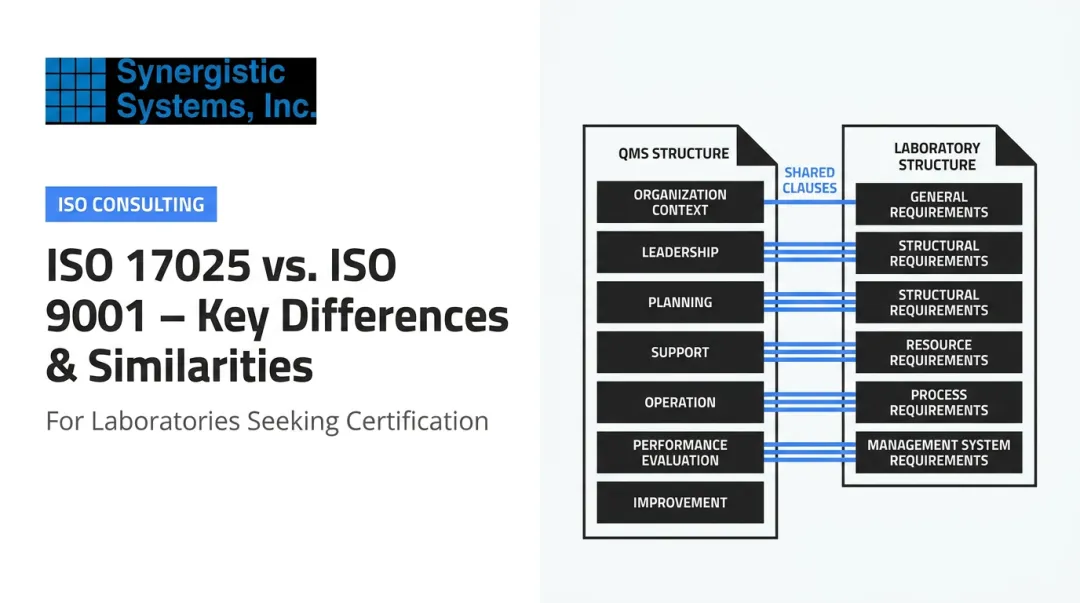
Both standards use the ISO Harmonized Structure — the same clause framework applied to all ISO management system standards. Clauses 4 through 10 are identical in numbering and high-level intent:
- Clause 4 – Context of the organization
- Clause 5 – Leadership
- Clause 6 – Planning
- Clause 7 – Support
- Clause 8 – Operation
- Clause 9 – Performance evaluation
- Clause 10 – Improvement
The clause numbering is identical across both standards. Where they diverge is in the specific requirements each clause contains — shaped entirely by whether the goal is quality delivery or environmental stewardship.
What Is ISO 9001?
ISO 9001 specifies the requirements for a Quality Management System. It defines whether your organization can consistently provide products or services that meet customer and applicable regulatory requirements. The standard provides the framework for establishing, implementing, maintaining, and continually improving the processes that make that possible.
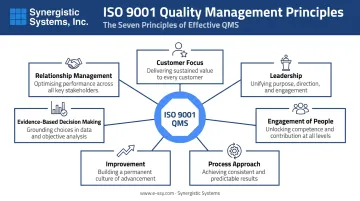
The Seven Quality Management Principles
ISO identifies seven principles that underpin ISO 9001, each with a direct operational outcome:
- Customer focus — understanding requirements drives higher retention and fewer complaints
- Leadership — visible commitment from top management creates accountability
- Engagement of people — competent, empowered employees produce better outputs
- Process approach — managing activities as interconnected processes reduces defects
- Improvement — systematic corrective action prevents recurrence
- Evidence-based decision making — data-driven choices reduce costly guesswork
- Relationship management — strong supplier relationships improve input quality
ISO 9001-Specific Requirements
Several requirements in ISO 9001 have no equivalent in ISO 14001:
- Customer communication (Clause 8.2.1) — formal processes for handling inquiries, contracts, and complaints
- Design and development controls (Clause 8.3) — structured product/service development with defined review gates
- Customer satisfaction monitoring (Clause 9.1.2) — measuring how well customer expectations are being met
Business Benefits
- Reduced rework and defect costs through process control
- Stronger competitive positioning in supply chains that require ISO 9001 from suppliers
- Expanded market access — particularly in automotive, aerospace, medical devices, and government contracting
- Documented evidence of quality performance for customer audits
Who Pursues ISO 9001?
ISO 9001 is industry-agnostic. Manufacturing (automotive, electronics, medical devices), IT services, construction, healthcare, professional services — any organization where product or service quality directly affects customer relationships is a candidate. With over 1.2 million valid certificates recorded in the ISO Survey 2022, it remains the most widely adopted management system standard worldwide.
What Is ISO 14001?
ISO 14001 provides a structured framework for organizations to identify, manage, monitor, and improve their environmental performance. The standard — now in its 2026 edition, replacing the withdrawn 2015 version — covers resource use, waste management, emissions, environmental compliance obligations, and stakeholder commitments.
ISO 14001-Specific Requirements
These requirements have no direct equivalent in ISO 9001:
- Environmental aspect and impact identification — systematically identifying how your operations interact with the environment
- Life cycle perspective — considering environmental impacts across a product's full life, not just during production
- Environmental compliance obligations — identifying and tracking applicable environmental laws and regulations
- Environmental objectives and targets — setting measurable goals for environmental performance improvement
Business Benefits
- Reduced regulatory risk and avoidance of environmental penalties
- Lower resource and energy costs through waste reduction programs
- Improved standing with ESG-focused investors and procurement bodies
- Documentation of environmental performance for sustainability reporting
ISO 14001 and ESG Reality
The business case for ISO 14001 has shifted considerably. According to ISO, more than 670,000 organizations worldwide hold ISO 14001 certification — and that number reflects growing commercial pressure, not just regulatory compliance.
The European Commission's Green Public Procurement framework cites ISO 14001 as a recognized environmental management system for public procurement criteria. In markets where ESG performance affects contract eligibility, ISO 14001 has moved from optional to functionally required.
Who Pursues ISO 14001?
The most common adopters span industries with direct environmental footprints:
- Energy companies and oil and gas operators
- Manufacturers, fabricators, and contract manufacturers
- Construction firms and infrastructure contractors
- Logistics providers and transportation companies
- Food processors and agricultural operations
Service-sector organizations with smaller environmental footprints also pursue ISO 14001 when clients or investors require documented sustainability commitments.
Key Differences and Similarities
The Core Difference
ISO 9001 is customer-facing. ISO 14001 is environment-facing. This single distinction drives most of the differences between them — in how risk is defined, how objectives are set, and who counts as a relevant stakeholder.
How each standard defines "risk" differs in ways that matter operationally:
- In ISO 9001, risk centers on quality failures and customer impact — missed specifications, service failures, nonconforming products
- In ISO 14001, risk includes environmental aspects and their potential impacts, plus compliance risk tied to environmental law
A single risk register can accommodate both standards, but the inputs and assessment criteria are distinct.
Where They're Genuinely Similar
The Harmonized Structure creates substantial overlap that organizations can use to their advantage. The following requirements share near-identical clause architecture in both standards:
| Shared Requirement | ISO 9001 Clause | ISO 14001 Clause |
|---|---|---|
| Documented information management | 7.5 | 7.5 |
| Monitoring and measurement | 9.1 | 9.1 |
| Internal audit | 9.2 | 9.2 |
| Management review | 9.3 | 9.3 |
| Nonconformity and corrective action | 10.2 | 10.2 |
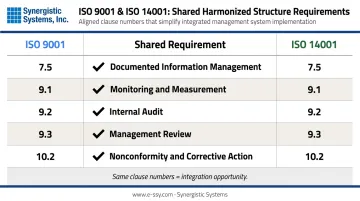
For organizations implementing both standards, these overlaps translate directly into documentation and audit efficiency: a single internal audit program, shared management review, and one corrective action system spanning both standards.
Integrated Management Systems in Practice
Organizations pursuing both certifications can — and typically should — build a single Integrated Management System (IMS) rather than two parallel systems. IAF MD 11:2023 formally governs how accredited certification bodies conduct audits of integrated management systems, meaning combined third-party audits are a recognized, standardized process.
In practice, this means one registrar, one audit cycle, and shared documentation infrastructure. Major accredited registrars — including DNV, Bureau Veritas, LRQA, BSI, NQA, SGS, and Intertek — all operate within this framework, so organizations aren't navigating uncharted territory when they pursue a combined audit.
When Synergistic Systems implements a combined ISO 9001 + ISO 14001 system, ISO 14001 is delivered as an integrated module on top of the ISO 9001 foundation — sharing document control, internal audit structure, risk-based thinking, and management review processes. This IMS-on-ISO-9001 approach typically cuts ISO 14001 implementation cost by 40–60% compared to building a standalone EMS from scratch.
Which Standard Does Your Organization Need?
Start With Your Pressure Points
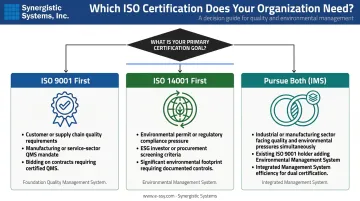
Use this framework to identify where to focus:
ISO 9001 is the right starting point if:
- Customers or procurement teams require quality certification from suppliers
- You're competing for contracts where ISO 9001 is a qualification criterion
- Product/service quality and customer satisfaction are your primary operational concerns
- You're in manufacturing, IT services, healthcare, or professional services
ISO 14001 is the priority if:
- You face environmental regulatory pressure or compliance obligations
- Your clients, investors, or procurement bodies assess ESG performance
- You operate in energy, manufacturing, logistics, food processing, or construction with significant environmental footprint
- Public sector contracts in your market reference environmental management system requirements
Pursue both if:
- You're in manufacturing or industrial sectors where customer quality requirements and environmental regulations both apply
- You already hold ISO 9001 and are facing growing ESG or procurement pressure
- You want to build one efficient system rather than two separate compliance programs
How Synergistic Systems Approaches This Decision
If you're still weighing which path fits your organization, that decision is exactly where Synergistic Systems starts.
Over 25 years, the firm has helped organizations across manufacturing, oil and gas, food processing, aerospace, automotive, and professional services implement ISO 9001 and ISO 14001 — separately or as integrated systems. ISO 14001 is delivered as an add-on module to the ISO 9001 foundation, not a standalone build, which means the documentation, audit program, and management review structure you build for quality certification carries directly into environmental management.
The cloud-based QMS intranet included in every engagement hosts both systems on a single platform — no hardware or software purchase required. Organizations pursuing both certifications simultaneously receive integrated pricing at a discount versus two separate projects.
Conclusion
ISO 9001 and ISO 14001 serve different but complementary purposes. The right choice depends on your organization's goals, industry requirements, and stakeholder expectations. A manufacturer under pressure from both a quality-conscious customer base and tightening environmental regulations needs both. A service firm responding to a supplier qualification requirement probably starts with ISO 9001.
What makes the decision easier than it looks: the shared Harmonized Structure means a combined system is often more practical to build and maintain than two separate ones. Organizations that pursue both certifications under an integrated framework typically spend less time, less money, and fewer internal resources than those that treat them as sequential projects.
Evaluate your current gaps against both standards before committing to a path. If you're unsure where to start, running a gap assessment against both standards simultaneously — before any implementation work begins — gives you a clear picture of scope, effort, and sequencing. That's typically the first step in any well-structured IMS engagement, and it avoids the cost of scoping each standard in isolation.
Frequently Asked Questions
What is ISO 9001 and ISO 14001 certification?
ISO 9001 certifies a Quality Management System, confirming that an organization consistently delivers products or services meeting customer and regulatory requirements. ISO 14001 certifies an Environmental Management System, confirming proactive management of environmental impacts and compliance obligations. Both are internationally recognized certifications issued by accredited third-party registrars.
Can a company be certified to both ISO 9001 and ISO 14001?
Yes, and many organizations do. The ISO Harmonized Structure shared by both standards allows them to be integrated into a single management system and audited together by one registrar under one audit cycle, which saves significant time and cost compared to maintaining separate certifications.
How long does it take to implement ISO 9001 or ISO 14001?
Timelines vary based on organization size, number of sites, process complexity, and current documentation maturity. Most organizations complete implementation within 6 to 18 months. A gap assessment at the start of the project provides a more accurate timeline specific to your situation.
How much does ISO 14001 certification cost?
Costs vary based on organization size, number of sites, environmental aspect complexity, and whether consulting support is used — with key drivers including gap assessment, documentation development, training, and third-party audit fees. When ISO 14001 is integrated with an existing ISO 9001 system, implementation costs can be reduced by 40–60% compared to a standalone build.
Is ISO 9001 changing in 2026?
Yes. ISO/FDIS 9001 — the sixth edition — is in Final Draft International Standard stage and expected to replace ISO 9001:2015 in September 2026. Draft discussions have addressed themes including quality culture, ethics, and resilience. Organizations should monitor the final publication and plan transition timelines accordingly.
What is the Harmonized Structure and why does it matter?
The ISO Harmonized Structure is the common clause framework ISO applies to all management system standards, giving them identical structure from Clause 4 through Clause 10 — which means organizations can build one integrated management system instead of separate, disconnected ones, reducing documentation, audit, and maintenance overhead across every standard they implement.