
For quality managers, operations leads, and business owners working toward or maintaining ISO 9001:2008 certification, internal audits are often the most underutilized part of the QMS. The tendency to treat them as a pre-certification checkbox — rather than a genuine improvement mechanism — is one of the most common reasons organizations struggle during external surveillance and recertification audits.
This guide covers what the standard actually requires, how to run the audit from start to finish, and what separates an effective audit program from a paper exercise.
TL;DR
- Internal audits are mandatory under ISO 9001:2008 Clause 8.2.2 — not optional, not discretionary
- The audit verifies that your QMS documentation meets requirements and that daily operations actually follow those documents
- An effective program requires a written procedure, risk-based schedule, trained auditors, and a closed-loop corrective action process
- Auditors must never audit their own work — objectivity is a hard requirement of the standard
- Internal audits drive real improvement — not just compliance paperwork
What Is an ISO 9001:2008 Internal Audit?
An ISO 9001:2008 internal audit is a first-party audit — conducted by or on behalf of the organization itself — to assess whether the QMS has been effectively implemented, maintained, and achieving its intended results. ASQ defines first-party audits as those where auditors have no vested interest in the outcomes of the area being reviewed.
Two Distinct Things Being Verified
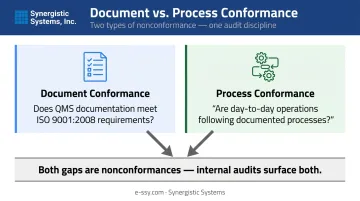
Every internal audit carries a dual focus that's easy to conflate but critical to keep separate:
- Document conformance — Does the QMS documentation actually meet ISO 9001:2008 requirements?
- Process conformance — Are day-to-day operations following those documented processes?
An organization can have beautifully written procedures that nobody follows. It can also have competent operations with documentation that doesn't map to reality. Both are nonconformances. A well-executed internal audit surfaces both problems — giving you a chance to correct them before a registrar does.
How It Differs from External Audits
| Audit Type | Conducted By | Purpose |
|---|---|---|
| First-party (internal) | The organization itself | Self-assessment, improvement |
| Second-party (supplier) | A customer of the organization | Supplier qualification |
| Third-party (certification) | Accredited registrar (DNV, BSI, NQA, etc.) | Certification |
Internal audits are a recurring requirement built into your QMS, not a one-time preparation exercise. Organizations that run them consistently arrive at their Stage 2 registration audit with documented evidence that the system actually works — which is exactly what registrar auditors want to see.
Why ISO 9001:2008 Requires Internal Audits
It's One of Six Mandatory Documented Procedures
ISO 9001:2008 requires exactly six documented procedures. Internal audit is one of them — alongside document control, records control, control of nonconforming product, corrective action, and preventive action. The fact that it sits in this small list tells you something about how central it is to the QMS framework.
Clause 8.2.2 specifies what the organization must do:
- Conduct audits at planned intervals
- Ensure all QMS processes are covered within the complete audit cycle
- Consider the status and importance of processes and results of previous audits when building the schedule
- Define audit criteria, scope, frequency, and methods
- Maintain records of audits and their results
- Ensure the management responsible for audited areas takes corrections and corrective actions without undue delay, then follow up to verify those actions and report the results
What Happens When It's Treated as a Formality
Organizations that run internal audits only to satisfy the checkbox follow a predictable failure pattern. Common signs include:
- Using the same generic checklist year after year
- Auditing their own work without independent review
- Filing nonconformance reports without ever verifying corrective actions
The result: nonconformances accumulate undetected, corrective actions stall or recur, and the external registrar auditor finds what the internal program missed.
Major findings during surveillance or recertification audits — including findings that put certified status at risk — are the direct consequence. The internal audit program is the organization's primary self-check. When it fails, the registrar's audit becomes the first real check, and by then the options are limited.
How to Conduct an ISO 9001:2008 Internal Audit Step by Step
The internal audit follows the Plan-Do-Check-Act cycle and feeds directly into management review. Done right, it functions as a continuous improvement loop — not a box-checking exercise that happens once a year.
Step 1: Establish the Internal Audit Procedure
The organization must document a formal audit procedure covering:
- Scope and objectives of the audit program
- Responsibilities (who owns the program, who can serve as auditors)
- Frequency and scheduling criteria
- Methods for planning and conducting audits
- How results are reported, recorded, and submitted for management review
This procedure is itself subject to audit. If it doesn't exist or isn't being followed, that's a finding.
Step 2: Develop the Audit Schedule
The schedule must ensure all key QMS processes are covered within the complete audit cycle. More importantly, frequency should reflect process risk, not convenience.
Factors that should drive higher audit frequency:
- Newly implemented or recently changed processes
- Processes with prior nonconformances or recurring issues
- Processes with high customer impact or regulatory exposure
- Areas where previous audits found significant gaps
Stable, low-risk support functions can be audited less frequently. The standard's language in Clause 8.2.2 — "status and importance of the processes and areas to be audited" — is the direct basis for this risk-based approach.
Step 3: Prepare Audit Checklists
Checklists should be built around QMS processes, not ISO clause numbers. A process-focused checklist asks whether a given process is working, not whether you've visited Clause 4.2.3 this year.
Drawing on ISO 19011:2018 guidance, a well-designed process audit checklist covers:
- Process inputs: What triggers the process, and where does the input originate?
- Process outputs: What is produced, and where does it go next?
- Sequence and interaction: How does this process connect to upstream and downstream processes?
- Controls and methods: What procedures, criteria, or work instructions govern the process?
- Resources: Are the right people, equipment, and materials in place?
- Monitoring and measurement: Is the process tracked, and are records maintained?
Tailor each checklist to the specific process being audited. A generic clause-by-clause checklist produces generic, low-value findings.
Step 4: Conduct the Audit
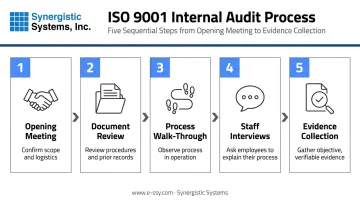
A typical audit sequence:
- Opening meeting — Confirm scope, schedule, and logistics with the auditee
- Document review — Review procedures, work instructions, and prior records before walking the floor
- Process walk-through — Observe the process in operation
- Staff interviews — Ask frontline employees to explain how they perform the process
- Evidence collection — Gather objective, verifiable evidence for all findings
The auditor's role is to gather evidence, not to catch people out. Staff interviews should feel like professional conversations. One firm rule applies: auditors must not audit their own work or any area they are responsible for. ISO 9001:2008 Clause 8.2.2 states this explicitly.
Step 5: Document Findings and Raise Nonconformances
All findings — conformances, observations, and nonconformances (NCRs) — must be recorded. For each NCR:
- State the requirement that was not met
- Describe the objective evidence that supports the finding
- Assign the NCR to the responsible department with a defined response deadline
- Require a corrective and preventive action (CAPA) that addresses root cause
Findings must be based on objective evidence. An auditor's opinion that a process looks inefficient is not an NCR. A documented procedure that isn't being followed — evidenced by records, observation, or staff testimony — is.
Managing NCRs and CAPA records in shared spreadsheets or email threads creates gaps. Synergistic Systems includes a cloud-based QMS intranet in every engagement, so nonconformance records, CAPA documentation, and audit evidence all live in one place with assigned owners and tracked deadlines.
Step 6: Verify Corrective Actions and Close Out
Submitting a response doesn't close an NCR. The auditor must verify three things before the item can be formally closed:
- The action taken actually addresses the root cause
- The nonconformance has not recurred
- Supporting evidence (updated procedures, training records, revised controls) is in place
Once all three are confirmed, the NCR is closed. Submit audit results and closed NCRs to the Management Representative as inputs for the management review meeting.
Key Elements That Make Internal Audits Effective
Auditor Selection and Objectivity
Auditors must be selected on two criteria: competence and impartiality. Competence means knowledge of the standard, auditing techniques, and the process being audited. Impartiality means they cannot audit work they are responsible for — regardless of skill level or good intentions.
The standard method for maintaining objectivity is the cross-functional audit team model: pair auditors from different departments to audit processes outside their own area. A purchasing manager auditing the production process, a production supervisor auditing purchasing — this cross-pollination works.
Organizations that can't staff enough qualified internal auditors often benefit from external support. Synergistic Systems provides hands-on audit execution as part of its 10-step ISO implementation methodology, conducting the system-wide internal audit directly and training internal team members to carry the program forward independently.
Risk-Based Scheduling
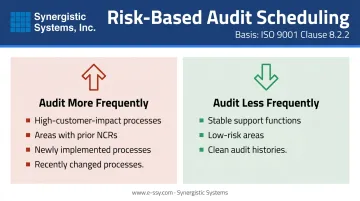
Not every process warrants the same audit frequency. Per Clause 8.2.2, the audit program must consider the status and importance of processes and previous audit results. In practice:
- Audit more frequently: High-customer-impact processes, areas with prior NCRs, newly implemented processes, and processes under recent change
- Audit less frequently: Stable, low-risk support functions with clean audit histories
Linking Audit Results to Management Review
Under Clause 5.6.2, internal audit results are a required input to management review. This is the mechanism that converts audit findings into executive-level decisions on resources, process changes, and improvement priorities.
When this link is missing, audit findings stall at the department level and never reach the people with authority to act on them. Connected to management review, those same findings drive resource decisions and improvement priorities at the top.
Maintaining Audit Records
External registrar auditors will review your internal audit records to confirm the program is functioning. Required records include:
- The documented audit procedure
- The audit schedule
- Completed audit checklists
- Audit reports
- NCR records
- CAPA responses and root cause analysis
- Evidence of CAPA effectiveness verification and close-out
Common Mistakes and Misconceptions to Avoid
Auditing Clauses Instead of Processes
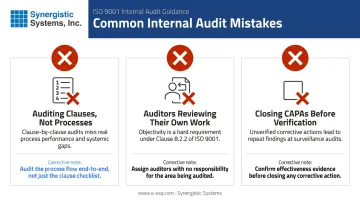
Many organizations set up their audit schedule to march through ISO clause numbers — 4.2.3 this month, 7.5 next month — rather than auditing how their actual processes operate. It's the most structurally common internal audit error, and it produces audits that check boxes without generating any real insight.
ISO 9001:2008 promotes the process approach throughout. Clause 8.2.2's own language focuses on "processes and areas to be audited." An audit that checks clause boxes without evaluating whether processes are documented, implemented, monitored, and effective misses the entire point.
Allowing Auditors to Audit Their Own Work
Auditor independence is non-negotiable under Clause 8.2.2 — and violations are among the most frequently cited findings during external registrar audits. Assigning an auditor to review their own work undermines the objectivity that makes the entire program credible.
Even a highly skilled, well-intentioned auditor cannot objectively evaluate their own work. When this happens in practice, findings get rationalized rather than documented — and registrars notice.
Closing CAPAs Before Effectiveness Is Verified
A corrective action response is not the same as a closed NCR. Until the auditor confirms the root cause is resolved and the nonconformance hasn't recurred, the record stays open.
Skipping effectiveness verification is the most common root cause of repeat findings in subsequent audits. The same issue surfaces again, documented differently, year after year — because nobody confirmed the fix actually worked.
Conclusion
The ISO 9001:2008 internal audit is the organization's primary self-check mechanism. When executed correctly, it confirms QMS conformance, surfaces genuine improvement opportunities, and prepares the organization to face external certification audits with confidence — not anxiety.
The structure isn't complicated: a documented procedure, a risk-based schedule, trained and objective auditors, process-focused checklists, and a disciplined corrective action loop that doesn't close until the fix is verified.
For organizations building this program from scratch — or repairing one that's been running as a compliance exercise — Synergistic Systems provides ready-to-use modular documentation, internal auditor training, and hands-on audit execution support. With 25+ years of ISO consulting experience and hundreds of projects delivered across diverse industries, the team has worked alongside every major accredited registrar to take organizations from no system to certified.
Frequently Asked Questions
Does ISO 9001 require internal audits?
Yes. Internal audits are a mandatory requirement under ISO 9001:2008 Clause 8.2.2 — one of only six mandatory documented procedures in the standard. The organization must establish a documented procedure, conduct audits at planned intervals, and maintain records of results.
What is an ISO 9001 internal audit?
An ISO 9001 internal audit is a first-party evaluation: the organization examines its own QMS to verify that documentation meets standard requirements and that operations conform to those documented processes. This differs from external certification audits conducted by accredited registrars.
What is the ISO standard for internal audit?
ISO 9001:2008 Clause 8.2.2 governs the internal audit requirement (Clause 9.2 in the 2015 version). ISO 19011:2018 provides supplementary guidance on auditing management systems, covering planning, auditor competence, and audit reporting.
Who can conduct an ISO 9001 internal audit?
Auditors must be competent (trained in the standard and auditing techniques) and objective, meaning they cannot audit their own work or areas they are responsible for. Auditors can be employees from other departments or external consultants — Synergistic Systems, for example, provides internal audit services through a Certified Quality Auditor (CQA).
How often should ISO 9001 internal audits be conducted?
The standard requires audits at planned intervals but sets no fixed minimum frequency. All key QMS processes must be covered within a complete audit cycle, and higher-risk or underperforming processes should be audited more often than stable, low-impact ones.
What records are required for ISO 9001:2008 internal audits?
Required records include: the internal audit procedure, the audit schedule, completed checklists, audit reports, NCR records, CAPA responses, and documented evidence that corrective actions were effective and closed out. External registrar auditors will review all of these to confirm the program is functioning.