Many shop owners still wonder whether certification is worth the effort, or whether it's just documentation overhead that takes attention away from running machines. That's a fair question. The honest answer is that the real value shows up on the shop floor and in customer relationships — not in a binder on a shelf.
This article breaks down the specific operational advantages ISO 9001:2015 delivers to machining companies, what's at stake without it, and how to extract maximum value once certified.
TL;DR
- ISO 9001:2015 governs how a machining company plans, executes, measures, and improves every process from order intake to final shipment.
- Certification delivers three core advantages: process consistency with part traceability, expanded market access, and cost reduction through early defect detection.
- ISO 9001:2015 is increasingly a prerequisite — not a preference — for winning contracts in regulated supply chains.
- Shops without certification face inconsistent output, limited market access, and reactive problem-solving.
- Maximum value comes from running the QMS as a live operational system, not a one-time documentation project.
What Is ISO 9001:2015?
ISO 9001:2015 is the internationally recognized standard for Quality Management Systems (QMS), published by the International Organization for Standardization and confirmed in 2021. It requires organizations to document, monitor, and continuously improve every process that affects product quality — from quoting and raw material sourcing through final inspection and delivery.
For machining companies, it applies regardless of size or specialization. CNC turning, milling, grinding, Swiss lathe, multi-axis — the standard is process-agnostic. What it cares about is whether those processes are defined, controlled, and improving over time.
The Foundation for Sector-Specific Standards
ISO 9001:2015 is the structural base that every major industry-specific QMS standard is built on:
- AS9100D — aerospace, space, and defense
- IATF 16949 — automotive (ISO explicitly states it is implemented as a supplement to ISO 9001:2015)
- ISO 13485 — medical devices
A machining shop that implements ISO 9001:2015 first establishes the documented foundation that AS9100D or IATF 16949 certification layers additional requirements on top of. Skipping ISO 9001 doesn't accelerate those higher certifications — it removes their structural base.
What ISO 9001 actually delivers is documented consistency: a skilled machinist's process knowledge captured in a form any trained operator can follow and any customer or auditor can verify.
Key Advantages of ISO 9001:2015 for Machining Companies
The three advantages below connect directly to how a shop runs day-to-day and how customers experience working with it — concrete operational outcomes with measurable business consequences.
Advantage 1: Process Consistency and Full Part Traceability
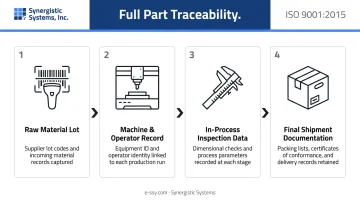
ISO 9001:2015 requires documented control plans, version-controlled work instructions, and calibrated measurement records for every part number. The result is a system where every machined component can be traced from raw material lot through each production stage to final shipment.
When a tolerance issue or field failure occurs, a certified shop can identify:
- Which machine ran the job
- Which operator completed it
- Which material lot was used
- What in-process inspection data was recorded
That eliminates guesswork and compresses the time between problem identification and root cause. In an uncertified shop, the same investigation can take days — because there's no record of what was done or when.
Why traceability matters to buyers: Aerospace, defense, and medical customers routinely require full material and process traceability before approving a supplier. The IAQG's AS9100 standard addresses traceability requirements in Clause 8.5.2, and FDA regulations under 21 CFR Part 820 impose device-level tracking requirements for medical applications. A shop that cannot demonstrate traceability isn't considered for the work, regardless of its machining capability.
KPIs this affects: defect escape rate, corrective action closure time, customer return rate, first-pass yield, audit pass rate.
When it matters most: High-volume production runs, complex multi-step jobs, regulated industry applications, and any part that interacts with a safety-critical assembly.
Advantage 2: Market Access and Competitive Positioning
ISO 9001:2015 certification has become a minimum entry condition for a significant portion of the manufacturing supply chain. OEMs and Tier-1 suppliers maintain approved vendor lists where certification is required before a shop can even receive an RFQ.
An uncertified shop is simply invisible to that segment of the market, regardless of its actual machining capabilities.
ISO reports that more than 1 million ISO 9001 certificates have been issued across 189 countries — a scale that reflects how thoroughly the standard has been adopted as the common language of supplier qualification. When a procurement team needs to qualify a new machining supplier, ISO 9001:2015 certification gives them a standardized, auditable baseline without the cost and scheduling burden of a full on-site audit.
Real evidence of this dynamic comes from a documented case: R&R Machine Industries, a family-owned CNC contract machine shop in Rhode Island, pursued ISO 9001:2015 specifically because clients required formal certification. After passing the registration audit on the first attempt, the shop retained 17 jobs and added 2 skilled positions — direct outcomes of expanded customer eligibility.
Beyond opening new doors, certification also strengthens existing customer relationships. A certified supplier provides certificates of conformance backed by auditable process records, which can reduce or eliminate incoming inspection requirements for buyers — lowering friction on both sides of every transaction.
KPIs this affects: qualified bid opportunities, customer acquisition cost, supplier audit frequency, customer retention rate, revenue from regulated industries.
When it matters most: Shops moving up-tier in the supply chain, expanding into new industries, or competing for production contracts rather than one-off prototype work.
Advantage 3: Defect Reduction and Measurable Cost Control
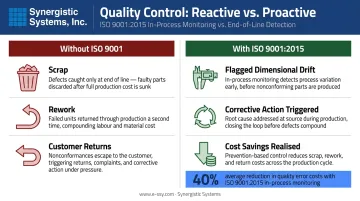
ISO 9001:2015 embeds quality control into the production process itself — not just at end-of-line inspection.
Through requirements for in-process monitoring (Clause 8.5), nonconforming product segregation, and structured corrective action (Clause 10.2), certified shops catch problems earlier and fix root causes rather than symptoms.
A dimensional drift flagged at part 50 of a 5,000-piece run saves the material, machine time, and labor that would otherwise be lost across the remaining run. A defect that reaches the customer costs far more — rework, returns, expedited replacements, and damage to the relationship that doesn't show up on any invoice.
The business impact is concrete. NIST documented a manufacturer that implemented ISO 9001:2015 and reduced production quality errors by 40%, retaining 30% of two major orders that would otherwise have been lost. The standard's in-process control requirements are specifically designed to produce this kind of outcome.
For shops running expensive materials — titanium, Inconel, medical-grade alloys — the math is straightforward: one avoidable scrap event on a long-run precision job can erase the margin on the entire order.
KPIs this affects: scrap rate, rework cost as a percentage of revenue, cost of poor quality (COPQ), on-time delivery rate, customer complaint rate.
When it matters most: High-volume production, precision machining of expensive materials, and jobs where a single out-of-spec dimension creates a nonconforming assembly downstream.
What Happens Without ISO 9001:2015 Certification
Without a formal QMS, quality depends on individual skill and institutional memory rather than documented process. That works — until an operator leaves, a shift changes, or a job runs at higher volume than the shop has handled before. Then the inconsistency surfaces, and usually at a costly moment.
The consequences compound over time:
- Customers increase incoming inspection requirements, adding friction and eroding trust with every order
- Time and resources shift toward recovering from problems rather than preventing them
- Scrap, rework, and return costs accumulate untracked because no system measures them
- Bid opportunities requiring ISO 9001:2015 certification become unavailable, narrowing the addressable customer pool
- Adding operators or capacity without documented work instructions introduces variability at exactly the wrong time
The market access risk isn't abstract. R&R Machine pursued certification after recognizing that without it, existing and prospective clients would move to shops that had it — a business outcome that's documented, not theoretical.
How to Get the Most Value from ISO 9001:2015
Certification delivers its full value only when the QMS is treated as a live operational system — not a set of documents created for an audit and stored in a binder. The certificate is the starting point, not the finish line.
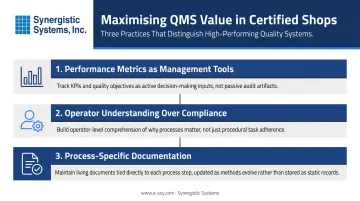
Three practices separate high-performing certified shops from those that merely maintain their certificate:
Use performance metrics as management tools, not compliance checkboxes. Scrap rate, on-time delivery, and customer complaint data should drive management review discussions and corrective action priorities — not just populate forms before the surveillance audit.
Invest in operator understanding, not just operator compliance. Machinists and floor-level staff who understand why a procedure exists — and how their work connects to customer outcomes — follow instructions more consistently and catch problems faster.
Build documentation around your actual processes, not generic templates. Generic templates don't survive contact with a real shop floor. A structured implementation partner — like Synergistic Systems, whose modular documentation system is built around client-specific processes — reduces both time to certification and the ongoing maintenance burden.
The return on investment from certification compounds. A shop actively using its QMS to drive improvement sees measurably lower defect rates, stronger customer relationships, and expanded market access year over year. Shops that treat certification as an ongoing management tool consistently outperform those that let the QMS go dormant between audits.
Conclusion
For machining companies, ISO 9001:2015 certification functions as operational infrastructure — not paperwork. When the system is actively used rather than passively maintained, its advantages compound across the shop floor and the sales cycle:
- Traceability gives customers and auditors documented proof of process control
- Market access expands as more OEMs and primes require ISO 9001 as a supplier prerequisite
- Defect and rework costs drop as documented processes replace tribal knowledge
- Continuous improvement becomes systematic rather than reactive
Customers already treat ISO 9001 certification as a baseline supplier requirement in most precision machining markets. The shops that build the system right — and use it daily — are the ones that win the contracts, retain them, and scale without quality falling apart. If your shop is ready to move from no-system to certified, Synergistic Systems has guided machine shops through that process for over 25 years.
Frequently Asked Questions
What is an ISO 9001:2015 certified company?
An ISO 9001:2015 certified company has had its Quality Management System independently verified by an accredited third-party registrar — confirming that its processes for planning, controlling, and improving product quality meet the standard's requirements. The certification is issued by the registrar, not ISO itself, and must be renewed through periodic surveillance and recertification audits.
What is the ISO standard for manufacturing companies?
ISO 9001:2015 is the primary quality management standard for manufacturing companies. Sector-specific extensions include AS9100D for aerospace and defense, IATF 16949 for automotive, and ISO 13485 for medical devices — all of which build additional requirements on top of the ISO 9001:2015 foundation.
How do you check if a company is ISO 9001:2015 certified?
Request the company's ISO 9001:2015 certificate, which includes an expiry date and scope statement, then verify it directly with the issuing registrar. Certificates can be lapsed or fraudulent — registrars accredited under ANAB (US) or UKAS (UK) standards provide the most credible independent verification.
What is Clause 7.2 of ISO 9001:2015?
Clause 7.2 addresses Competence — requiring organizations to determine the skills needed for personnel whose work affects quality, verify those people are actually competent, and retain documented evidence. In a machining context, this means keeping training records for operators qualified to run specific equipment or processes.
How long does it take a machining company to get ISO 9001:2015 certified?
Most small-to-mid-sized machine shops take 6 to 18 months from initial gap analysis through third-party certification audit, depending on existing documentation and process maturity. Structured consulting engagements — such as Synergistic Systems' fixed-price methodology with modular documentation — can compress that timeline by eliminating the trial-and-error common in self-directed implementations.
Does ISO 9001:2015 certification guarantee zero defects in machined parts?
No. ISO 9001:2015 governs the quality management system, not the physical output directly. What it ensures is that when nonconforming parts occur, they are detected, documented, and addressed through verified corrective action — reducing recurrence rather than claiming perfection.