Introduction
ISO 9001 is the world's most widely adopted quality management standard, with over one million certificates issued across more than 170 countries — spanning virtually every industry from manufacturing and food production to healthcare and professional services.
Despite that reach, many organizations still find the path to certification unclear. The 10 clauses, documentation requirements, and two-stage audit process can feel like a moving target — especially without a structured roadmap.
This guide covers everything you need: a plain-English breakdown of all 10 clauses, the 7 quality management principles, a step-by-step implementation sequence, documentation requirements, and how the certification process actually works — including what happens after you get certified.
TLDR
- ISO 9001:2015 is the international QMS standard applicable to any size or industry
- The standard is built on 7 quality management principles and organized into 10 clauses, with Clauses 4–10 as the auditable requirements
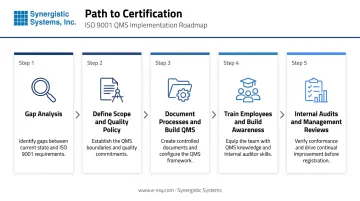
- Implementation follows five core steps: gap analysis → scope/policy → documentation → training → internal audit
- Certification involves a two-stage external audit; certificates are valid for three years with annual surveillance
- A 2024 amendment added climate change language to Clauses 4.1 and 4.2; full revision expected September 2026
What Is ISO 9001:2015?
ISO 9001:2015 is the international standard for quality management systems, published by the International Organization for Standardization. It provides a framework for consistently delivering products and services that meet customer and regulatory requirements — and applies to organizations of any size, industry, or geography.
A Brief Revision History
ASQ traces ISO 9001's origins to 1987, with major revisions in 1994, 2000, 2008, and 2015:
| Edition | Key Change |
|---|---|
| 1987 | First published standard |
| 1994 | Improved design and development controls |
| 2000 | Introduced process approach |
| 2008 | Clarified application issues from 2000 edition |
| 2015 | Risk-based thinking, leadership accountability, organizational context |
The 2015 edition was the most significant overhaul. Where ISO 9001:2008 treated prevention as a separate element, the 2015 revision embedded risk-based thinking throughout the entire standard.
It also expanded applicability from products to services, elevated leadership requirements, and required organizations to understand their internal and external context — a shift that made the standard more strategic and less procedural.
Why Organizations Pursue Certification
Certified organizations report consistent gains across operations, customer relationships, and market access:
- Process consistency — documented, repeatable processes reduce variation and error
- Customer confidence — certification signals quality commitment to customers and supply chain partners
- Reduced waste, rework, and nonconformances drive measurable operational efficiency
- Research published by Harvard Business School in 2010 found certified companies showed higher survival rates and stronger growth following certification
- Foundation for sector-specific standards — AS9100 (aerospace), IATF 16949 (automotive), ISO 13485 (medical devices), and others are all built on the ISO 9001 foundation
The 7 Quality Management Principles of ISO 9001:2015
ISO's Quality Management Principles publication states that ISO 9001 and related quality standards are based on seven foundational principles. These principles shape how the entire QMS is designed and operated — from policy development to daily decision-making.
| Principle | What It Means in Practice |
|---|---|
| Customer Focus | Embed customer requirements into policies and objectives; measure and respond to satisfaction data |
| Leadership | Top management takes active, visible accountability for the QMS — not just delegation to a quality manager |
| Engagement of People | Competent, empowered employees at every level drive QMS effectiveness; awareness and training are non-negotiable |
| Process Approach | Manage interlinked activities as a coherent system using Plan-Do-Check-Act, not as isolated departmental tasks |
| Improvement | Continual improvement is an ongoing organizational obligation, not a one-time project |
| Evidence-Based Decision Making | Quality decisions are grounded in data and analysis, not assumptions or habit |
| Relationship Management | Actively manage supplier and partner relationships to optimize their impact on quality outcomes |
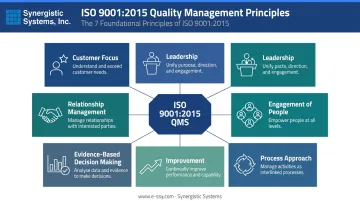
Together, these principles move quality management from a compliance checkbox into an organization-wide operating culture. Top management must visibly champion all seven — which is why Clause 5 puts leadership accountability front and center.
Understanding the 10 Clauses of ISO 9001:2015
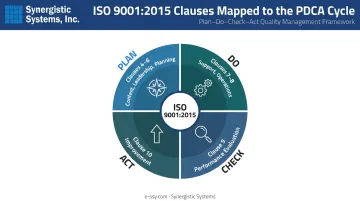
Clauses 1–3 cover scope, normative references, and definitions. The auditable requirements — the ones that matter for certification — are Clauses 4 through 10, structured around the Plan-Do-Check-Act cycle.
Plan — Context, Leadership, and Risk (Clauses 4–6)
Clause 4 — Context of the Organization sets the strategic foundation. Organizations must:
- Identify internal and external issues relevant to their purpose
- Understand the needs and expectations of interested parties (customers, regulators, employees, suppliers)
- Define the QMS scope — which sites, products, services, and processes are included
- Establish and manage processes in an integrated way
This clause is often underestimated by first-time implementers. Getting context right determines what the rest of the QMS is actually built around.
Clause 5 — Leadership requires top management to take direct accountability for the QMS. This means establishing a customer-focused quality policy, assigning clear roles and responsibilities, and ensuring the QMS is integrated into business processes — not siloed in the quality department.
Clause 6 — Planning moves the organization from reactive to proactive. Requirements include:
- Identifying risks and opportunities and planning actions to address them
- Setting measurable quality objectives aligned with strategic direction
- Planning for changes to the QMS in a controlled way
A practical note on implementation: Clause 6 works best when the risk register lives inside the QMS itself — not in a standalone spreadsheet that gets updated once a year before an audit. Keeping risk planning integrated with the rest of the system ensures it stays current and visible to the people who need it.
Do — Support and Operations (Clauses 7–8)
Clause 7 — Support covers everything the organization needs to run the QMS:
- Resources: people, infrastructure, work environment, monitoring and measurement equipment
- Competence: verifying that personnel are qualified for their roles
- Awareness: ensuring employees understand the quality policy and their contribution to it
- Communication: defining what, when, how, and to whom quality information is communicated
- Documented information: creating and controlling the QMS documentation and records
Clause 8 — Operation is the execution layer — where the QMS meets actual work. It covers:
- Operational planning and control
- Customer requirements management and review
- Design and development (where applicable)
- Control of external providers (suppliers and subcontractors)
- Production and service delivery controls
- Release of products and services
- Handling of nonconforming outputs
Clause 8 is the most extensive clause for manufacturers and service organizations — because it maps directly to how products and services are created and delivered. Everything upstream in the QMS (context, planning, resources) either supports or shows up here.
Check and Act — Performance Evaluation and Improvement (Clauses 9–10)
Clause 9 — Performance Evaluation closes the loop by measuring whether what you built is actually working. Requirements include:
- Monitoring and measuring processes and outputs
- Tracking customer satisfaction
- Conducting a scheduled internal audit program
- Holding formal management reviews with defined inputs and outputs
Clause 10 — Improvement is where findings become action. The standard requires:
- Addressing nonconformities through documented corrective action
- Investigating root causes — not just surface symptoms
- Identifying and pursuing continual improvement opportunities
These two clauses function as a closed loop. Internal audits surface gaps; management reviews prioritize them; corrective actions close them. Organizations that treat Clauses 9 and 10 as active management tools — rather than boxes to check before the registrar arrives — are the ones that get real operational value out of their QMS.
How to Implement ISO 9001:2015: Step-by-Step
Step 1 — Conduct a Gap Analysis
Compare current processes, practices, and documentation against each ISO 9001:2015 clause. The output answers two questions: where does conformance already exist, and what gaps need to be closed before certification? The gap analysis result becomes the project roadmap — prioritizing effort, resourcing, and sequencing.
Step 2 — Define QMS Scope and Quality Policy
Establish the boundaries of the QMS: which sites, products, services, and processes are included. Then draft a quality policy that reflects strategic direction, customer commitments, and measurable quality objectives. The scope and policy aren't boilerplate; they set the expectations every audit will test against.
Step 3 — Document Key Processes and Build the QMS
Map all processes within scope and develop the required documentation. This is typically the most resource-intensive phase. Multi-site operations face added complexity here, since document consistency across locations must be maintained throughout. A cloud-based QMS intranet — like the one Synergistic Systems provisions for every engagement — keeps all controlled documents, records, audits, and corrective actions accessible from any device, with role-based permissions, and no client-side hardware required.
Core documentation produced in this phase typically includes:
- Quality manual and quality policy
- Documented procedures for each in-scope process
- Work instructions for critical tasks
- Forms and records required by the standard
- Risk register and opportunity log
Step 4 — Train Employees and Build Quality Awareness
All personnel need to understand the quality policy, their role in the QMS, and the consequences of nonconformance. Document training completion and competence verification. Buy-in from the CEO to the shop floor matters. A QMS that only lives in the quality department won't hold up under audit scrutiny — and auditors notice quickly when awareness stops at the quality manager's door.
Step 5 — Conduct Internal Audits and Management Reviews
Run a system-wide internal audit before the external certification audit. This simulates the Stage 2 audit experience, surfaces remaining gaps, and produces the corrective action evidence auditors will want to see. The internal audit feeds directly into the formal management review, where leadership evaluates QMS performance, reviews findings, and agrees on improvement actions. Both are required evidence under the standard:
- Internal audit: confirms process conformance and surfaces nonconformities before the registrar arrives
- Management review: documents leadership's evaluation of QMS effectiveness and sets direction for improvement
Neither is optional preparation. Auditors will request both as evidence of a functioning system.
ISO 9001:2015 Documentation and Records Requirements
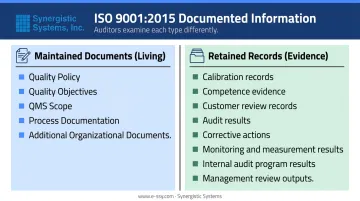
A common point of confusion for first-time implementers: ISO 9001:2015 distinguishes between two types of documented information. Auditors examine each type differently, which makes understanding the distinction audit-critical before your registration date.
Maintained (living documents):
- Quality policy
- Quality objectives
- QMS scope
- Process documentation and procedures
- Any other documentation the organization determines necessary for QMS effectiveness
Retained (records as evidence):
- Calibration and monitoring records
- Evidence of employee competence and training
- Customer requirements review records
- Design and development records (where applicable)
- External provider evaluation records
- Internal audit program and results
- Management review minutes
- Nonconforming output and corrective action records
Document Control Best Practices
ISO 9001:2015 requires a system ensuring only current, approved document versions are in use. NQA's implementation guidance specifies that controlled documents must be identifiable, protected from unintended alteration, and accessible to appropriate personnel. Each document should also carry version/issue status, ownership, review dates, and defined retention rules.
Three principles that separate a compliant system from a paper exercise:
- Keep documentation proportional to the organization's size and complexity — ISO 9001:2015 explicitly does not require unnecessary bureaucracy
- Treat documented information as living evidence of a working system, not a paper exercise
- Auditors will compare what documents say against what actually happens on the floor — gaps between the two are the most common source of nonconformances
The ISO 9001 Certification Process and Ongoing Compliance
Two-Stage External Audit
Certification is conducted by an independent, accredited certification body (registrar) — not by ISO itself, and not by your consultant.
The two stages serve distinct purposes:
- Stage 1 (Documentation Review): The auditor confirms whether the QMS is sufficiently developed, the scope is appropriate, and the organization is ready for Stage 2. Gaps typically result in observations or action items to resolve before proceeding.
- Stage 2 (On-Site Audit): The auditor verifies that documented processes are actually implemented and effective — through interviews, observation, and records review. This is where certification is won or lost.
Registrars can differ in audit style and documentation preferences — something organizations don't always anticipate. Synergistic Systems provides onsite audit support during both stages and has worked alongside accredited registrars including ABS Quality Evaluations, DNV, Bureau Veritas, Lloyd's Register, BSI, NQA, SGS, Intertek, and others. That cross-registrar experience helps clients navigate those differences without surprises.
Surveillance and Recertification Cycle
Certification doesn't end at Stage 2. The ongoing compliance calendar looks like this:
- Year 1: Initial certification (Stage 1 + Stage 2)
- Year 2: Surveillance Audit 1
- Year 3: Surveillance Audit 2
- Year 4: Full recertification audit (restarts the three-year cycle)
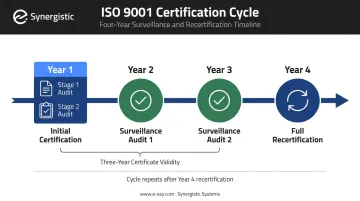
Consistent internal auditing, management review, and corrective action between external audits is what makes recertification achievable. Organizations that treat compliance as a year-round discipline rarely scramble when an auditor arrives.
Responding to Nonconformances
When audits do surface issues, understanding how to respond matters. Nonconformances fall into two categories:
- Minor nonconformance — an isolated lapse or gap that doesn't represent a systemic failure
- Major nonconformance — a systemic failure or absence of a required element that puts certification at risk
For either type, the response process is the same: submit a corrective action plan to the certification body and close the nonconformance by addressing root cause, not just the symptom. Per ANAB's corrective action requirements, plans must be submitted within 30 days and closed within 90 days. Organizations that chase symptoms rather than causes tend to see the same nonconformances recur at the next surveillance audit.
Frequently Asked Questions
What is the ISO 9001:2015 quality management system?
ISO 9001:2015 is the international standard for quality management systems, published by the International Organization for Standardization. It defines requirements for consistently delivering products and services that satisfy customer and regulatory expectations, and applies to any size or industry.
What are the 7 principles of ISO 9001:2015?
The seven principles are: Customer Focus, Leadership, Engagement of People, Process Approach, Improvement, Evidence-Based Decision Making, and Relationship Management. Together, they define how a well-functioning QMS is designed, operated, and improved over time.
What are the 7 steps of QMS?
The core QMS implementation steps are: conducting a gap analysis, defining scope and quality policy, documenting processes, assigning resources and responsibilities, training employees, conducting internal audits and management reviews, and pursuing continual improvement through performance evaluation.
Is ISO 9001 changing in 2026?
Yes. The ISO/FDIS 9001 revision is expected to replace ISO 9001:2015 in September 2026. In the interim, a 2024 amendment (ISO 9001:2015/Amd 1:2024) added climate change consideration language to Clauses 4.1 and 4.2, requiring organizations to determine whether climate change is a relevant issue for their QMS.
How long does ISO 9001 certification typically take?
Most organizations complete ISO 9001 certification in 3–12 months, depending on size, number of sites, and current process maturity. Smaller operations with documented processes often land on the shorter end; multi-site organizations typically need more time. Partnering with an experienced ISO consultant — like Synergistic Systems — can compress the timeline significantly by bringing proven documentation systems and audit-ready structure from day one.