This guide provides a phase-by-phase ISO 9001 certification checklist — covering preparation through post-certification maintenance — that gives organizations a clear sequence of tasks regardless of company size, industry, or starting point.
TL;DR
- Start with a gap analysis and defined QMS scope before creating a single document
- Build document control infrastructure first — every other QMS element depends on it
- Your QMS must be operational for at least three months before you're eligible for certification
- Complete an internal audit and management review before the Stage 2 audit
- Plan for a three-year certification cycle with annual surveillance audits in between
What Is an ISO 9001 Certification Checklist (and Why You Need One)
An ISO 9001 certification checklist is a stage-by-stage tool that maps the full certification journey — from initial preparation through documentation, implementation, internal auditing, and the certification audit itself. Rather than presenting a broad list of standard requirements to interpret, it gives organizations a concrete sequence of tasks with clear outputs at each step.
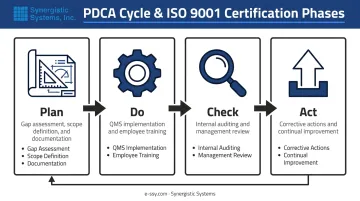
The checklist mirrors the Plan-Do-Check-Act (PDCA) cycle that underpins ISO 9001:2015. ISO's own process approach guidance defines PDCA as: Plan (set objectives and resources), Do (implement), Check (monitor and measure), Act (improve performance).
Each certification phase maps directly onto this cycle:
- Plan — gap assessment, scope definition, and documentation development
- Do — QMS implementation and employee training
- Check — internal auditing and management review
- Act — corrective actions and continual improvement before the registration audit
One important clarification: the scale of effort differs between a 12-person machine shop and a 1,200-person contract manufacturer, but the phases and required tasks remain consistent. A smaller organization will produce leaner documentation and move through phases faster; the sequence doesn't change.
Phase 1: Pre-Implementation Preparation Checklist
Getting Phase 1 right determines the quality of everything downstream. Rushing past scope definition or skipping a proper gap analysis creates compounding problems in later phases.
Define Your QMS Scope
Per ISO 9001:2015 Clause 4.3, the scope statement must specify which products, services, sites, and processes fall under the QMS. It becomes required documented information — meaning auditors will review it at every certification and surveillance audit.
Key scope decisions to document:
- Which products or service lines are included
- Which physical sites or locations are covered
- Any justified exclusions with documented objective evidence (Clause 8.3 Design and Development is commonly excluded by organizations that manufacture to a defined customer specification and do not modify product characteristics — but auditors require documented justification, not just an assertion)
Set Measurable Quality Objectives
Auditors review quality objectives (Clause 6.2) directly — vague targets won't pass. Each objective must be SMART: Specific, Measurable, Achievable, Relevant, and Time-bound, and must align with the quality policy and the organization's strategic direction.
"Improve customer satisfaction" is not an objective. "Achieve a customer satisfaction score of 85% or higher by Q4" is.
Assign Leadership Responsibility
Clause 5 holds top management accountable for QMS effectiveness — not a quality manager working in isolation. This accountability cannot be delegated, and auditors will verify it directly.
A clear leadership structure is required from day one:
- Designate a quality lead with authority to drive implementation across all departments
- For multi-site organizations, assign site-level representatives reporting to a central lead
- Ensure top management can demonstrate active involvement — not just sign-off on documents
Conduct a Gap Analysis
Compare current practices against ISO 9001:2015 requirements to identify what already exists, what needs to be built, and what needs correction. This assessment shapes the project plan and timeline.
For organizations with no existing quality infrastructure, the gap analysis is often where scope creep begins. Working with an experienced ISO consultant — Synergistic Systems, for example, starts every engagement with a complimentary discovery meeting and a fixed-price quotation with defined deliverables — keeps the analysis contained and the project plan realistic.
Secure Genuine Organizational Support
Lack of real management commitment — not documentation gaps — is what causes QMS implementations to stall or produce systems that exist only on paper. Inform employees early: what the project involves, how it will affect their roles, and how they contribute. Staff who understand the why follow procedures consistently; those who don't treat the QMS as an obstacle.
Phase 2: Documentation Requirements Checklist
Understand "Maintain" vs. "Retain"
ISO 9001:2015 makes a structural distinction that affects how your document control system is built:
- Maintain = living documents kept current (procedures, policies, the quality manual if you have one)
- Retain = records that serve as evidence of activities carried out (audit results, calibration records, training records)
Building this distinction into your system from day one prevents one of the most common audit findings: records classified as controlled documents, or procedures treated as static records.
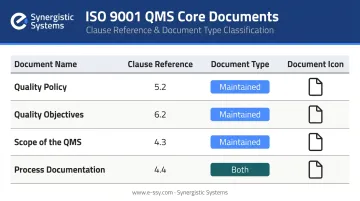
Create the Four Core Documents First
These form the QMS foundation and are reviewed at every certification audit:
| Document | Clause | Type |
|---|---|---|
| Quality Policy | 5.2 | Maintained |
| Quality Objectives | 6.2 | Maintained |
| Scope of the QMS | 4.3 | Maintained |
| Process documentation | 4.4 | Both |
Note: a formal Quality Manual is not mandatory under ISO 9001:2015. Many organizations maintain one as a useful overview document, but its absence is not an audit finding.
Build Your Complete Records List
The standard specifies retained records across multiple clauses. Categories include:
- Calibration and measurement evidence (Clause 7.1.5)
- Employee competence records (Clause 7.2)
- Design and development records, where applicable (Clause 8.3)
- Supplier evaluation and selection records (Clause 8.4.1)
- Nonconformity and corrective action records (Clauses 8.7 and 10.2)
- Internal audit results (Clause 9.2.2)
- Management review outputs (Clause 9.3.3)
Work through each applicable clause systematically. ISO guidance uses "at least" language around record requirements — don't treat any published practitioner count as an official ISO total.
Establish Document Control Before Anything Else
Before creating any other QMS document, write the document control procedure. It needs to define how documents are created, reviewed, approved, versioned, distributed, and retired. Every subsequent document you create will be controlled under this procedure — if it doesn't exist yet, nothing else is properly controlled.
That sequencing matters in practice, not just in theory. Synergistic Systems provisions a cloud-based QMS intranet at the start of every engagement — a controlled environment with defined permission levels — so documentation development begins inside a properly structured system. The result: uncontrolled or obsolete documents in active work areas, one of the most cited audit findings, don't appear in the first place.
Keep Documentation Proportional
ISO 9001:2015 explicitly allows documentation to vary based on organization size, process complexity, and personnel competence. A 15-person fabrication shop doesn't need a 40-page procedure for every process — and a 200-person plant shouldn't be using the same one-page form the shop uses. Documents should describe how work actually happens, not how a downloaded template assumes it does. Auditors notice when procedures don't match observed practice. So do employees, which is why generic templates drive non-compliance as reliably as they drive audit findings.
Phase 3: QMS Implementation and Process Checklist
Introduce Procedures Sequentially
Start with document control, then work through each affected department or function. Use structured sessions — brief manager meetings, team walkthroughs, or one-on-one working sessions — to introduce new procedures. The goal is confirmed understanding: every employee should be able to describe their specific role in the process to an auditor.
Deliver Layered Training
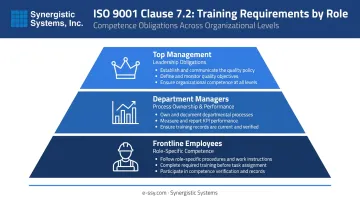
Training requirements under Clause 7.2 are tiered by role:
- Top management: Leadership obligations under Clause 5, quality policy, and quality objectives
- Department managers: Process ownership, performance measurement, and KPI tracking
- Frontline employees: Procedures and work instructions relevant to their specific functions
Training records are required documented information — they serve as evidence of competence, not just attendance. Store completed training records in a controlled location — a cloud-based QMS intranet works well — so they're immediately retrievable during a registration audit.
Establish Operational Controls and Generate Records
As each process goes live:
- Define acceptance criteria for products and services
- Implement monitoring and measurement at key process points
- Set up controls for externally provided products and services (Clause 8.4)
- Start generating records immediately
Certification auditors need evidence that the system was operational before the audit. Records — not just written procedures — are that evidence.
Document Nonconformities as They Arise
Implementation will surface problems. Document them, determine root causes, and apply corrective actions per Clause 10.2. A consistent pattern of identified and resolved nonconformities is a strength during certification audits — it shows the corrective action process is working as intended, not that the organization has problems.
Phase 4: Internal Audit and Management Review Checklist
Set Up a Structured Audit Program
Create an annual schedule ensuring all QMS processes and applicable clauses are audited within a defined cycle. Develop audit checklists derived from ISO 9001 requirements and your own process documentation. Clause 9.2 is explicit on auditor independence: auditors cannot audit their own work.
Complete One Full Internal Audit Before Certification
Before your registrar arrives, the QMS must be fully operational for a minimum of three months and must have completed a full internal audit cycle and management review — a requirement confirmed in NQA's ISO 9001 certification guidance. Any nonconformities found during the internal audit must be addressed with documented corrective actions before the Stage 1 audit.
An incomplete or absent internal audit is one of the most consistent reasons organizations fail Stage 1 readiness checks. Don't skip it or rush it.
Hold a Formal Management Review
Before certification, conduct a management review per Clause 9.3. Required inputs include:
- Status of actions from previous reviews
- Changes in external and internal issues relevant to the QMS
- Customer satisfaction data and quality objective achievement
- Process performance and product/service conformity
- Nonconformity and corrective action status
- Internal audit results and external provider performance
- Resource adequacy and improvement opportunities
Document the outputs with specific decisions and resource commitments. Your registrar will review this record during the certification audit — the minutes need to show what was decided and what resources were committed, not just what topics were discussed.
Phase 5: Certification Audit Preparation Checklist
Select an Accredited Registrar
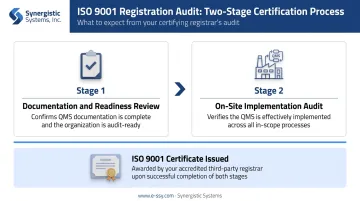
Choose a certification body accredited by a recognized accreditation body — ANAB in the US or UKAS in the UK are the primary options. The certification audit runs in two stages:
- Stage 1: Documentation and readiness review — the auditor confirms your QMS documentation is complete and you're prepared for a full assessment
- Stage 2: On-site audit verifying the QMS is effectively implemented and operating across all in-scope processes
Synergistic Systems has worked with ABS Quality Evaluations, DNV, Bureau Veritas, BSI, LRQA/Lloyd's Register, NQA, SGS, TUV, Intertek, Perry Johnson Registrars, and others. This breadth of registrar experience helps clients select the right body and understand each registrar's specific audit approach.
Prepare Staff and Facilities
Before the Stage 2 audit:
- Remove obsolete or uncontrolled documents from all work areas
- Brief employees on the audit process and the questions they'll be asked
- Confirm every employee can describe their role, their procedure, and how their work connects to quality objectives
Auditors follow process flows and interview personnel at every level. Employees who clearly understand their procedures create a strong impression; those who can't explain their own work create findings.
Plan for Post-Certification Maintenance
ISO 9001 certification operates on a three-year cycle: surveillance audits in years one and two, followed by a full recertification audit in year three. The first surveillance audit must occur no more than 12 months after the final day of the Stage 2 audit.
To keep certification in good standing between audits:
- Address nonconformities from surveillance audits promptly
- Maintain internal audits and management reviews on schedule
- Keep the QMS running as a live operational system year-round
Frequently Asked Questions
What do you need for ISO 9001 certification?
You need a QMS that meets ISO 9001:2015 Clauses 4–10, a completed internal audit, a documented management review, and a successful two-stage external audit conducted by an accredited certification body. The QMS must have been operational for at least three months before the certification audit.
What are the four core documents for ISO 9001?
The four essential maintained documents are the Quality Policy (Clause 5.2), Quality Objectives (Clause 6.2), Scope of the QMS (Clause 4.3), and process documentation and sequence (Clause 4.4). A Quality Manual is no longer mandatory under ISO 9001:2015, though many organizations keep one as a practical reference document.
How long does it take to get ISO 9001 certified?
Most small and mid-sized organizations achieve certification in 3–6 months; larger or multi-site operations typically run 6–12 months. The QMS must be operational for at least three months before the certification audit, and faster timelines depend heavily on management commitment and existing process maturity.
What is the difference between a Stage 1 and Stage 2 audit?
Stage 1 is a documentation and readiness review — the auditor confirms your QMS documentation is complete and the organization is prepared for a full assessment. Stage 2 is the on-site audit that verifies the QMS is effectively implemented and operating across all processes within scope.
How often does ISO 9001 certification need to be renewed?
Certification is valid for three years. Annual surveillance audits occur in years one and two, and a full recertification audit is required in year three. The QMS must remain active and maintained throughout this cycle.
Do I need a consultant to get ISO 9001 certified?
A consultant isn't required, but one reduces time-to-certification, prevents common documentation errors, and brings experience navigating registrar expectations that first-time organizations rarely have in-house. The return is highest for organizations starting from scratch or managing multi-site implementations.