The honest answer is that no single price exists. As ISO itself clarifies, it develops the standard but does not issue certifications. Independent accredited certification bodies handle audits, and their fees vary by registrar, region, organization size, and scope. Layer in preparation costs, consultant support, and a three-year cycle of surveillance audits, and the total picture looks very different from a simple invoice.
This article breaks down realistic cost ranges by organization size, explains every major cost component, and offers practical guidance for budgeting the full certification cycle — not just the initial audit.
TL;DR
- ISO 9001 certification typically costs $5,000–$80,000+ depending on size, complexity, and approach
- Total cost includes gap analysis, documentation, training, audit fees, and recurring surveillance — not a one-time payment
- Small businesses can certify for under $15,000; larger organizations should plan for $35,000–$80,000+ over three years
- Consultant support reduces rework risk and can shorten timelines significantly
- Budget for the full three-year cycle from the start; surveillance and recertification costs are predictable when planned in advance
ISO 9001 Certification Cost by Organization Size
Two budgeting mistakes come up repeatedly: accounting only for audit fees and ignoring preparation costs, and missing the annual surveillance and recertification expenses that continue across the three-year cycle. The ranges below cover the complete picture.
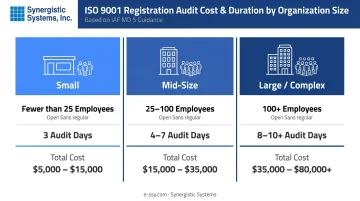
Small Organizations (Fewer Than 25 Employees, Single Site)
Typical total cost: $5,000–$15,000
For a company with fewer than 10 employees at a single location, Amtivo's 2025 pricing guide puts audit fees alone at $4,000–$6,000. Add preparation, documentation, and training and the realistic all-in range lands between $5,000 and $15,000 for initial certification.
Best for:
- Startups and small manufacturers pursuing certification for the first time
- Service firms qualifying for specific vendor or government contracts
- Single-site businesses with fewer than 25 employees
Audit day basis: Per IAF MD 5:2023, a 16–25 employee organization requires approximately 3 audit days for initial certification — a primary driver of what the certification body charges.
Mid-Size Organizations (25–100 Employees, 1–3 Locations)
Typical total cost: $15,000–$35,000
At this size, audit days increase significantly — IAF MD 5 sets 4–7 days for organizations in the 26–125 employee range. More departments require process documentation, training scales across teams, and consultant involvement becomes more substantial.
To illustrate audit-only fees: a 4-day audit at $1,400/day totals $5,600, plus roughly $1,000 in travel — before any preparation costs are added.
Best for:
- Growing companies with established but informal processes
- Organizations that need structured QMS documentation to support scale or new market entry
- Teams facing customer-mandated compliance requirements
Large or Complex Organizations (100+ Employees, Multiple Sites)
Typical total cost: $35,000–$80,000+
Multiple sites, cross-functional documentation, coordinated training programs, and longer audit cycles drive costs at this scale. IAF MD 5 requires 8–10+ audit days for organizations with 126–425 employees. Multi-site organizations face additional complexity under IAF MD 1, which governs whether site sampling is permitted or all locations must be audited individually.
Best for:
- Enterprises in manufacturing, engineering, or healthcare supply chains
- Regulated industries where certification scope spans multiple divisions or facilities
- Organizations managing product lines across several sites
Key Factors That Drive ISO 9001 Certification Cost
Five variables account for most of the spread in ISO 9001 certification costs — and most of them are within your control.
Organization Size and Number of Sites
Employee headcount directly determines auditor day requirements , the primary lever certification bodies use to set fees. Multiple locations multiply costs: each site may require its own on-site assessment, adding both auditor days and travel costs. For multi-site organizations, confirm with any prospective registrar whether site sampling applies to your scope or whether all locations will be audited individually.
Current State of the QMS
Organizations with documented processes, internal audit experience, or prior quality frameworks (AS9100, IATF 16949, ISO 13485) require substantially less preparation time. A gap analysis at the outset reveals exactly how much remediation work stands between your current state and Stage 1 readiness. Skipping it often means paying for audit days before your system is ready to be assessed.
NQA's certification requirements confirm that a QMS must have operated for at least three months with a completed management review and full internal audit cycle before certification can proceed.
Choice of Certification Body
Accredited certification bodies vary in fees, auditor specialization, geographic coverage, and industry recognition. Getting quotes from three or four IAF-accredited registrars (such as ABS Quality Evaluations, DNV, Bureau Veritas, BSI, NQA, and Perry Johnson Registrars) is worthwhile. Verify that each quote explicitly includes:
- Stage 1 documentation review fees
- Stage 2 on-site audit fees
- Travel and accommodation costs
- Administrative and reporting fees
- Surveillance audit terms for years 2 and 3
Level of Consultant Support
Consultant involvement ranges from full-service implementation to targeted support on specific gaps. Published rates from consultancy sources suggest US daily rates in the range of $1,000–$1,400, though rates vary by experience and scope. In practice, organizations with little internal quality infrastructure get the most from full-service support, while those with an existing QMS foundation may only need help closing specific gaps.
Industry and Process Complexity
Regulated industries (aerospace, medical devices, food manufacturing) require more detailed documentation and longer audit cycles. Organizations pursuing industry-specific add-ons (AS9100, IATF 16949, ISO 13485) will see scope and cost increase accordingly.
ISO 9001 Certification Cost Breakdown
The total cost extends well beyond the certification body's invoice. Here are the core cost components, organized by whether they're one-time or recurring.
| Cost Component | Type | Typical Range |
|---|---|---|
| Gap analysis | One-time | Varies by consultant scope |
| Documentation & QMS development | One-time | $997–$5,625+ (template to full build) |
| Employee awareness training | One-time | ~$349/person (online) |
| Internal auditor training | One-time | $1,195/person (3-day, Intertek) |
| Lead auditor training | One-time | $749–$1,695/person |
| Stage 1 + Stage 2 audit fees | One-time per cycle | $4,000–$6,000 (small); scales up with size |
| Travel and accommodation | One-time + recurring | ~$1,000/audit (example, The Center) |
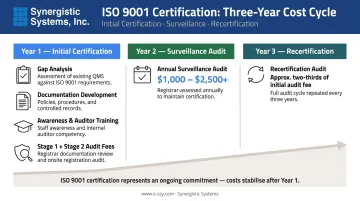
| Annual surveillance audits | Recurring (years 1–2) | $1,000–$2,500+/year |
| Recertification audit (year 3) | Recurring | ~2/3 of initial audit time/cost |
IAF MD 5 sets annual surveillance audit time at roughly one-third of the initial certification audit, and recertification at roughly two-thirds. Budget for both from day one — skipping a surveillance audit results in certificate suspension.
The table covers the visible line items. What catches most organizations off guard are the costs that never appear in a registrar's quote.
Where Hidden Costs Appear
- Corrective action rework following a nonconformance finding adds consultant time and pushes your certification timeline back
- Staff time diverted from daily operations during implementation — a real cost that almost no one budgets for
- Document control gaps that accumulate between audits, making each surveillance audit more time-consuming and expensive
- Travel and accommodation fees excluded from registrar quotes — always request a fully loaded quote before signing
DIY vs. Consultant-Assisted Certification
This is the most consequential cost decision organizations face. Neither approach is universally cheaper — the right answer depends on internal expertise, timeline, and risk tolerance.
Comparing the Two Approaches
| Dimension | DIY | Consultant-Assisted |
|---|---|---|
| Time to certification | Typically longer — steeper learning curve and competing internal priorities | Faster — structured methodology and defined deliverables keep the project on track |
| Documentation quality | Variable — common to over-document or miss key requirements | Consistent — modular, well-structured QMS reduces ongoing maintenance burden |
| Audit nonconformance risk | Higher — gaps often discovered during the certification audit itself | Lower — pre-audit internal audit catches issues before the registrar arrives |
| Three-year cycle cost | Lower upfront; potential re-audit and rework costs offset savings | Higher upfront; fewer surprises and more sustainable QMS over the cycle |
Targeted Consultant Support: The Practical Middle Ground
Many organizations benefit most from targeted consultant support — gap analysis, documentation templates, audit preparation, and internal auditor training — rather than full outsourcing. This preserves internal ownership while bringing in outside expertise on the phases where gaps are most likely to surface.
Synergistic Systems structures every engagement this way: a fixed-price contract with defined deliverables covering a cloud-based QMS intranet, awareness and internal auditor training, collaborative documentation development, a system-wide internal audit, and onsite Stage 1/Stage 2 registration audit support. The total cost is agreed before the project starts, so there are no billing surprises midway through implementation.
How to Keep ISO 9001 Certification Costs Under Control
Cost overruns are common and largely preventable. Most stem from inadequate planning, not from the standard itself being expensive. The highest-impact actions to keep costs in check:
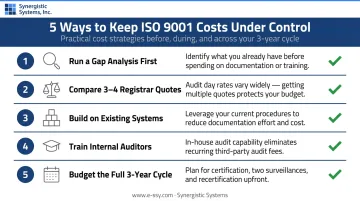
- Run a gap analysis before engaging a registrar — you don't want to pay for audit days you're not ready for
- Get quotes from 3–4 accredited certification bodies and verify what's included: travel, admin fees, all audit stages, and surveillance terms
- Build on existing systems and processes — skip redocumenting what's already working
- Train internal staff as auditors to reduce reliance on outside resources between surveillance cycles
- Budget the full three-year cycle upfront: plan for annual surveillance ($1,000–$2,500+) and year-3 recertification from day one
Several costs catch organizations off guard:
- Corrective action rework when nonconformances surface during Stage 2
- Auditor travel and accommodation fees buried in (or missing from) quotes
- Employee hours lost to documentation and training during the implementation phase
- Undocumented process changes that accumulate between audits, making each surveillance cycle harder and more expensive to pass
Conclusion
ISO 9001 certification cost isn't a single number. It's a function of organization size, process complexity, implementation approach, and the registrar chosen. Small businesses can realistically achieve certification for $5,000–$15,000. Larger organizations should plan for $35,000–$80,000+ across the full three-year cycle.
The right investment is one that's planned accurately and executed with expertise. Synergistic Systems has delivered hundreds of ISO 9001 implementations across manufacturing, oil and gas, aerospace, food processing, and professional services over more than 25 years, with a fixed-price model that eliminates cost surprises from day one.
Contact Synergistic Systems for a consultation tailored to your organization's size, industry, and processes.
Frequently Asked Questions
How much does it cost to get ISO 9001 certified?
Costs range from roughly $5,000 for a small single-site business to $80,000+ for larger or multi-site organizations. No fixed price exists because ISO does not issue certifications — independent certification bodies set their own fees. The size-tier breakdown earlier in this article covers each range in detail.
Is ISO 9001 hard to get?
ISO 9001 is achievable for any size organization, but it requires documented processes, trained staff, and a two-stage audit. Most organizations complete certification within 4–12 months. Registrars typically require at least three months of QMS operation — including a completed internal audit and management review — before the Stage 2 certification audit can proceed.
What does a certification body charge for an ISO 9001 audit?
Fees are based on employee count and audit days required. For a small organization, Stage 1 + Stage 2 combined typically runs $4,000–$6,000 based on published benchmarks; larger organizations pay more as audit days scale. Always compare quotes from multiple IAF-accredited registrars and confirm that travel is itemized separately.
How long does ISO 9001 certification take?
The 4–12 month range holds for most organizations, but what drives the timeline varies. The biggest factors are documentation gaps, employee count, and how mature existing quality practices already are. Organizations with little prior documentation take longer; those with solid process discipline can move quickly through the three-month QMS operation window.
Can a small business afford ISO 9001 certification?
Yes — small businesses are well-suited for ISO 9001, and costs are manageable with targeted consultant support and a right-sized certification body. Many small organizations achieve certification for under $15,000 total by building on existing processes rather than building documentation from scratch.
What are the ongoing costs after initial certification?
Annual surveillance audits typically run $1,000–$2,500+ per year depending on organization size, with travel on top of that. Year three requires a recertification audit roughly equivalent to two-thirds of the initial audit cost. Internal audit activities, document maintenance, and periodic training refreshers are additional ongoing considerations.