This guide is written for quality managers, operations leaders, and business owners in manufacturing, services, and multi-site organizations who are planning or actively managing an ISO 9001 certification project. It walks through the three core implementation phases as a practical, phased checklist — with enough detail to keep your project on track from kick-off through certification.
TL;DR
- Implementation follows three phases: Preparation and Planning, Documentation and Process Design, and Internal Auditing and Certification
- Management commitment and a thorough gap analysis are the two most critical prerequisites — skipping either creates serious audit risk
- The 2015 standard dropped the traditional quality manual requirement; it now requires specific documented information controlled under a document control procedure
- The certification process involves two audits: Stage 1 (documentation review) and Stage 2 (on-site evidence review), typically conducted several weeks apart
- Working with a consultant who has completed hundreds of ISO 9001 projects reduces implementation time and lowers audit risk versus self-implementation
What Is ISO 9001 Implementation — and Why Does It Require a Project Plan?
ISO 9001 implementation means building and operating a Quality Management System (QMS) that satisfies the requirements of ISO 9001:2015, then demonstrating its effectiveness to an accredited third-party auditor. In practical terms, that involves:
- Identifying all customer and regulatory requirements affecting your products or services
- Mapping existing processes and measuring them against the standard
- Closing compliance gaps through documentation, training, and operational changes
- Running the system under real conditions long enough to generate objective evidence
- Completing a formal certification audit with an accredited registrar
ISO-compliant and ISO-certified are not the same thing. ISO itself does not certify organizations — certification is written assurance issued by an independent, accredited certification body after verifying that your system meets the standard's requirements. Compliance means your processes meet the requirements.
Certification means a qualified third party has independently confirmed that fact through documented evidence.
Without a structured project plan, the gap between compliant and certified stays wide. Resources get misallocated, documentation is written in the wrong order, and the organization enters the Stage 1 audit without the evidence base an auditor expects to see.
Phase 1 – Preparation and Planning
The organizations that move through implementation fastest are the ones that invest the most time upfront. Solid preparation means fewer corrective actions at audit and less rework across later phases.
Secure Management Commitment and Assign a Project Lead
ISO 9001:2015 Clause 5.1 requires top management to demonstrate leadership and commitment — not simply sign off on a project charter. As NQA notes, this commitment should be reviewed regularly and should be visible across the organization.
In practice, that means:
- Allocating budget and staff time to the project
- Participating in management review meetings
- Communicating quality priorities to all levels of the organization
- Making resource decisions when the QMS reveals problems
The project lead — whether an internal quality manager or an external consultant — needs clear authority to coordinate across functions.
Cross-functional representation matters here. If documented procedures are written only by the quality department, they tend to reflect how processes should work rather than how they actually do. Production, HR, operations, and purchasing all need a seat at the table.
Conduct a Gap Analysis
A gap analysis is a clause-by-clause comparison of ISO 9001:2015 requirements against what your organization currently has in place. Its output is a prioritized action plan — the backbone of your project.
The gap analysis should examine:
- Existing documented procedures and whether they cover required clauses
- Current record-keeping practices and retention controls
- Process performance measurement and monitoring activities
- How customer feedback, complaints, and nonconformities are currently handled
- Management's involvement in quality decisions
NQA describes the gap analysis as an early certification-journey activity that helps organizations understand what is in place versus what is still needed. Conducting this review with an experienced consultant surfaces compliance risks that are easy to miss on a first read of the standard and prevents costly rework later in the project.
Define Scope, Quality Policy, and Quality Objectives
Three foundational decisions get made here:
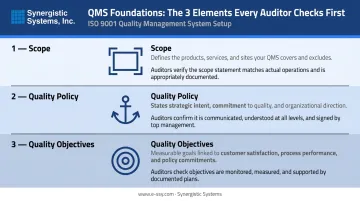
- Scope: Defines which products, services, sites, and processes fall inside your QMS boundary. Too broad and the system becomes unmanageable; too narrow and it may fail to satisfy customer or regulatory requirements — and auditors will question any exclusions.
- Quality policy: The strategic anchor of your QMS. It must reflect genuine organizational intent, not boilerplate language copied from a template.
- Quality objectives: Must be measurable and linked to customer satisfaction, process performance, and continual improvement. Generic statements like "we will meet customer requirements" won't satisfy an auditor looking for linkage to real performance data.
Phase 2 – Documentation and Process Design
ISO 9001:2015 made a significant shift: it no longer requires a traditional quality manual. What it does require is specific documented information — a precise set of maintained documents and retained records. Understanding that distinction prevents both under-documentation and over-documentation.
Develop Mandatory Documented Information
Build your document control procedure first. Every other document in the QMS must be governed by it — version management, approval authority, access controls, and retention rules. Getting this right at the start prevents rework across everything that follows.
The table below summarizes what ISO 9001:2015 explicitly requires:
| Clause | Documented Information | Maintain or Retain |
|---|---|---|
| 4.3 | QMS scope | Maintain |
| 5.2 | Quality policy | Maintain |
| 6.2 | Quality objectives | Maintain |
| 7.2 | Evidence of competence | Retain |
| 8.6 | Authorized release of products/services | Retain |
| 8.7 | Nonconforming outputs and actions taken | Retain |
| 9.2.2 | Audit program and audit results | Retain |
| 9.3.3 | Management review results | Retain |
| 10.2.2 | Nonconformities, actions taken, results | Retain |
Additional documented information is required under Clauses 4.4, 7.1.5, 8.2.3, 8.3.x, 8.4.1, 8.5.x, and 9.1.1. The standard does not prescribe specific formats — only that information be controlled and accessible.
Map and Document Key Processes
ISO 9001 uses a process approach: rather than documenting isolated tasks, you identify how processes connect. For each key process, documentation should address:
- Inputs and expected outputs
- Sequence and interaction with other processes
- Responsible parties and authorities
- Performance measures and monitoring methods
- Risks and opportunities affecting process outcomes
Capturing all five elements for every key process is where first-time implementations often stall. Synergistic Systems' modular documentation framework means clients don't start from a blank page — industry-adaptable templates are customized to reflect how the organization actually operates, which reduces implementation time and gets documentation audit-ready earlier in the project.
Implement and Operate the QMS
Documentation alone does not constitute a working QMS. Staff must be trained, records must begin accumulating under live operating conditions, and the system must be actively used before a certification body will consider it mature enough to audit.
Training happens at two levels:
- Awareness training (all staff): explains why the QMS exists, what certification requires, and what each employee's role is within the system
- Internal auditor training (designated auditors): covers audit planning, clause-based review techniques, finding documentation, and maintaining objectivity
- Process owner training (department leads): focuses on operating procedures, record-keeping responsibilities, and performance monitoring within their specific processes
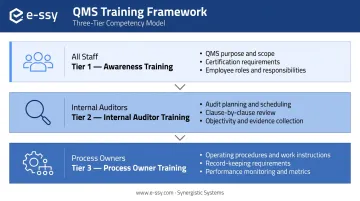
In a standard Synergistic Systems engagement, all three training types are delivered as Step 5 of the 10-step implementation methodology. The firm also provisions a cloud-based QMS intranet included in the project price — no hardware or software purchase required. It hosts all controlled documents, records, corrective actions, management reviews, and audit evidence in one accessible system.
Phase 3 – Internal Auditing, Corrective Action, and Certification
Conduct Internal Audits and Management Review
The internal audit program must cover every process within the QMS scope before the certification audit. Internal auditors must be independent of the process being audited — a requirement that creates a scheduling challenge in smaller organizations and is one reason cross-training internal auditors pays off.
During the audit, auditors verify three things:
- Processes are being followed as documented
- Records exist to demonstrate they are
- The system is achieving planned results
The management review is a separate, required leadership event. Top management evaluates QMS performance data — customer feedback, internal audit results, process trends, resource needs — and makes formal decisions about objectives, improvements, and allocation. The output of that meeting is a retained record. Auditors check for it directly.
Synergistic Systems conducts the system-wide internal audit as Step 8 of its methodology and facilitates the management review as Step 9, ensuring both activities produce the documented evidence an auditor expects.
Close Nonconformities with Corrective Action
Corrective action is not just fixing the immediate problem. ISO 9001:2015 Clause 10.2 requires:
- Identifying the root cause of the nonconformity
- Taking action to eliminate that root cause
- Verifying that the action was effective
As DNV explains, major nonconformities — those that create significant doubt about whether your system can deliver its intended outputs — require evidence of effectively implemented corrective actions before certification can proceed. Arriving at Stage 2 with open corrective actions is a leading cause of certification delays — and one of the most preventable.
Select a Certification Body and Prepare for the Audit
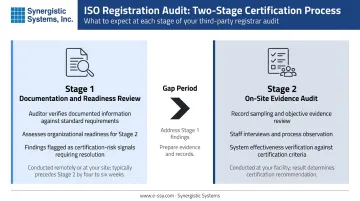
The certification audit has two stages:
- Stage 1 — Primarily a documentation and readiness review. The auditor verifies that your documented information addresses all ISO 9001 requirements and assesses whether your organization is ready for Stage 2. Treat any findings here as certification-risk signals, not minor administrative notes.
- Stage 2 — The on-site evidence audit. Auditors sample records, interview staff, and observe processes to verify the system is implemented and effective. According to SGS, Stage 2 is typically conducted several weeks after Stage 1 to allow time to address any Stage 1 findings.
When selecting a certification body, check:
- Accreditation status through ANAB (US) or UKAS (UK)
- Auditor experience in your specific industry
- Sample nonconformity report format and clarity
- Surveillance audit frequency and scheduling requirements
When your chosen registrar arrives, Synergistic Systems is on-site for both Stage 1 and Stage 2 as Step 10 of its engagement. The firm has worked alongside accredited registrars including ABS Quality Evaluations, DNV, BSI, LRQA, NQA, SGS, Bureau Veritas, TUV, and Intertek, among others.
Common Pitfalls That Derail ISO 9001 Implementation
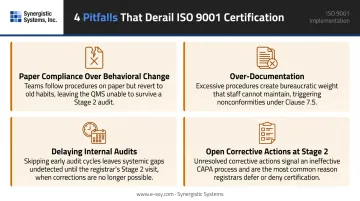
Four mistakes account for the majority of failed or delayed ISO 9001 certifications:
- Paper compliance over behavioral change. Writing procedures without changing behavior collapses under audit scrutiny. If staff can't describe how a procedure applies to their daily work, the auditor will find out.
- Over-documentation. ISO 9001:2015 requires a documented QMS, not a system of documents. Documenting every activity at a granular level creates a system too burdensome to maintain — procedures get ignored, bypassed, or forgotten. Document only where the absence of documentation would negatively affect quality.
- Delaying internal audits. Internal audits should function as an iterative learning tool throughout Phase 3, not a one-time pre-certification check in the final four weeks. Early audits surface nonconformities while there is still time to investigate root causes, implement corrective actions, and verify effectiveness before Stage 2.
- Open corrective actions at Stage 2. Any major nonconformity from your internal audit program must have documented evidence of effective corrective action before the registration auditor arrives. An unresolved finding signals the system isn't operating as intended and can draw a major nonconformity against Clause 10.2.
Frequently Asked Questions
What are the steps to implement ISO 9001?
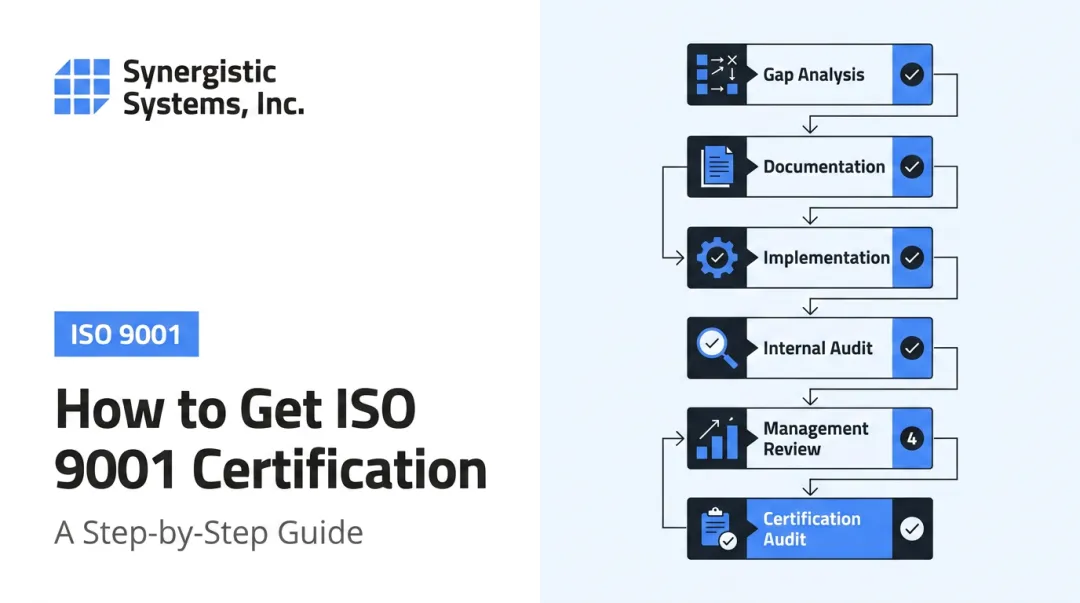
Implementation follows three phases: Preparation and Planning (gap analysis, scope definition, team assignment), Documentation and Process Design (mandatory documented information, process mapping, staff training), and Internal Auditing and Certification (internal audits, corrective action closure, Stage 1 and Stage 2 certification audits).
What documents are required in ISO 9001 implementation?
ISO 9001:2015 requires maintained documents (scope statement, quality policy, quality objectives) and retained records (competence evidence, monitoring results, audit program and results, management review outputs, nonconformity and corrective action records). The standard doesn't prescribe specific formats — only that all documented information be controlled and accessible.
What is the ISO 9001 audit checklist?
An ISO 9001 audit checklist is a clause-by-clause review tool that verifies each section of the standard — from Context of the Organization (Clause 4) through Improvement (Clause 10) — has been addressed through documented evidence and observable practice. Both internal and registrar auditors use this format.
What are the 7 basic principles of ISO 9001?
The seven quality management principles are: customer focus, leadership, engagement of people, process approach, improvement, evidence-based decision making, and relationship management. These principles underpin every clause of the standard and guide how the QMS is designed and operated.
How long does it take to get ISO 9001 certified?
The timeline depends on organizational size, number of sites, existing process maturity, resource availability, and whether an experienced consultant is involved. Because these factors differ so widely, Synergistic Systems provides a fixed-price quotation with a defined timetable after an initial discovery meeting — not a generic estimate.
Can a small organization implement ISO 9001 without a consultant?
Yes — documentation toolkits and public resources make self-implementation possible. However, first-time implementers consistently underestimate the time needed for gap analysis, document control setup, and internal auditor training. An experienced consultant shortens the project timeline, surfaces compliance gaps early, and lowers the risk of major nonconformities at Stage 2.