Introduction
Many manufacturers, contractors, and service companies are facing the same pressure: clients are requiring ISO certification, but it's not clear which standard applies, what the certification process actually involves, or whether pursuing all three means building three entirely separate systems.
ISO 9001 governs quality management, ISO 14001 covers environmental performance, and ISO 45001 addresses occupational health and safety. All three are published by the International Organization for Standardization and recognized worldwide across industries and sectors.
These three standards share a common architecture — which means pursuing all three together is often more efficient than tackling them one at a time. This guide explains what each standard requires, how they relate, and how the certification process works.
TL;DR
- ISO 9001 = Quality Management System (QMS); ISO 14001 = Environmental Management System (EMS); ISO 45001 = Occupational Health & Safety Management System (OHSMS)
- All three share the same 10-clause Harmonized Structure (Annex SL), making integrated implementation practical
- Certification is issued by accredited third-party registrars — not ISO itself
- Certification follows five stages: gap analysis, documentation, implementation, internal audit, and third-party audit
- Pursuing all three together reduces cost, eliminates duplicate documentation, and unifies your improvement culture
What Are ISO 9001, ISO 14001, and ISO 45001?
All three are management system standards built around the principle of continual improvement. None prescribe specific outcomes — instead, each provides a framework for systematically managing a defined area of organizational risk.
ISO 9001: Quality Management System
ISO 9001 gives organizations a framework for consistently delivering products and services that meet customer and regulatory requirements. Its core principles include customer focus, process approach, leadership commitment, and continual improvement.
Any organization that needs to demonstrate consistent quality — manufacturers, service providers, contractors, distributors — can benefit. According to 2024 data from IAF CertSearch, 1,474,118 ISO 9001 certificates are currently active across more than 2.3 million sites worldwide, making it the most widely adopted management system standard globally.
ISO 14001: Environmental Management System
ISO 14001 helps organizations identify, monitor, and reduce their environmental impacts through a structured EMS — covering resource use, emissions, waste, and compliance with environmental legislation.
It's particularly relevant for organizations with a meaningful environmental footprint, including:
- Manufacturers and industrial processors
- Construction and civil engineering firms
- Oil and gas operators and energy companies
- Any organization subject to environmental regulatory oversight
Note: ISO 14001:2015 has been replaced by ISO 14001:2026, published in April 2026. Organizations currently certified to the 2015 edition should confirm transition requirements with their registrar.
ISO 45001: Occupational Health and Safety Management System
ISO 45001 provides a framework for preventing workplace injuries, illnesses, and fatalities by proactively identifying hazards, assessing risks, and implementing controls — covering physical and psychological wellbeing.
It replaced OHSAS 18001 as the global reference standard for OHS management systems. Liberty Mutual's 2024 Workplace Safety Index reports that U.S. businesses spend more than $58 billion per year — over $1 billion per week — on serious workplace injuries. Any organization that employs workers or manages contractors has a direct financial stake in getting this right.
Key Differences and Shared Structure
The three standards address distinct risk categories and stakeholder groups:
- ISO 9001 is customer-facing: output quality, process control, and meeting customer requirements
- ISO 14001 targets external impact — environmental performance and regulatory compliance
- ISO 45001 looks inward, focusing on worker safety, hazard control, and operational health
Despite these different focuses, all three share the same underlying architecture.
The Annex SL Harmonized Structure
ISO deliberately designed its management system standards around a common framework called the Harmonized Structure (Annex SL). Every standard uses the same 10 clause headings:
| Clause | Heading |
|---|---|
| 1 | Scope |
| 2 | Normative references |
| 3 | Terms and definitions |
| 4 | Context of the organization |
| 5 | Leadership |
| 6 | Planning |
| 7 | Support |
| 8 | Operation |
| 9 | Performance evaluation |
| 10 | Improvement |
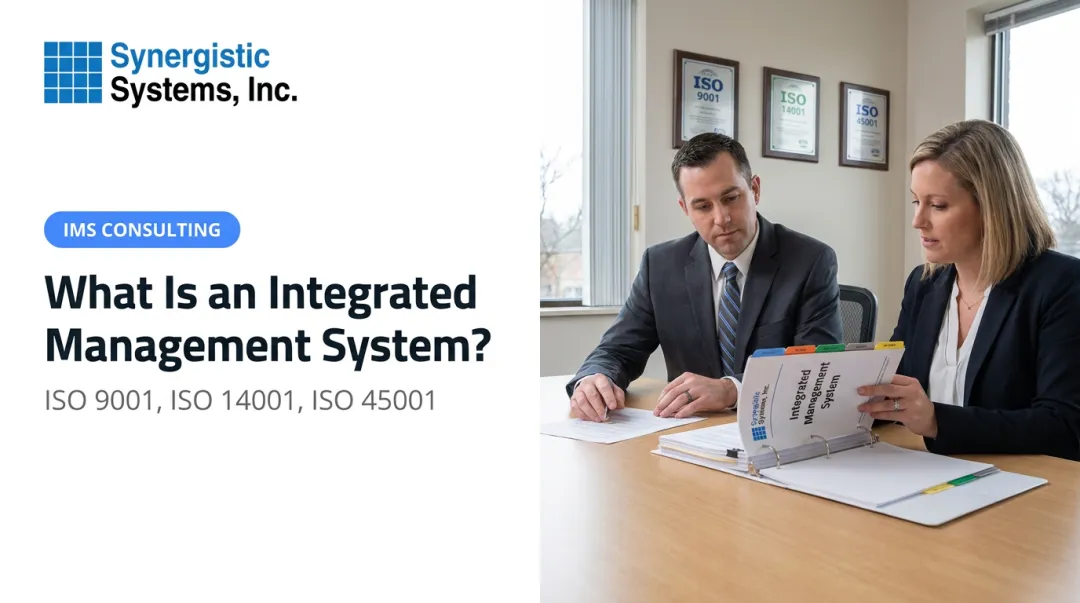
This shared structure means the same policies, procedures, internal audits, and management reviews can satisfy all three standards simultaneously. That's the practical foundation of an Integrated Management System (IMS) — one coherent system instead of three parallel ones.
Where the Standards Diverge
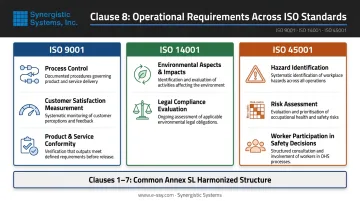
Clauses 1 through 7 are largely common ground — shared by design so organizations can build a single IMS. The divergence happens at Clause 8, where each standard defines its unique operational requirements:
- ISO 9001 emphasizes process control, customer satisfaction measurement, and product/service conformity
- ISO 14001 requires identification of environmental aspects and impacts, plus legal compliance evaluation
- ISO 45001 focuses on hazard identification, risk assessment, and meaningful worker participation in safety decisions
Why These Standards Matter for Your Business
Market Access and Contract Requirements
Certification has moved well beyond a "nice to have." Large enterprises, government agencies, and global supply chains now list one or more of these standards as a supplier qualification requirement.
In U.S. federal procurement, SAM.gov solicitations have explicitly required ISO 9001:2015 certification through ANAB- or IAF-accredited bodies as a contract condition. Defense, aerospace, and heavy manufacturing supply chains routinely list ISO 9001 as a baseline expectation — and ISO 14001 is increasingly referenced in sustainability procurement policies worldwide.
Operational Benefits by Standard
Each certification drives measurable operational improvement:
- ISO 9001 — Systematic process control reduces defects, rework, and warranty costs. A 2021 peer-reviewed study of automotive component manufacturers found a statistically significant relationship between ISO 9001 adoption and operational performance.
- ISO 14001 — Structured environmental management reduces resource consumption and waste generation costs. A meta-analysis covering 53 studies and 182,926 companies found a positive relationship between ISO 14001 and corporate environmental performance.
- ISO 45001 — Fewer incidents mean less downtime, lower workers' compensation claims, and reduced insurance premiums — directly addressing the $58B annual injury cost burden cited above.
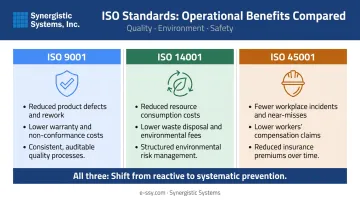
All three standards push organizations from reactive problem-solving to systematic prevention — identifying risks before they materialize rather than responding after the fact. That discipline, once embedded, becomes part of how the business operates — not just how it passes audits.
The Case for Pursuing All Three Together
That proactive mindset is strongest when quality, environmental, and safety management operate as one system rather than three separate programs. When ISO 9001, ISO 14001, and ISO 45001 are implemented as an Integrated Management System:
- Policies and procedures serve all three standards from a single set of documents
- A single internal audit cycle covers quality, environmental, and safety requirements
- Management reviews performance across all three areas in one session
- Training effort is consolidated rather than repeated three times
Synergistic Systems structures ISO 14001 and ISO 45001 as add-on modules built on an ISO 9001 foundation — using the existing process approach, document control infrastructure, and audit framework rather than building parallel systems. This integrated approach typically cuts implementation cost by a material margin compared to three standalone projects.
How ISO Certification Works: Step-by-Step
One critical point first: ISO does not certify organizations. ISO writes and publishes the standards. Certification is issued by independent, accredited third-party registrars after a formal audit process. Synergistic Systems has supported clients through certification with registrars including ABS Quality Evaluations, DNV, Bureau Veritas, LRQA, BSI, QMI-SAI Global, NSF-ISR, NQA, TUV, SGS, and Intertek, among others.
Step 1: Gap Analysis
A gap analysis compares your current management practices against the requirements of the target standard(s). The output identifies what documentation, processes, and controls need to be developed or modified before implementation begins. This is the logical starting point: you can't plan a project without knowing where the gaps are.
Step 2: Documentation and System Design
Organizations must develop the required documented information to meet standard requirements. For ISO 9001, this includes:
- Quality Policy and quality objectives
- Scope statement and documented procedures
- Work instructions, forms, and records
ISO 14001 and ISO 45001 add standard-specific requirements — environmental aspects registers, legal compliance evaluations, hazard logs, and incident records — built into the same document control system.
Documentation should be proportional to the organization's size and complexity. The goal is a practical system people will actually use, not a binder that lives on a shelf.
Step 3: Implementation and Training
The management system must be actively embedded across the organization. This means:
- Awareness training — ensuring all personnel understand what the standard requires and how it affects their roles
- Internal auditor training — equipping staff to conduct system audits going forward
- Working sessions — translating documented procedures into daily operational practice
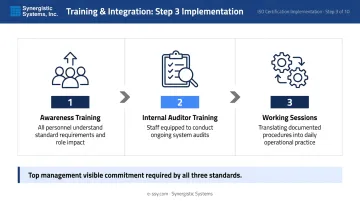
Top management commitment isn't optional here. All three standards explicitly require visible leadership engagement, not just a signed policy statement.
Step 4: Internal Audit and Management Review
Before the third-party audit, the organization must complete a full internal audit verifying the system is functioning as intended, followed by a management review to evaluate performance data and set improvement objectives. Non-conformances identified at this stage should be resolved before the external audit — this is exactly what the internal audit is designed to catch.
Synergistic Systems conducts the system-wide internal audit and facilitates the management review as part of its standard engagement scope, providing clients with a clear picture of readiness before the registrar arrives.
Step 5: Third-Party Certification Audit
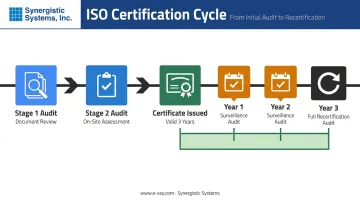
The external registrar conducts the audit in two stages:
- Stage 1 — Document review; the auditor confirms the management system is documented and the scope is appropriate
- Stage 2 — On-site conformance assessment; the auditor verifies the system is implemented and operating effectively through objective evidence
Successful completion results in certification valid for three years, with annual surveillance audits required to maintain it. A full recertification audit occurs at the end of the three-year cycle.
Common Misconceptions About ISO Certification
Misconception #1: "ISO Certification Is Primarily About Paperwork"
Documentation is required, but it's a means to an end — not the goal. The goal is better-run operations, not a filing cabinet full of procedures. Organizations that treat documentation as the deliverable consistently struggle to maintain certification — they've built a system that lives on paper but not in practice.
Misconception #2: "Three Certifications Require Three Entirely Separate Systems"
Because ISO 9001, ISO 14001, and ISO 45001 share the Annex SL Harmonized Structure, organizations can implement a single Integrated Management System that satisfies all three. One unified set of policies, one combined audit, one management review. This is the practical case for pursuing them together.
Misconception #3: "ISO Certification Is Only Realistic for Large Companies"
All three standards are explicitly designed to scale to organizations of any size. The key is proportionality:
- A 15-person machine shop needs far less documentation depth than a 500-person manufacturer
- Both can achieve and maintain certification under the same standard requirements
- The requirements don't change — the implementation approach does
Frequently Asked Questions
What is ISO 9001, ISO 14001, and ISO 45001?
ISO 9001 is the Quality Management System standard, ISO 14001 is the Environmental Management System standard, and ISO 45001 is the Occupational Health and Safety Management System standard. All three are published by ISO, follow the same Annex SL Harmonized Structure, and apply to any organization regardless of size or industry.
How do I get ISO 9001, ISO 14001, or ISO 45001 certified?
Conduct a gap analysis, build and implement the required management system with supporting documentation, complete an internal audit and management review, then pass a two-stage external audit conducted by an accredited third-party registrar. The registrar — not ISO — issues the certificate.
How much does ISO 45001 certification cost?
External audit fees vary based on audit duration, organization size, scope, complexity, and number of sites — there is no universal published rate. Certification costs are typically offset over time by reductions in incident-related downtime, workers' compensation claims, and insurance premiums. Synergistic Systems provides fixed-price engagement quotes following a complimentary discovery meeting.
Can ISO 9001, ISO 14001, and ISO 45001 be certified together?
Yes. Organizations can implement an Integrated Management System (IMS) that satisfies all three standards through a single unified framework, taking advantage of the shared Annex SL Harmonized Structure to reduce duplication across documentation, audits, and training.
How long does ISO certification take?
The management system must be operational for at least three months and must have completed a full internal audit cycle before the certification audit. End-to-end timelines typically range from several months to over a year depending on the organization's current state of readiness, size, and complexity. Synergistic Systems' fixed-price, 10-step implementation methodology is designed to move organizations from no system to certified as efficiently as their readiness allows.
Is ISO 9001, ISO 14001, or ISO 45001 certification mandatory?
All three are voluntary in most jurisdictions. In practice, they are often effectively required — client contracts, supply chain qualification requirements, and public procurement processes in manufacturing, construction, and defense frequently list one or more certifications as a condition of doing business.