Introduction
The ISO 9001 management review is a mandatory, top-management-led evaluation of the Quality Management System — defined under Clause 9.3 of ISO 9001:2015 — to confirm the QMS remains suitable, adequate, and effective.
This guide is written for quality managers, management representatives, and operations leaders responsible for implementing or maintaining an ISO 9001 QMS. The management review is one of the most closely scrutinized elements during third-party certification audits — because it's where auditors look for evidence that leadership is genuinely engaged.
Too many organizations reduce it to a once-a-year paperwork exercise. The standard doesn't ask for that — it asks for genuine performance evaluation and leadership-directed improvement. This guide covers what Clause 9.3 actually requires, what a well-executed review looks like in practice, and the mistakes organizations make most often.
TL;DR
- Clause 9.3 requires management review — conducted by top management, at planned intervals, with no exceptions
- Defined inputs (audit results, customer feedback, nonconformities, risks, resources) must feed into the review; documented outputs with decisions and assigned actions are required
- Frequency should reflect organizational risk and complexity — not default to once a year
- Integrate reviews into existing management cadences — provided all required inputs are covered and records are retained
- The goal is continual improvement, not compliance theater
What Is an ISO 9001 Management Review and Why Does It Matter?
The Clause 9.3 Framework
ISO 9001:2015 Clause 9.3.1 states that top management shall review the organization's QMS at planned intervals to ensure its continuing suitability, adequacy, effectiveness, and alignment with strategic direction. The clause is organized into three sub-clauses:
- 9.3.1 General — establishes the top-management obligation
- 9.3.2 Management review inputs — defines what must be considered
- 9.3.3 Management review outputs — defines what the review must produce
This structure maps directly onto the PDCA (Plan-Do-Check-Act) cycle. The management review is the "Check" mechanism at the system level — where top management steps back from daily operations and asks whether the QMS as a whole is still fit for purpose.
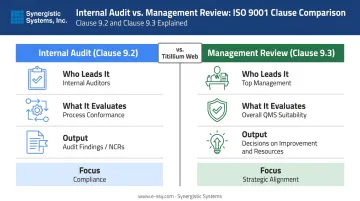
Management Review vs. Internal Audit
These two are often conflated, but they serve fundamentally different functions.
| Internal Audit (Clause 9.2) | Management Review (Clause 9.3) | |
|---|---|---|
| Who leads it | Internal auditors | Top management |
| What it evaluates | Conformance to requirements at the process level | Overall QMS suitability, adequacy, and effectiveness |
| Output | Audit findings, nonconformity reports | Decisions on improvement, resources, and QMS changes |
| Focus | Compliance | Strategic alignment and performance |
Why It's a Leadership Responsibility
The management review is the primary mechanism for top management to act on performance signals rather than simply receive them. When conducted with discipline, it drives concrete outcomes:
- Allocates resources to address gaps identified in audits and customer feedback
- Updates quality objectives to reflect shifts in strategic direction
- Directs corrective actions and continual improvement initiatives
- Closes the loop between QMS data and executive decision-making
Without this discipline, the review becomes a documentation exercise — and the organization loses its clearest window into whether the QMS is actually working.
Required Inputs for the ISO 9001 Management Review
What Clause 9.3.2 Requires
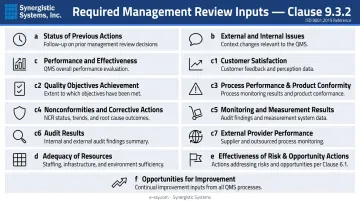
Clause 9.3.2 defines six input categories (a through f) that must be addressed within each management review cycle. Missing inputs are a recurring audit finding. "Planned intervals" means all inputs don't have to be covered in a single meeting — but they must all be addressed within the review programme.
The full input list:
| Input | What to Cover |
|---|---|
| a | Status of actions from previous management reviews |
| b | Changes in external and internal context (Clauses 4.1/4.2) |
| c1 | Customer satisfaction and feedback |
| c2 | Extent to which quality objectives have been met |
| c3 | Process performance and product/service conformity |
| c4 | Nonconformities and corrective actions |
| c5 | Monitoring and measurement results |
| c6 | Internal and external audit results |
| c7 | Performance of external providers |
| d | Adequacy of resources |
| e | Effectiveness of actions taken to address risks and opportunities |
| f | Opportunities for improvement |
Two Inputs Organizations Frequently Overlook
Risks and opportunities (input e): Organizations often track risks in a register but never formally evaluate whether the actions taken to address them actually worked. Clause 9.3.2(e) requires that effectiveness review — not just status.
Changes in context (input b): This includes regulatory shifts, market changes, and supply chain disruptions. Following the ISO 9001:2015/Amd 1:2024 climate action amendment published in February 2024, climate change considerations added to Clauses 4.1 and 4.2 may now flow into the management review through this input if determined relevant to the organization's QMS context.
Why Trend Analysis Matters
Clause 9.3.2 requires the review to consider trends in data, not just point-in-time snapshots. A single month's defect rate tells you very little. Six months of data showing a gradual upward drift tells you a process is degrading before it becomes a systemic failure. That early-warning capability is what separates a management review that drives decisions from one that simply documents them.
Pre-Meeting Data Preparation
Well-run management reviews depend on groundwork done before anyone enters the room. To make the session productive:
- Assign a named owner to compile each input category in advance
- Distribute data to all attendees before the meeting
- Reserve the session itself for analysis and decisions — not first-time data review
Organizations that skip pre-distribution typically spend 60% of the session reviewing numbers and 40% making decisions. That ratio should be reversed.
How to Conduct an ISO 9001 Management Review
An effective management review follows three practical stages: preparation and planning, the review session itself, and monitoring and follow-up.
Step 1: Preparation and Planning
Build a review program, not just a meeting.
Define the schedule, frequency, agenda structure, and input owners before the review cycle begins. For organizations with multiple sites or complex process structures, a tiered approach works well: departmental or site-level reviews feed consolidated data into an executive-level review. This structure keeps the top-level session focused on strategic decisions rather than operational detail.
Let risk — not habit — drive your review frequency.
The standard requires "planned intervals" — it does not specify annual. One practical structure:
- Monthly or quarterly: Customer feedback, nonconformities, process performance KPIs, corrective action status
- Semi-annually: Audit results, supplier performance, resource adequacy
- Annually (or as triggered): Policy review, strategic objectives, context changes
Annual-only reviews are generally insufficient for organizations experiencing active quality issues, high process variability, or significant customer complaints.
For multi-site operations, coordinating inputs across locations adds real complexity. Synergistic Systems has facilitated management reviews across hundreds of ISO 9001 implementations and helps organizations build modular review programs suited to their structure — especially where tiered reporting across sites is involved.
Step 2: Conducting the Management Review Session
Who must attend: A member of top management must chair the review. Other participants typically include functional and line managers, process owners, and internal auditors as appropriate. The standard doesn't prescribe a specific format — reviews may be standalone meetings, embedded within existing management cadences, or a combination — provided records are maintained.
What good discussion looks like:
- Management evaluates trends, not just reports numbers
- Decisions are made on improvement actions, not deferred
- Resource plans are updated where data demands it
- Objectives are revised if current targets are no longer meaningful
- Strategic changes affecting the QMS are formally addressed
The session should produce real decisions. If the output of your management review is "everything is fine, continue as-is," either your QMS is performing exceptionally well or the review wasn't scrutinized closely enough.
Step 3: Monitoring and Follow-Up
After the review, every action item must have:
- A named individual responsible for completion
- A target completion date
- Communication to affected parties
- Tracked closure before the next review cycle
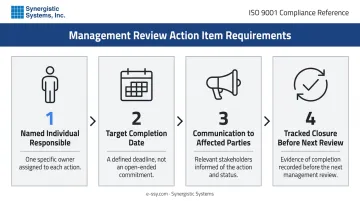
The status of actions from the previous management review is itself a required input at the next cycle (Clause 9.3.2(a)). This creates a closed-loop accountability structure — open actions must be formally addressed, not carried forward indefinitely.
DNV's guidance on ISO audit mistakes identifies failure to follow up on nonconformities and corrective actions as a critical audit risk. The same principle applies here: unresolved prior management review actions appearing repeatedly across review cycles is a direct audit red flag.
All outputs and decisions must be retained as documented information — meeting minutes, action logs, and data presentations all qualify. The format is flexible; the evidence must be retrievable.
Management Review Outputs and Documentation Requirements
What Clause 9.3.3 Requires
The management review must produce documented outputs covering:
- Decisions and actions related to opportunities for improvement of the QMS, its processes, and products/services
- Resource needs — budget, personnel, equipment, infrastructure
- Changes to the QMS — including policy or quality objectives where warranted
These outputs must be directly traceable to the inputs reviewed. If customer satisfaction data showed a declining trend, the output should reflect a decision in response to that trend.
What Records Must Be Retained
Per ISO 9001:2015, Clause 9.3.3 requires organizations to retain evidence of the results of management reviews. At minimum, retain:
- Meeting minutes capturing decisions made
- Actions assigned with named owners and due dates
- Evidence that all required inputs from Clause 9.3.2 were addressed
The format is flexible — electronic records, shared platforms, or formal reports all work. What auditors look for is completeness, traceability, and evidence of genuine decision-making.
The Difference Between Real Outputs and Placeholder Outputs
| Example | |
|---|---|
| Strong output | "Following three consecutive quarters of measurement system failures, the review approved budget for two additional calibration instruments and assigned procurement to the Quality Manager by Q3." |
| Weak output | "The organization will continue to monitor quality performance and address issues as needed." |
The second statement satisfies the format but provides no management direction. Auditors recognize this pattern immediately — certification bodies flag it consistently. Every output should show a clear link from input data to a specific decision.
Routing Corrective Outputs Through Clause 10.2
If the management review identifies systemic process failures or significant resource shortfalls, those issues should be routed through the organization's nonconformity and corrective action system under Clause 10.2 — not tracked informally in meeting minutes. This ensures root cause analysis is conducted and effectiveness is verified, not just that the issue was acknowledged.
This connection between management review outputs and the CAPA system is a common gap in practice. Organizations that track review action items in a separate spreadsheet or standalone meeting minutes often lose the thread between the original finding and its corrective resolution — which is exactly what an auditor will look for when verifying Clause 10.2 conformance.
Common Mistakes Teams Make in ISO 9001 Management Reviews
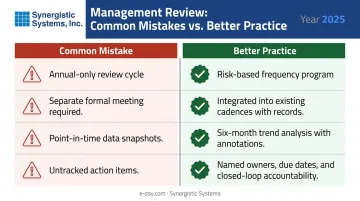
Mistake 1: Treating It as an Annual Compliance Exercise
The most common failure. An annual management review often means a 12-month gap between identifying a performance trend and doing anything about it. If customer complaints spiked in March and the management review is in November, you've already lost eight months of potential corrective time.
More practically, annual reviews tend to have input coverage gaps. When data spans an entire year, organizations often struggle to reconstruct trends — especially for items like corrective action status or supplier performance — leading to surface-level discussion and audit findings around incomplete inputs.
Mistake 2: Believing the Review Must Be a Separate Formal Meeting
It doesn't. The standard requires the review, the inputs, the outputs, and the retained records. It doesn't require a ceremony.
Organizations can integrate management review elements into existing operational meetings — quarterly business reviews, leadership team meetings, operational cadences — as long as all Clause 9.3.2 inputs are covered within the program and evidence is retained.
The key constraint is documentation: the review must be traceable. A normal business meeting that covers the right topics but produces no records does not satisfy Clause 9.3.
Mistakes 3 and 4: Point-in-Time Data and Untracked Actions
Two additional mistakes consistently surface in management review programs:
- Point-in-time data review misses the intent of Clause 9.3.2. Presenting last month's defect rate without context tells management nothing useful. A six-month trend with annotations showing where process changes were implemented gives them something they can act on.
- Untracked action items undermine the entire purpose of the review. Organizations that open each new review with the same list of open actions — ownership unclear, due dates passed — have created a paper trail that documents systemic failure to improve. Third-party auditors look for exactly this pattern during surveillance audits, and repeated carry-over with no closure is a reliable path to a major nonconformity.
Frequently Asked Questions
What is a management review for ISO 9001?
It's a required periodic evaluation conducted by top management under Clause 9.3 of ISO 9001:2015. The purpose is to assess whether the QMS remains suitable, adequate, and effective — and to make formal decisions on improvement actions, resource needs, and QMS changes.
What is the ISO clause for management review?
Management review is covered under Clause 9.3, organized into three sub-clauses: 9.3.1 (General requirements), 9.3.2 (Required inputs), and 9.3.3 (Required outputs). The obligation is normative: it cannot be excluded from the QMS scope.
What is the management review agenda for ISO 9001?
The agenda must address all mandatory inputs from Clause 9.3.2: prior action status, customer feedback, process performance, audit results, nonconformities, risks and opportunities, supplier performance, and resource adequacy. These topics can be distributed across multiple review sessions within a planned program rather than covered in a single meeting.
How often should the ISO 9001 quality management system be reviewed?
The standard requires "planned intervals" without specifying a fixed frequency. Higher-risk or higher-complexity organizations typically review critical inputs monthly or quarterly. Annual-only reviews rarely provide timely enough insight into performance trends — and a program that can't demonstrate coverage of all required inputs is a common audit finding.
Who should attend an ISO 9001 management review?
A member of top management must chair the meeting. Other attendees typically include functional managers, process owners, and internal auditors. The appropriate participants depend on the topics being reviewed — there's no single prescribed attendee list in the standard.
What documented information is required from an ISO 9001 management review?
Organizations must retain evidence of the results, including meeting minutes, decisions made, improvement actions assigned with owners and due dates, and evidence that all required inputs from Clause 9.3.2 were addressed. Format is flexible, but records must be retrievable during audits.