Introduction
A customer sends a supplier questionnaire. It asks whether your organization holds ISO 9001, ISO 14001, or ISO 27001 — and suddenly you're weighing three certifications you may not have compared before. The question most business leaders land on: which one do I actually need?
ISO 9001, ISO 14001, and ISO 27001 are among the most widely pursued management system certifications worldwide — ISO's most recent annual survey counts over 1.5 million ISO 9001 certificates issued globally, with ISO 14001 and ISO 27001 each adding hundreds of thousands more. Each standard targets a distinct operational domain: ISO 9001 governs quality, ISO 14001 governs environmental performance, and ISO 27001 governs information security.
All three share a common structural framework and get bundled together in the same conversations about "ISO certification." Their purposes, requirements, and best-fit industries, however, are meaningfully different.
This article breaks down what each standard covers, how they compare side by side, how to determine which one fits your organization, and how to pursue multiple certifications without duplicating your work.
TL;DR
- ISO 9001 = Quality Management System — ensuring consistent products and services that meet customer requirements
- ISO 14001 = Environmental Management System — reducing environmental impact and maintaining regulatory compliance
- ISO 27001 = Information Security Management System — protecting data and managing cybersecurity risk
- All three share the same Annex SL High Level Structure, enabling integration into a single management system
- The right certification depends on your industry, customer requirements, and operational priorities; many organizations need more than one
What Are ISO 9001, ISO 14001, and ISO 27001?
The International Organization for Standardization (ISO) develops and publishes these standards. All three are management system standards — meaning they define how an organization structures its internal systems and processes, not a specific product, technology, or piece of equipment.
ISO 9001: Quality Management System (QMS)
ISO 9001 provides the international framework for building and maintaining a Quality Management System. Its four core principles are:
- Keeps the organization aligned with what customers actually need, not just internal assumptions
- Manages work as interconnected processes rather than isolated tasks
- Drives decisions from data and measurable evidence, not gut feel
- Builds in continual improvement through the Plan-Do-Check-Act (PDCA) cycle
ISO's own data reports more than 1 million certificates issued across 189 countries, making it the world's most widely adopted ISO management standard — applicable to any organization, regardless of size, industry, or sector.
ISO 14001: Environmental Management System (EMS)
ISO 14001 provides the framework for an Environmental Management System. Key requirements include:
- Identifying environmental aspects and impacts using a lifecycle perspective — from raw material acquisition through disposal
- Setting measurable environmental objectives
- Ensuring compliance with applicable environmental laws and regulations
It's particularly relevant in industries with significant environmental footprints: manufacturing, energy, construction, agriculture, and transportation.
ISO 27001: Information Security Management System (ISMS)
ISO 27001 provides the framework for an Information Security Management System. Its distinguishing features include:
- A risk-based approach to identifying threats and vulnerabilities
- Annex A — a defined set of information security controls organizations select from based on their risk assessment
- A required Statement of Applicability (SoA) documenting which controls apply
- Protecting the confidentiality, integrity, and availability (CIA) of information assets
ISO's data shows over 70,000 certificates in 150 countries, with information technology holding nearly one-fifth of all valid ISO 27001 certificates globally.
All three standards share a common high-level structure (Annex SL), which means organizations can integrate them into a single management system rather than running three separate programs in parallel.
How ISO 9001, ISO 14001, and ISO 27001 Compare
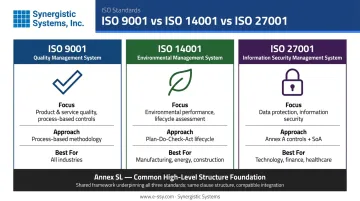
All three standards share the Annex SL High Level Structure — identical clause numbering and a common set of core requirements:
- Leadership commitment
- Risk and opportunity management
- Documented information
- Internal audits
- Management review
- Nonconformity handling
That shared architecture is what makes running them as an Integrated Management System (IMS) practical rather than a theoretical exercise.
Side-by-Side Comparison
| Dimension | ISO 9001 | ISO 14001 | ISO 27001 |
|---|---|---|---|
| Primary Focus | Product/service quality | Environmental performance | Information security |
| Management System Type | QMS | EMS | ISMS |
| Core Output | Consistent quality delivery | Reduced environmental impact | Protected information assets |
| Risk Approach | Risk-based thinking; organization defines controls | Environmental aspects & lifecycle assessment | Formal risk assessment + Annex A controls |
| Best-Fit Industries | All industries and sectors | Manufacturing, energy, construction, logistics | Technology, finance, healthcare, professional services |
What They Have in Common
All three reinforce a culture of continual improvement, require top management engagement, and demand data-driven performance monitoring. Organizations that implement one standard are already well-positioned when adopting the next — documentation habits, audit processes, and management review disciplines carry over directly.
Where They Diverge
The key distinctions come down to prescriptiveness:
- ISO 9001 is process- and customer-focused with no defined control set — organizations define their own controls based on their processes
- ISO 14001 introduces environmental aspects assessment and lifecycle thinking not present in ISO 9001
- ISO 27001 is the most prescriptive of the three — it uniquely requires a formal information security risk assessment and mandates selecting and applying controls from its Annex A, producing a documented Statement of Applicability
Key Benefits of Each ISO Certification
ISO 9001 Benefits
ISO 9001 certification delivers measurable operational and commercial value:
- Improved quality consistency — documented processes reduce variation and defects
- Stronger customer satisfaction — systematic customer feedback loops drive loyalty
- Streamlined operations — process discipline reduces waste and rework
- Market credibility — with over 1 million certificates worldwide, it's a globally recognized signal of operational maturity
A Harvard Business School working paper found that ISO 9001-certified firms showed employment approximately 10.3% higher after certification compared to non-certified peers, rising to 32.5% higher in years 7–9 post-certification.
ISO 14001 Benefits
ISO 14001 creates value across regulatory, operational, and reputational dimensions:
- Reduced regulatory risk — proactive environmental compliance management prevents costly violations
- Cost savings — improved resource and energy efficiency lowers operating costs
- Enhanced reputation — demonstrates environmental responsibility to ESG-conscious customers and investors
- Market access — increasingly required in public sector procurement and supply chains with sustainability mandates
It also positions organizations ahead of tightening environmental regulations rather than scrambling to catch up.
ISO 27001 Benefits
IBM's 2025 Cost of a Data Breach Report puts the global average cost of a data breach at $4.44 million — a figure that makes the case for ISO 27001 on its own. Certification helps organizations:
- Reduce breach risk through systematic identification and treatment of security vulnerabilities
- Build customer and partner trust — demonstrating disciplined information handling
- Align with data protection regulations — the ISMS framework is relevant to managing risks under GDPR, HIPAA, and similar regimes
- Win competitive business — clients in technology, finance, and healthcare increasingly require or prefer certified vendors
For organizations pursuing more than one of these certifications, all three can be integrated into a single management system — reducing documentation overhead and audit burden while covering quality, environmental, and information security obligations under one framework.
Which ISO Certification Does Your Organization Need?
Decision Framework
Use this practical guide to prioritize:
| If your primary challenge is... | Start with... |
|---|---|
| Inconsistent product/service quality or customer satisfaction issues | ISO 9001 |
| Environmental impact, regulatory exposure, or sustainability-driven customer requirements | ISO 14001 |
| Sensitive data, cybersecurity risk, or client data protection expectations | ISO 27001 |
Industry Mapping
- Manufacturing, machine shops, fabrication, contract manufacturing, distributors → ISO 9001 (often the mandatory baseline for supplier approval)
- Energy, oil and gas, construction, agriculture, logistics, chemical processing → ISO 14001 alongside ISO 9001
- Technology, SaaS, finance, healthcare, legal, professional services → ISO 27001 often the primary driver
Many organizations — particularly mid-market manufacturers, oil and gas service companies, and multi-service businesses — have legitimate needs across two or all three domains simultaneously.
The Customer Mandate Factor
When an international customer or a specific contract requires certification, the decision timeline compresses fast. Pursuing the wrong standard first creates unnecessary rework. A proper needs assessment before committing to a standard saves time and avoids that rework entirely.
Can You Pursue Multiple ISO Certifications?
Yes, and many organizations do. Because ISO 9001, ISO 14001, and ISO 27001 all share the Annex SL High Level Structure, work done toward one standard directly reduces the effort required for the others.
The Integrated Management System (IMS) Approach
An Integrated Management System consolidates multiple ISO standards under a single documented framework. Key integration points include:
- Unified risk register — one document addresses quality, environmental, and security risks
- Combined internal audit program — one audit cycle covers all standards simultaneously
- Single management review — one meeting addresses performance across all systems
- Integrated training programs — staff learn the management system once, not three times separately
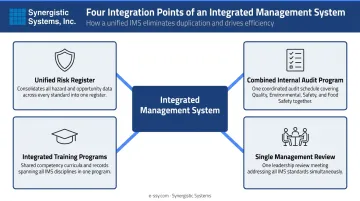
This approach reduces duplication, lowers total audit costs, and gives leadership a more complete view of organizational risk.
Sequencing Recommendation
Most organizations benefit from starting with ISO 9001 as the foundation. It builds the management discipline, documentation habits, and process thinking that accelerate ISO 14001 and ISO 27001 implementation. Organizations that already have ISO 9001 typically cut their ISO 14001 implementation effort by 40–60% compared to a standalone EMS build.
Two situations call for a different starting point:
- Active ISO 27001 demand — clients or contracts requiring information security certification now
- Regulatory data security pressure — industries with imminent compliance deadlines tied to information security
In either case, ISO 27001 moves to the front of the sequence, with ISO 9001 and ISO 14001 integrated in the next phase.
How to Start Your ISO Certification Journey
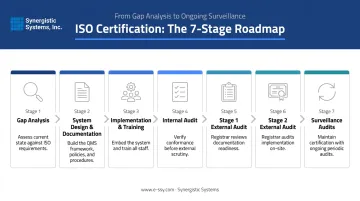
The certification path follows seven stages regardless of which standard you pursue:
- Gap analysis — assess your current state against the standard's requirements to identify what's missing
- System design and documentation — develop policies, procedures, work instructions, and records
- Implementation and training — embed the system in daily operations; train staff at all levels
- Internal audit — verify the system is working before external auditors arrive
- Stage 1 external audit — document review by your chosen third-party registrar
- Stage 2 external audit — implementation verification and certification decision
- Surveillance audits — ongoing audits (typically annually) to maintain certification
An experienced ISO consultant compresses this timeline considerably — moving from gap analysis to certified typically takes six to twelve months with structured support, compared to two or more years when organizations navigate the process alone.
Synergistic Systems has guided organizations across manufacturing, oil and gas, construction, food and beverage, engineering, and professional services through ISO 9001 and ISO 14001 certification using a fixed-price 10-step methodology, from initial gap assessment through Stage 1 and Stage 2 audit support. Every engagement includes a cloud-based management system intranet that hosts all controlled documents, audits, corrective actions, and management reviews in one place — no client hardware or software required.
Synergistic Systems has working experience with all major accredited registrars, including ABS Quality Evaluations, DNV, Bureau Veritas, Lloyd's Register, BSI, NQA, SGS, Intertek, and others.
Frequently Asked Questions
What is the difference between ISO 9001, ISO 14001, and ISO 27001?
ISO 9001 governs quality management and customer satisfaction; ISO 14001 governs environmental management and regulatory compliance; ISO 27001 governs information security and data protection. All three share a common Annex SL framework, making them compatible for integrated implementation.
How much does ISO 27001 certification cost?
Costs vary based on organization size, scope, complexity, and registrar selection. They typically include consultant/implementation fees, employee training, and external audit fees. A fixed-price quotation from a consultant like Synergistic Systems will give you a clear total cost tied to defined deliverables and a timetable — no surprises.
Can a company be certified to all three ISO standards at the same time?
Yes. Organizations can pursue ISO 9001, ISO 14001, and ISO 27001 simultaneously or sequentially. The shared Annex SL structure creates significant documentation and audit overlap, cutting documentation and audit effort substantially compared to running three separate projects.
How long does it typically take to get ISO certified?
Timelines range from several months to over a year depending on your organization's starting point, resource availability, and operational complexity. Organizations starting from scratch with a structured consultant typically reach certification faster than those navigating the process independently.
Are ISO 9001, ISO 14001, and ISO 27001 certifications mandatory?
All three are voluntary international standards. In practice, however, many industries, customers, and contracts treat them as functional requirements — making them a practical requirement in many competitive and regulated industries.
What industries benefit most from ISO 14001 certification?
Manufacturing, energy, oil and gas, construction, agriculture, logistics, and transportation see the highest demand. Any organization with a significant environmental footprint or sustainability-focused customers stands to benefit from formal EMS certification.