Many organizations discover this the hard way. They invest in getting certified, then let their QMS drift — outdated procedures, unresolved corrective actions, internal audits that slip. When the surveillance auditor arrives, the gaps are hard to hide.
This guide covers exactly what you need to know: how surveillance audits fit into the three-year certification cycle, what auditors examine, how frequency can change, and how to prepare so there are no surprises.
TL;DR
- Surveillance audits occur once per year in years two and three of the three-year certification cycle — two total before recertification
- They cover selected QMS processes, not the full system — but management review, internal audits, and corrective actions are reviewed every time
- Multi-site organizations use the 0.6 × √(number of sites) formula to determine how many locations must be audited
- Missing a required surveillance audit can trigger certificate suspension under ISO/IEC 17021-1
- Preparation requires a completed internal audit, up-to-date documentation, and employees who know what to expect
What Is an ISO 9001 Surveillance Audit?
A surveillance audit is a mandatory periodic check conducted by your accredited certification body to confirm your organization is still meeting ISO 9001:2015 requirements — with real consequences if it isn't.
Unlike the initial Stage 2 certification audit — which examined your entire QMS from the ground up — a surveillance audit takes a focused snapshot. Auditors typically cover:
- Selected processes and procedures from your QMS
- Corrective actions from prior audits (verifying they've been closed)
- Evidence that your quality management system is actively maintained, not shelved after initial certification
Where Surveillance Audits Fit in the Certification Lifecycle
ISO/IEC 17021-1:2015 defines the structure clearly: surveillance audits are mandatory checkpoints between your initial Stage 2 audit and your recertification audit. Their purpose is ongoing monitoring — verifying that the improvements and processes you demonstrated at certification are being sustained.
If your QMS is healthy and active, a surveillance audit should feel routine. If your system has gone dormant since certification day, that's precisely what this audit is designed to surface.
ISO 9001 Surveillance Audit Frequency: The 3-Year Certification Cycle
The standard certification cycle has a straightforward structure:
| Year | Activity |
|---|---|
| Year 1 | Stage 1 + Stage 2 initial certification audit |
| Year 2 | Surveillance Audit 1 |
| Year 3 | Surveillance Audit 2 → Recertification audit |
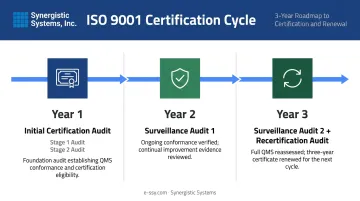
ISO/IEC 17021-1:2015 clause 9.1.3.3 requires certification bodies to conduct surveillance audits at least once per calendar year, except in years when a recertification audit is performed. That works out to two surveillance audits across the three-year cycle.
The first surveillance audit must occur no later than 12 months from the certification decision date — the governing standard does not allow a grace period beyond that.
When Frequency Can Change
Annual surveillance is the baseline, but it can shift in either direction:
- Certification bodies can require more frequent audits after major nonconformances, significant organizational changes (new product lines, mergers, site additions), or in regulated industries with heightened oversight. ISO/IEC 17021-1:2015 clause 9.6.4 also permits special short-notice audits to investigate complaints.
- Some organizations voluntarily request more frequent surveillance — a smart move during rapid growth or significant operational change.
- Individual certification bodies like BSI, DNV, NQA, LRQA, and Bureau Veritas may have additional scheduling requirements beyond the ISO/IEC 17021-1 minimum. Confirm exact timing windows with your registrar.
Multi-Site Organizations: The Square Root Rule
Single-site frequency rules are straightforward. For organizations with multiple locations under one ISO 9001 certificate, IAF MD 1:2023 introduces a sampling formula that determines how many sites must be audited:
Surveillance sample size = 0.6 × √(number of sites), rounded up
For example, an organization with 16 sites must have at least 3 locations audited per surveillance visit (0.6 × √16 = 0.6 × 4 = 2.4, rounded up to 3). For 25 sites: 0.6 × √25 = 0.6 × 5 = 3 sites minimum.
A few important caveats under IAF MD 1:2023:
- At least 25% of the sample must be selected at random (not all auditor-chosen)
- The central function must be audited at least once per calendar year as part of surveillance
- If a major nonconformance is found at any single site, certification for the entire organization is affected — individual sites cannot be simply excluded
What Happens If You Miss the Window
Missing a required surveillance audit is treated seriously. ISO/IEC 17021-1:2015 clause 9.6.5.2 explicitly requires certification bodies to suspend certification when clients do not allow surveillance audits to proceed at required frequencies. Under suspension, your certificate is temporarily invalid — meaning you cannot legitimately claim ISO 9001 certification during that period.
If the issue that caused suspension is not resolved, clause 9.6.5.4 requires withdrawal or reduction of scope — permanent loss of certification. The audit schedule is not flexible by default.
What Does an ISO 9001 Surveillance Audit Cover?
Surveillance audits do not cover your entire QMS — that's what recertification is for. But certain areas are reviewed in every surveillance audit, without exception.
Mandatory Review Areas (Every Surveillance Audit)
Per ISO/IEC 17021-1:2015 clause 9.6.2.2, auditors must examine:
- Internal audit results and schedule
- Management review records
- Actions taken on nonconformances from prior audits
- Customer complaint handling
- Progress on continual improvement activities
- Operational controls and any notable changes
- Use of the ISO 9001 certification mark
Rotating Process Coverage
Beyond the mandatory areas, auditors rotate through other QMS processes across the two surveillance audits, with the goal of covering the full system before recertification. Which processes get examined in a given surveillance audit depends on risk, previous findings, and what has changed since the last audit.
Key Documents Auditors Will Request
Come prepared with:
- Internal audit records, schedule, and findings
- Corrective action logs with closure evidence
- Management review meeting minutes
- Customer complaint and satisfaction records
- Current quality procedures and work instructions
- Supplier evaluation data
Nonconformance Consequences
Auditors can raise two types of findings:
- Minor nonconformance — an isolated issue that doesn't threaten overall system integrity; requires a documented corrective action plan within a defined timeframe
- Major nonconformance — a systemic failure or a critical ISO 9001 requirement not being met; can trigger certificate suspension if not resolved within the agreed timeframe
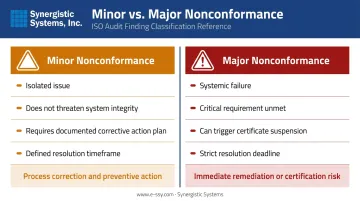
Nonconformances left unresolved from a prior audit don't simply carry forward — auditors can escalate them from minor to major findings, which puts your certificate at risk. Close every corrective action before the next audit cycle, not after.
Surveillance Audit vs. Recertification Audit: Key Differences
| Surveillance Audit | Recertification Audit | |
|---|---|---|
| Frequency | Annually (years 2 and 3) | Every 3 years |
| Scope | Selected QMS processes | Full QMS review |
| Duration | ~1–2 audit days (varies by size) | ~2/3 of initial certification time |
| Outcome | Confirms existing certificate remains valid | Issues new 3-year certificate |
| Depth | Focused snapshot | Comprehensive assessment |
Per IAF MD 5:2023, annual surveillance audit time should be approximately one-third of the time spent on the initial certification audit. Recertification audits run approximately two-thirds of initial certification time.
A surveillance audit does not result in a new certificate — it confirms your existing one stays active. Only a successful recertification audit triggers certificate renewal with a new three-year expiration.
Outside this standard cycle, one scenario changes the rules entirely: switching certification bodies or transitioning to a revised standard version requires a full transfer audit — comparable in scope to recertification — and resets the three-year cycle from scratch.
How to Prepare for an ISO 9001 Surveillance Audit
Surveillance audit preparation comes down to consistent discipline in the months before the auditor arrives — not a last-minute scramble.
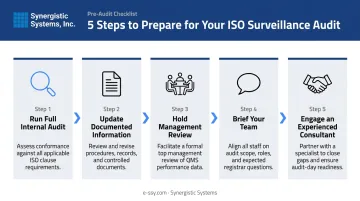
1. Run a Full Internal Audit
An internal audit conducted before the surveillance audit serves two purposes: it satisfies ISO 9001's internal audit requirement, and it surfaces any nonconformances while you still have time to address them. Document corrective actions with objective evidence of closure — not just a note that action was planned.
2. Update Your Documented Information
Auditors routinely find that procedures no longer reflect how processes actually operate. Review your quality manual, work instructions, and forms for accuracy. Outdated documents signal that your QMS is being maintained on paper, not in practice.
3. Hold Your Management Review Before the Audit
Hold your management review before the surveillance audit and document it thoroughly. Auditors look for evidence that top management is actively engaged — reviewing quality objectives, customer feedback, audit results, and improvement actions.
A well-documented management review from the past few months is one of the clearest signals of a functioning QMS.
4. Brief Your Team
Auditors interview employees directly. Every person the auditor speaks with should be able to:
- Describe their role in the QMS
- Explain the procedures relevant to their work
- Demonstrate awareness of quality objectives
Unprepared employees can generate findings even when your documentation is in good order.
5. Consider Working With an Experienced Consultant
For organizations that want an objective assessment before the auditor arrives, a consultant with hands-on registrar experience can catch gaps that internal teams sometimes miss. Synergistic Systems has guided clients through audit cycles with registrars including ABS Quality Evaluations, DNV, Bureau Veritas, BSI, NQA, and SGS — and that familiarity with registrar-specific expectations matters when findings are on the line.
The firm's cloud-based QMS intranet consolidates corrective actions, internal audit records, and management review documentation in one place, making evidence retrieval straightforward when auditors start requesting records.
Frequently Asked Questions
How often are ISO 9001 surveillance audits required?
Surveillance audits are required once per year, occurring in years two and three of the three-year certification cycle — two total before recertification. The first must be completed no later than 12 months from the initial certification decision date.
What is the difference between a surveillance audit and a recertification audit?
A surveillance audit reviews selected QMS processes annually to confirm ongoing compliance and does not issue a new certificate. A recertification audit is a full QMS review conducted every three years that results in a renewed three-year certificate if successful.
What happens if you fail an ISO 9001 surveillance audit?
Unresolved major nonconformances within the agreed timeframe can lead to certificate suspension, which temporarily invalidates your certification. Persistent failure to resolve issues can result in full certificate withdrawal under ISO/IEC 17021-1:2015 clause 9.6.5.4.
Can ISO 9001 surveillance audit frequency be increased?
Yes. Your organization can request increased frequency voluntarily, and your certification body can require it following major nonconformances, significant scope changes, new sites, or certain regulatory requirements in your industry.
What documents should I have ready for an ISO 9001 surveillance audit?
Prepare the following before your audit:
- Internal audit schedule and findings
- Corrective action logs with closure evidence
- Management review minutes
- Customer complaint and satisfaction records
- Current quality procedures and work instructions
How long does an ISO 9001 surveillance audit take?
Typically one to two days on-site, depending on organization size and complexity. Per IAF MD 5:2023, surveillance audit time is calculated as approximately one-third of the time spent on the initial certification audit.