ISO 9001 addresses this directly. It gives manufacturers the documented, repeatable processes needed to catch problems before they reach customers, satisfy procurement teams that require it, and build the kind of operational discipline that sustains quality across shifts, sites, and product lines.
This article covers what ISO 9001 actually requires from manufacturing companies, how the certification process works step by step, and what it takes to maintain it long-term.
TL;DR
- ISO 9001 is the world's most widely adopted quality management standard, with the ISO Survey 2024 reporting 1.47 million certificates worldwide
- Certification requires a QMS built across seven core clauses, covering leadership, risk planning, internal audits, and continual improvement
- The certification path follows a structured sequence: gap analysis → QMS development → training → internal audit → external certification audit
- Beyond the certificate, ISO 9001 drives fewer defects, reduced rework, stronger customer retention, and access to contracts requiring demonstrated quality credentials
Why ISO 9001 Matters in Manufacturing
ISO 9001 is an internationally recognized Quality Management System (QMS) standard developed by the International Organization for Standardization. While it applies across industries, manufacturing is where it carries the sharpest operational weight: defective products, rework, and recalls have direct financial consequences that generic process improvement frameworks don't systematically prevent.
To clarify the family of standards:
- ISO 9000 defines quality vocabulary and principles
- ISO 9001 sets the certifiable QMS requirements (what manufacturers pursue)
- ISO 9004 guides sustained organizational improvement
The Supply Chain Qualification Reality
According to IISE, poor quality costs in manufacturing range from 5% to 35% of the sales dollar — a significant exposure that systematic process controls directly target.
Across key sectors, ISO 9001 also functions as a market access prerequisite:
- Automotive: GM and Stellantis customer-specific requirements reference ISO 9001:2015 and IATF 16949 as minimum QMS requirements for suppliers
- Aerospace: Boeing contractually flows QMS standards including ISO 9001 and AS9100 to its supply chain
- Government contracting: FAR 46.202-4 lists ISO 9001 as an example of a higher-level contract quality standard
- Medical devices: Medtronic and BD supplier requirements reference ISO 9001 and/or ISO 13485 compliance
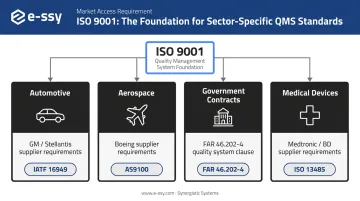
Manufacturers without ISO 9001 can be excluded from entire procurement channels before a conversation ever happens.
ISO 9001 vs. Sector-Specific Standards
ISO 9001 is the foundation. Most industry-specific standards build directly on it:
| Standard | Sector | Relationship to ISO 9001 |
|---|---|---|
| IATF 16949 | Automotive | Built on ISO 9001 with additional automotive requirements |
| AS9100 | Aerospace & Defense | Adds aerospace-specific requirements on top of ISO 9001 |
| ISO 13485 | Medical Devices | Separate regulatory QMS standard (not simply an add-on) |
For manufacturers serving multiple sectors, ISO 9001 certification establishes the baseline that sector-specific certifications layer onto.
What ISO 9001 Actually Requires
ISO 9001:2015 is organized around seven operational clauses. Understanding what each demands in a manufacturing context removes the mystery from the certification process.
The Seven Clauses in Manufacturing Terms
| Clause | Title | What It Means for Manufacturers |
|---|---|---|
| 4 | Context of the Organization | Map internal/external factors that affect quality outcomes |
| 5 | Leadership | Top management must actively own quality goals — not delegate them entirely |
| 6 | Planning | Risk-based thinking replaces the old "preventive actions" approach |
| 7 | Support | Resource management, employee training, document control |
| 8 | Operation | Control production from design specs through supplier inputs |
| 9 | Performance Evaluation | Internal audits, customer satisfaction tracking, management reviews |
| 10 | Improvement | Corrective actions, ongoing QMS refinement |
What Changed in the 2015 Version
The shift from ISO 9001:2008 to ISO 9001:2015 was significant. Key changes include:
- Replaced the prescriptive preventive action model with risk-based thinking
- Made top management accountability explicit — a signature on a quality policy is no longer enough
- Shifted documentation requirements away from rigid formats toward evidence of controlled processes
- Aligned with other ISO management system standards through Annex SL, enabling integrated systems
The practical implication: auditors assess whether people actually do what the system says, not whether the binders are thick enough.
Documentation Requirements in Practice
That shift in auditor focus changes how manufacturers should approach documentation. You need evidence of controlled processes, not volume. That evidence spans several areas:
- Quality policy and measurable objectives
- Procedures for key operational processes
- Records of production controls, corrective actions, and supplier management
- Evidence of internal audits and management reviews
A structured, modular approach to documentation — quality policies, procedures, work instructions, forms, and records — reduces the time and complexity of building a compliant QMS. Synergistic Systems develops this documentation collaboratively with client teams, adapting proven frameworks to each manufacturer's specific processes rather than starting from scratch.
What ISO 9001 does NOT require: It does not prescribe exactly how to run operations. There is no universal checklist. Requirements are interpreted within each organization's specific risk environment and process context.
How to Get ISO 9001 Certified: Step by Step
Step 1 — Conduct a Gap Analysis
Before building anything, compare current processes and documentation against ISO 9001:2015 clause requirements. This determines where the organization already complies, where gaps exist, and what work lies ahead. The gap analysis sets realistic timelines and informs the project scope.
Step 2 — Build and Implement the QMS
Develop the documentation, process definitions, quality policy, measurable objectives, and operational controls the standard requires. This is the most time-intensive phase, requiring input from leadership, quality teams, and frontline workers.
Synergistic Systems builds this documentation collaboratively with the client team using proven modular frameworks adapted to each manufacturer's processes. Working sessions ensure the QMS takes hold in daily operations — not just in a binder on a shelf.
Every engagement includes a cloud-based QMS intranet provisioned as part of the project price, covering:
- Document control and records management
- Internal audits and corrective actions
- Management reviews and risk registers
No hardware or software purchase required.
Step 3 — Train the Organization
With the QMS documented, the next step is making sure everyone understands it. ISO 9001:2015 requires demonstrated employee competence and awareness — workers at every level must understand their role. Training should cover:
- The quality policy and objectives
- Relevant procedures and work instructions
- How to identify and report nonconformities
- What the QMS means for their specific role
Step 4 — Conduct an Internal Audit
Before any external auditor arrives, a structured internal audit assesses QMS compliance. Trained internal auditors evaluate whether documented processes match actual practice and whether the system meets clause requirements.
When nonconformities surface, corrective actions are documented and closed before moving forward. Most certification bodies expect evidence of a functioning QMS — at least one completed internal audit and management review — before the Stage 2 audit. Synergistic Systems conducts this system-wide internal audit directly, drawing on direct audit experience before the registrar arrives.
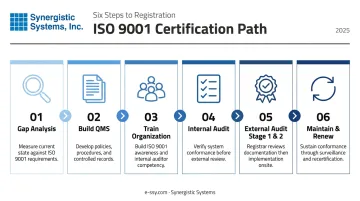
Step 5 — Select a Registrar and Complete the External Audit
The external certification audit happens in two stages:
- Stage 1 — Documentation and readiness review; the auditor assesses scope, QMS documentation, and site conditions
- Stage 2 — On-site assessment of whether the QMS operates as documented, through interviews, record review, and observation
Select an IAF-accredited certification body (accreditation ensures the certificate is recognized globally). Synergistic Systems has direct experience supporting clients through audits with ABS Quality Evaluations, DNV, Bureau Veritas, LRQA, BSI, SGS, Intertek, NQA, NSF-ISR, and others, and provides onsite support when the registrar arrives.
Step 6 — Maintain and Renew Certification
ISO 9001 certificates are valid for three years, with the first surveillance audit due no more than 12 months after the Stage 2 audit. Continual improvement is a built-in requirement : manufacturers must keep refining their QMS, not simply preserve the status quo.
The Tangible Benefits of ISO 9001 Certification
Operational Efficiency
Standardized, documented processes eliminate ambiguity at every production stage. Workers know what to do, supervisors have checkpoints, and corrective action systems catch problems before they compound. BSI's client survey data reports that 60% of businesses reduced errors and 66% improved products/services following ISO 9001 certification — based on BSI client survey responses.

Market Access and Contract Qualification
Beyond internal efficiency, ISO 9001 certification directly affects which contracts a manufacturer can compete for. Customers in these industries treat certification as a vendor qualification filter:
- Automotive OEMs and tier-1 suppliers
- Aerospace primes and defense contractors
- Medical device OEMs and contract manufacturers
- Government and federal procurement programs
Without certification, a manufacturer often cannot enter those procurement conversations at all.
Customer Confidence and Retention
An ISO 9001-certified manufacturer can demonstrate — through an auditable, documented track record — that accountability structures exist when quality issues arise. Customers see that nonconformances get logged, investigated, and closed. That transparency builds the kind of trust that keeps a manufacturer on the preferred vendor list rather than on a corrective action notice.
Common ISO 9001 Challenges in Manufacturing
Documentation Overload
Many manufacturers initially over-document, creating procedures for everything and struggling to keep them current. The ISO 9001:2015 standard was deliberately revised to focus on evidence of practice, not paperwork volume.
A structured, modular approach cuts through that complexity:
- Document only what the standard actually requires
- Build procedures that reflect how your operation actually runs
- Reuse proven frameworks rather than building from scratch every time
Sustaining Leadership Engagement
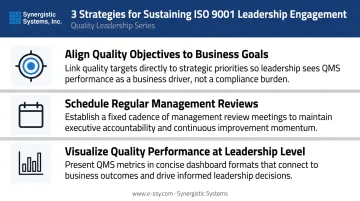
ISO 9001:2015 explicitly requires top management involvement. Certification fails when quality becomes solely the quality manager's responsibility. Practical ways to maintain leadership engagement:
- Tie quality objectives directly to business goals (customer returns, on-time delivery, scrap rates)
- Schedule management reviews on a calendar — not as a reaction to audits
- Make quality performance visible at the leadership level, not just in the quality department
Multi-Site Consistency
Beyond leadership alignment, manufacturers with multiple locations face a separate challenge: keeping QMS procedures consistent across every site. A centralized, cloud-based platform solves this by giving all locations access to the same controlled documents, audit records, and corrective actions — no local variations, no version conflicts. Synergistic Systems' cloud QMS intranet is built specifically for multi-site organizations, so every facility works from a single source of truth regardless of geography.
Frequently Asked Questions
Which ISO certification is required for manufacturing companies?
No single ISO certification is universally mandated for all manufacturers, but ISO 9001 is the most widely required by customers and contracts. Specific sectors add industry-specific standards: IATF 16949 for automotive, AS9100 for aerospace, ISO 13485 for medical devices — all of which build on ISO 9001 as the foundation.
How do I get ISO 9001 certification for my company?
Conduct a gap analysis, build and implement an ISO 9001-compliant QMS, complete an internal audit with corrective actions, then engage an accredited certification body for a two-stage external audit. Working with an experienced implementation consultant compresses the timeline and avoids common pitfalls.
How long does it take to get ISO 9001 certified?
Timelines vary based on organization size, complexity, and current quality maturity. Most manufacturers take between 6 and 18 months from initial gap analysis to certification, with established quality systems shortening that timeline.
How much does ISO 9001 certification cost for a manufacturing company?
Costs vary based on company size, QMS development scope, training needs, number of sites, and registrar audit fees. Primary cost drivers are internal resource time, consultant or documentation support, and external registrar fees. Request a detailed scope of work from any consultant to keep costs predictable.
What is the difference between ISO 9001 and IATF 16949 or AS9100?
ISO 9001 is the universal QMS foundation applicable to all industries. IATF 16949 (automotive) and AS9100 (aerospace) are industry-specific extensions that layer additional sector requirements on top. Manufacturers in those sectors pursue the specialized standard, which embeds all ISO 9001 requirements within it.
How often does ISO 9001 certification need to be renewed?
ISO 9001 certificates are valid for three years, with annual surveillance audits required to maintain certification status. Renewal requires demonstrating continued compliance and evidence of continual improvement throughout the certification cycle.