This guide is written for quality managers, operations leaders, and business owners across manufacturing, services, healthcare, and similar industries who are starting or planning their ISO 9001 journey. Knowing the standard exists is one thing. Knowing how to prepare for the audit — and avoid the mistakes that cause organizations to fail or repeat it — is another.
What follows covers what certification actually involves, why it matters, a step-by-step preparation roadmap, common mistakes to avoid, and what the audit looks like from start to finish.
TL;DR
- ISO 9001 certification is a third-party verification that your QMS meets requirements for customer focus, process control, and continual improvement
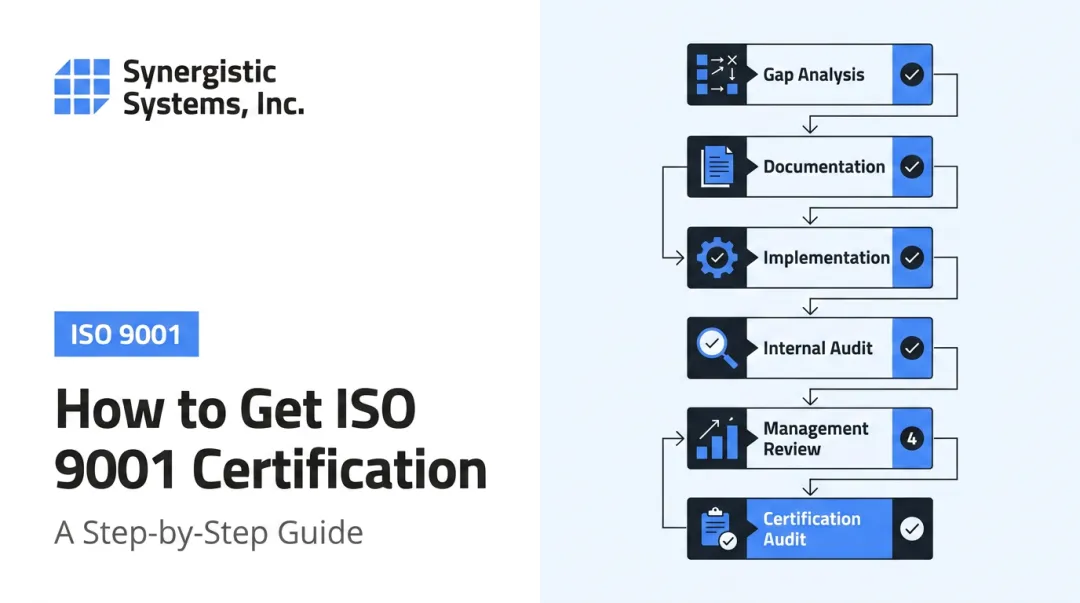
- Preparation follows five phases: gap analysis, leadership alignment, documentation, implementation and training, then internal audit and management review
- The registration audit runs in two stages: Stage 1 reviews documentation; Stage 2 evaluates on-site operating effectiveness
- Timeline varies by organization size, complexity, and how mature your existing processes already are
- Certification is valid for three years, with annual surveillance audits required to keep it active
What Is ISO 9001 Certification and Who Needs It?
ISO 9001:2015 is the international standard for Quality Management Systems — the only standard in the ISO 9000 family that organizations can be certified to. It applies to any industry or size, from a five-person machine shop to a global manufacturer. Rather than dictating how you operate, it defines the outcomes your QMS must achieve — giving organizations flexibility in how they get there.
ISO itself does not issue certificates. Certification comes from an accredited third-party Certification Body (registrar) that independently audits your QMS. Self-declared compliance (where an organization simply claims to meet the standard) carries no third-party validation and won't satisfy most customer or procurement requirements.
Who Actually Needs It?
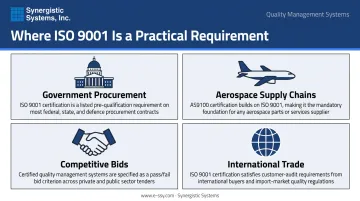
ISO 9001 is technically voluntary, but in practice it functions as a hard commercial requirement across many sectors:
- Government procurement — FAR 46.202-4 lists ISO 9001 as an example higher-level quality standard for complex or critical federal contracts
- Aerospace supply chains — Boeing requires suppliers to obtain accredited QMS certification, including ISO 9001
- Competitive bids — many private-sector buyers use ISO 9001 as a baseline supplier qualification filter
- International trade — with over 1 million certificates issued across 189 countries, ISO 9001 is the standard global trading partners expect to see
Why Pursue ISO 9001 Certification?
Operational Benefits
A functioning QMS built to ISO 9001 requirements changes how work actually gets done:
- Documented, controlled processes reduce recurring errors at the source
- Replaces reactive firefighting with structured root cause analysis and corrective action
- Gives you a data-driven framework for identifying and managing operational risks before they escalate
- Builds the process discipline that makes scaling operations far less chaotic
ISO's published guidance notes that ISO 9001 helps organizations increase productivity and reduce internal costs — benefits realized regardless of whether the end goal is a certificate.
Commercial and Competitive Benefits
The scale of adoption matters here. ISO reports over one million certificates issued across 189 countries, making ISO 9001 the world's most widely adopted management system standard. That adoption reflects a straightforward commercial reality: certified organizations access customers and contracts that non-certified competitors simply cannot.
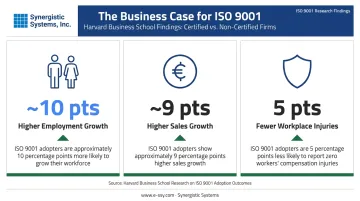
Research from Harvard Business School tracked 622 matched pairs of California companies and found ISO 9001 adopters had employment roughly 10 percentage points higher and sales nearly nine percentage points higher than matched non-adopters after certification. Certified firms were also five percentage points more likely to report zero workers' compensation injuries.
What Happens Without a QMS
The flip side of those commercial gains is the cost of inaction. Organizations without structured quality systems share the same problems: inconsistent outputs, quality issues that recur without resolution, no mechanism for turning customer complaints into process improvements, and difficulty scaling because no one has documented how good work actually gets done. ISO 9001 certification is the structured path out of that cycle — and the next sections walk through exactly how to get there.
How to Prepare for ISO 9001 Certification: Step-by-Step
Preparation is the most effort-intensive phase of the ISO 9001 journey. What an organization does before the certification audit largely determines whether certification happens on the first attempt or requires costly re-auditing.
Step 1: Conduct a Gap Analysis and Define Your QMS Scope
A gap analysis evaluates your current processes, documentation, and practices against each clause of ISO 9001:2015. The output is a prioritized list of what needs to be built, changed, or documented before your QMS is audit-ready.
ISO's TC 176 guidance requires that Clause 4.3 scope definition cover the QMS boundaries and applicability, the products and services covered, and a justification for any requirements determined not applicable. Getting scope right at the start prevents both audit surprises and unnecessary implementation work.
Key scope decisions to make:
- Which products, services, sites, or departments will be included
- Whether multi-site organizations will certify sites together or in phases
- Whether any ISO 9001 clauses are genuinely not applicable to your operations
Synergistic Systems works with organizations at this early stage — using their experience across hundreds of projects to quickly understand complex operations and translate them into a realistic implementation plan. For multi-site organizations, getting scope boundaries wrong creates compounding problems at every subsequent step — making this upfront work especially useful before any documentation begins.
Step 2: Secure Leadership Commitment and Assign Responsibility
ISO 9001 explicitly requires top management involvement — not just approval of documents. Leadership must establish a quality policy, define quality objectives, assign QMS roles and responsibilities, and demonstrate commitment through their own behavior.
Without genuine executive support, QMS implementation stalls at documentation and never produces real operational change.
The Management Representative role: Designate an internal point person responsible for driving and coordinating the ISO 9001 project. This person needs:
- Sufficient authority to require process changes across departments
- Access to all relevant functions and personnel
- Working knowledge of the standard to make informed decisions
- Enough organizational credibility that people take the project seriously
For multi-location organizations, consider appointing site-level representatives who report to a central QMS owner.
Step 3: Build Your QMS Documentation
ISO 9001:2015 reduced prescriptive document mandates compared to earlier versions, but requirements remain substantive. ISO/TC 176's documented information guidance identifies maintained documented information required for:
- QMS scope (Clause 4.3)
- Quality policy (Clause 5.2)
- Quality objectives (Clause 6.2)
- Process operation support (Clause 4.4)
Records that must be retained include evidence of process operation, competence, product/service conformance, internal audit results, management review outputs, and nonconformity/corrective action evidence. A quality manual is not required by the standard, though many organizations find one useful for orientation.
The critical principle: Documentation must reflect how your organization actually operates — not an idealized version of it. Procedures written in generic "ISO language" or copied from templates without customization fail audits when auditors observe real work that doesn't match the documents.
Synergistic Systems provides a modular documentation system that clients adapt to their specific operations — building only what adds operational value. All documentation is hosted on a secure, cloud-based QMS intranet included in every engagement, with no hardware or software purchase required.
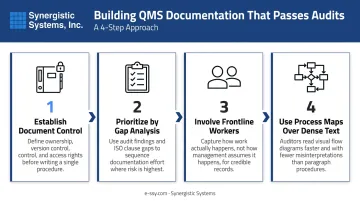
Practical documentation approach:
- Start with Clause 7.5 (document and record control) — establish control practices before creating other documents
- Tackle requirements clause by clause in priority order from the gap analysis
- Involve the people who actually perform the work, not just managers describing it
- Use process maps and flowcharts rather than dense text wherever possible
Step 4: Implement the QMS and Train Your Team
Documentation means nothing if it stays on a server. Implementation means putting procedures into daily practice — and that requires training at every level.
Employees need to understand:
- The quality policy and what it means for their work
- Their specific responsibilities within the QMS
- Any changes to how their work is performed
- Why the changes matter, not just what to do
One practical approach that consistently reduces resistance: have department managers lead their own team's process mapping sessions. People adopt processes they helped design far more readily than ones handed down from a quality department they rarely interact with.
Synergistic Systems delivers both ISO 9001 awareness training and internal auditor training as part of their implementation engagements, along with working sessions that help team members understand their specific roles in the system.
Step 5: Conduct Internal Audits and a Management Review
A complete internal audit is a mandatory prerequisite for certification. Trained auditors — independent of the processes they audit — must evaluate whether the QMS has been implemented effectively and conforms to both ISO 9001 requirements and your own documented procedures. Partial audits during implementation are useful for course-correcting, but a full-scope internal audit covering all QMS processes must be completed before the certification audit.
Before moving to the external audit, two additional requirements must be closed out:
- Management review: Senior management formally reviews QMS performance — evaluating audit results, customer feedback, objective achievement, corrective actions, and risks. The review must be documented, including decisions and action items. It's not a status meeting; it's the leadership engagement the standard requires evidence of.
- Corrective action closure: Any nonconformities found during internal audits must be addressed with root cause analysis and documented corrective actions. Auditors specifically check whether internal findings were treated seriously or quietly filed away.
Synergistic Systems conducts the system-wide internal audit and facilitates the management review directly — bringing consulting expertise into the execution of these processes rather than leaving clients to navigate them independently before the certification audit.
Key Factors That Affect Your ISO 9001 Preparation Timeline
Organizational Complexity and Process Maturity
A small service firm with well-documented processes can reach audit-readiness in a few months. A multi-site manufacturer with fragmented documentation often needs a year or more. The gap analysis results are the most reliable input for setting a realistic timeline — treat them seriously rather than working backward from an arbitrary target date.
Artificial deadlines that force superficial implementation create a dangerous outcome: an organization that achieves certification but operates a QMS that doesn't actually function.
Resource Availability and Executive Priority
Organizations with a capable, empowered Management Representative and visible executive support move faster. Part-time or under-resourced QMS projects consistently take longer and produce weaker systems, and often require expensive remediation before the audit.
Working with an experienced ISO consultant who knows multiple accredited registrars compresses timelines by preventing the costly missteps that first-time implementers routinely make. Synergistic Systems works this way — fixed price, defined deliverables, structured timetable — so organizations know exactly what they're getting and when they'll be certified.
Registrar Selection Timing
Select and contract with an accredited Certification Body early, not at the end of implementation. Early selection lets you align on audit scope, scheduling, and access requirements before your internal audit phase — preventing last-minute delays when you're closest to the finish line.
Synergistic Systems has working relationships with all major accredited registrars, including:
- DNV, BSI, Bureau Veritas, LRQA
- NQA, SGS, Intertek, TUV
- ABS Quality Evaluations, QMI-SAI Global, NSF-ISR
On-site support is provided during both Stage 1 and Stage 2 audits, so you're never navigating the registration audit alone.
Common Mistakes to Avoid When Preparing for ISO 9001 Certification
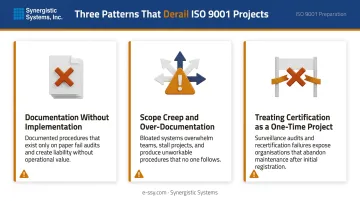
Three patterns consistently derail ISO 9001 projects — even well-funded ones with committed leadership:
- The documentation-without-implementation trap — procedures written to satisfy auditors but never embedded in daily work
- Scope creep and over-documentation — applying the standard to every corner of the business before the team is ready
- Treating certification as a one-time project — neglecting the QMS after the certificate arrives
The first trap is the most common. Organizations write procedures to satisfy auditors on paper but never integrate them into daily work. The result is a "paper QMS" that collapses at Stage 2 when auditors observe actual processes contradicting documented ones. DNV identifies insufficient involvement of relevant personnel as one of the most critical audit mistakes — a finding that almost always traces back to documentation developed in isolation. Documentation and implementation must run in parallel, not sequentially.
Scope creep compounds the problem. Teams new to ISO 9001 often try to document everything or apply the standard to every business function at once. This creates a QMS too large to manage consistently, and auditors find inconsistencies quickly. Document only where it adds operational value — scoping decisions should be deliberate, not exhaustive.
The third mistake is one that shows up after certification, not before. Organizations that skip internal audits, let corrective actions pile up, or allow documentation to go stale face failed surveillance audits and certificate withdrawal. ISO 9001 is a continuous improvement framework, not a finish line. The value compounds when it's maintained. For organizations navigating the full three-year certificate cycle, Synergistic Systems provides surveillance and recertification support to keep the QMS active and audit-ready between registration visits.
Frequently Asked Questions
How difficult is ISO 9001 certification?
Difficulty depends on your organization's size, complexity, and current process maturity. With structured preparation and experienced guidance, most organizations achieve first-attempt certification. Underestimating the implementation effort — especially around documentation and training — is the most common reason projects take longer than planned.
How long does it take to become ISO 9001 certified?
Most organizations take 3–6 months to prepare for certification; larger or more complex operations often need 6–12 months or more. The biggest factors are your current QMS maturity, how quickly your team can complete documentation and training, and whether you're working with experienced guidance.
What documents are required for ISO 9001 certification?
Core required documented information includes: quality policy, quality objectives, QMS scope statement, documented procedures for key processes, work instructions where needed, and records demonstrating conformance. ISO 9001:2015 is less prescriptive about format than earlier versions — a quality manual is not required, though many organizations maintain one voluntarily.
Do you need a consultant to get ISO 9001 certified?
A consultant isn't required, but experienced guidance cuts preparation time and lowers first-audit failure risk. It's most valuable for organizations new to ISO standards, those with limited internal quality expertise, and multi-site companies where scope and documentation decisions carry significant downstream consequences.
What happens during Stage 1 and Stage 2 certification audits?
In Stage 1, the Certification Body reviews your QMS documentation — typically remotely — to confirm your system design meets ISO 9001 requirements. Stage 2 is an on-site evaluation of whether the QMS is effectively implemented and operating. Both stages can produce findings requiring resolution before the certificate is issued.
How long does ISO 9001 certification last?
The ISO 9001 certificate is valid for three years. Annual surveillance audits verify ongoing conformance during that period. At the end of three years, a full recertification audit is required to renew the certificate.